We build AI agents that do work, not just answer questions: software that reads a request, plans the steps, acts in your CRM, helpdesk, or ERP, and asks a person before anything important changes. Fixed-scope projects are quoted after scoping, and you get a scoped written proposal within 48 hours.
AI agent development at StudioKrew, at a glance
An AI agent is software that uses a large language model to plan and complete a task inside your systems, not just to answer a question. Projects are quoted after scoping, dedicated AI engineers cost $18 to $55 per hour, and every inquiry gets a scoped written proposal within 48 hours.
48h
to a scoped written proposal after your inquiry
$18 to $55
per hour for dedicated AI engineers; dedicated teams from $15,000 per month
3
model families: OpenAI, Anthropic Claude, and open-source models such as Llama, Mistral, and Qwen
Self-hosted
option: agents can run on your own infrastructure, so your data stays under your control
An AI agent development company designs, builds, and runs software agents that complete tasks for your business inside the systems you already use. StudioKrew builds agents for customer support, operations, sales, and internal knowledge work, on OpenAI, Anthropic Claude, or open-source models. Fixed-scope agent projects are quoted after a short scoping phase, dedicated AI engineers cost $18 to $55 per hour, and you receive a scoped written proposal within 48 hours of your inquiry.
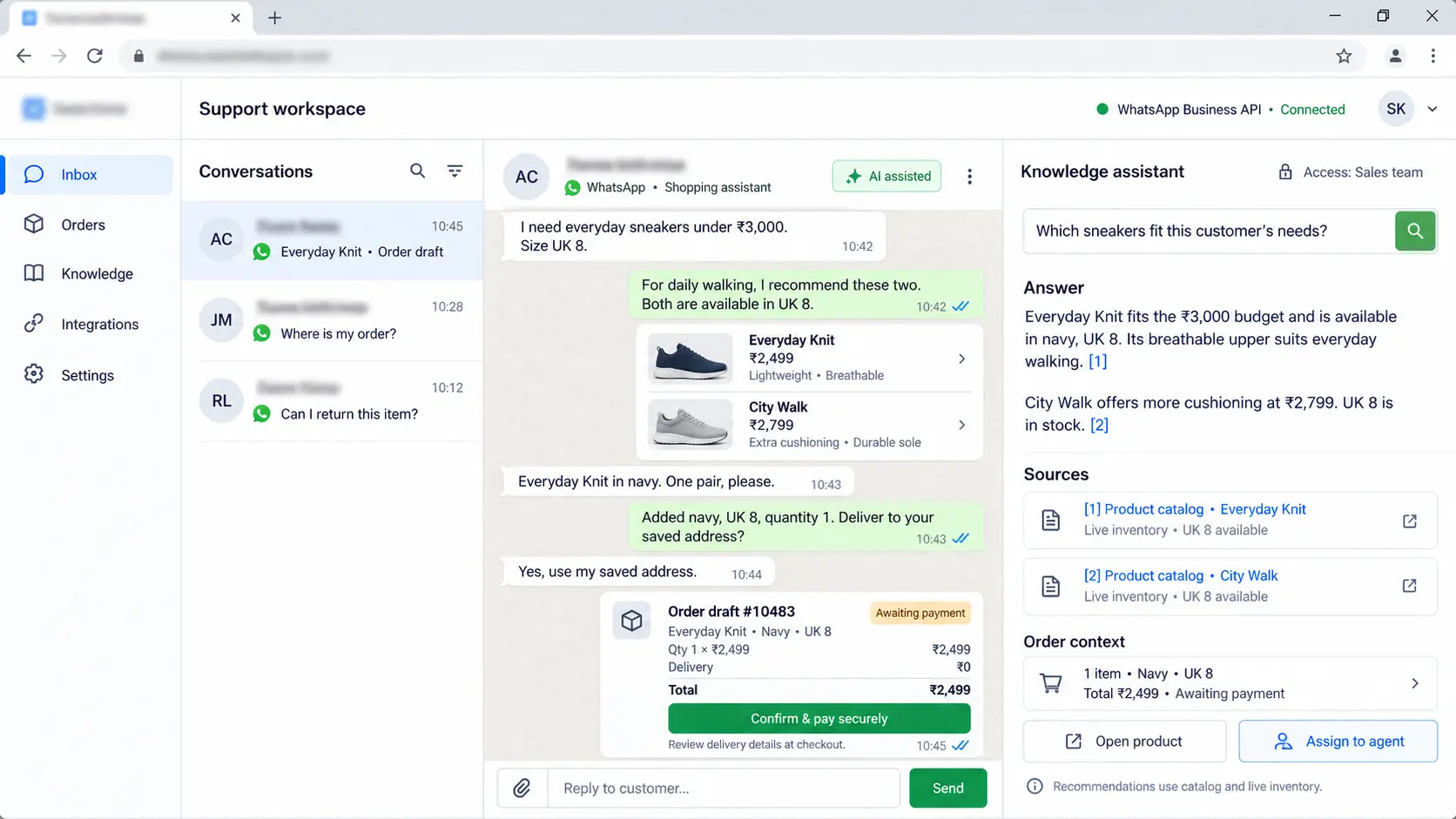
The difference between an agent and the chatbots most companies already have is action. A chatbot answers. An agent reads the ticket, checks the order in your ERP, drafts the refund, and waits for a person to approve it. That approval step is not an afterthought in our builds. It is designed in from the first day.
Our agentic AI development services cover the full path: scoping the workflow, choosing the model, connecting the tools, testing against real cases, and running the agent in production with monitoring and cost controls. They sit within our wider work as an AI development company. For teams that want to start small, we recommend one workflow, measured, before anything multi-agent.
An AI agent is software that uses a large language model to plan and complete a task, not just to answer a question. Given a goal, such as resolving a support ticket, it works out the steps, calls the tools it needs (a CRM, a helpdesk, a database, an API), checks its own results, and hands off to a person when a decision needs human judgment. It runs inside your existing systems rather than replacing them.
Three different tools solve three different problems. This is how we help clients choose, and why we often recommend the simpler option.
| Criterion | AI agent | Chatbot | Workflow automation |
|---|---|---|---|
| What it does | Plans and completes multi-step tasks across your systems | Answers questions and guides conversations | Runs fixed steps when a trigger fires |
| Handles new situations | Yes, within the limits you set | Only within its scripted or trained scope | No, every step is predefined |
| Takes actions in other systems | Yes, through tools and APIs, with approval gates | Rarely; it usually hands off to a person | Yes, but only the exact actions configured |
| Best for | Support resolution, operations, research, lead qualification | FAQs, lead capture, first-line support | Data syncs, notifications, approvals with fixed rules |
| Needs human oversight | Approval steps for important actions, plus monitoring | Light; a review of transcripts | Low once tested |
| Typical starting point | One workflow with measurable time saved | A website or in-app assistant | A trigger with a clear rule |
If your need is answering questions well, a chatbot is the better and cheaper fit. See our AI chatbot development services.
Each of these starts as one workflow that costs your team time today. Where a related service has its own page, the link takes you there.
Agents that read incoming tickets, pull the customer's history and order status, draft the reply or the refund, and resolve routine cases end to end. Complex or sensitive cases are escalated to your team with a summary attached.
Explore AI chatbot developmentBack-office agents that reconcile records between systems, chase missing documents, prepare reports, and flag exceptions for a person. They connect to ERP, finance, and project tools through APIs, with every write action gated.
Explore enterprise application developmentAgents that research inbound leads, score them against your criteria, draft personalized follow-ups for a rep to approve, and keep your CRM current without manual data entry.
Assistants that answer staff questions from your own documents, policies, and past work, with citations. Built on retrieval, so answers stay grounded in what your company actually knows.
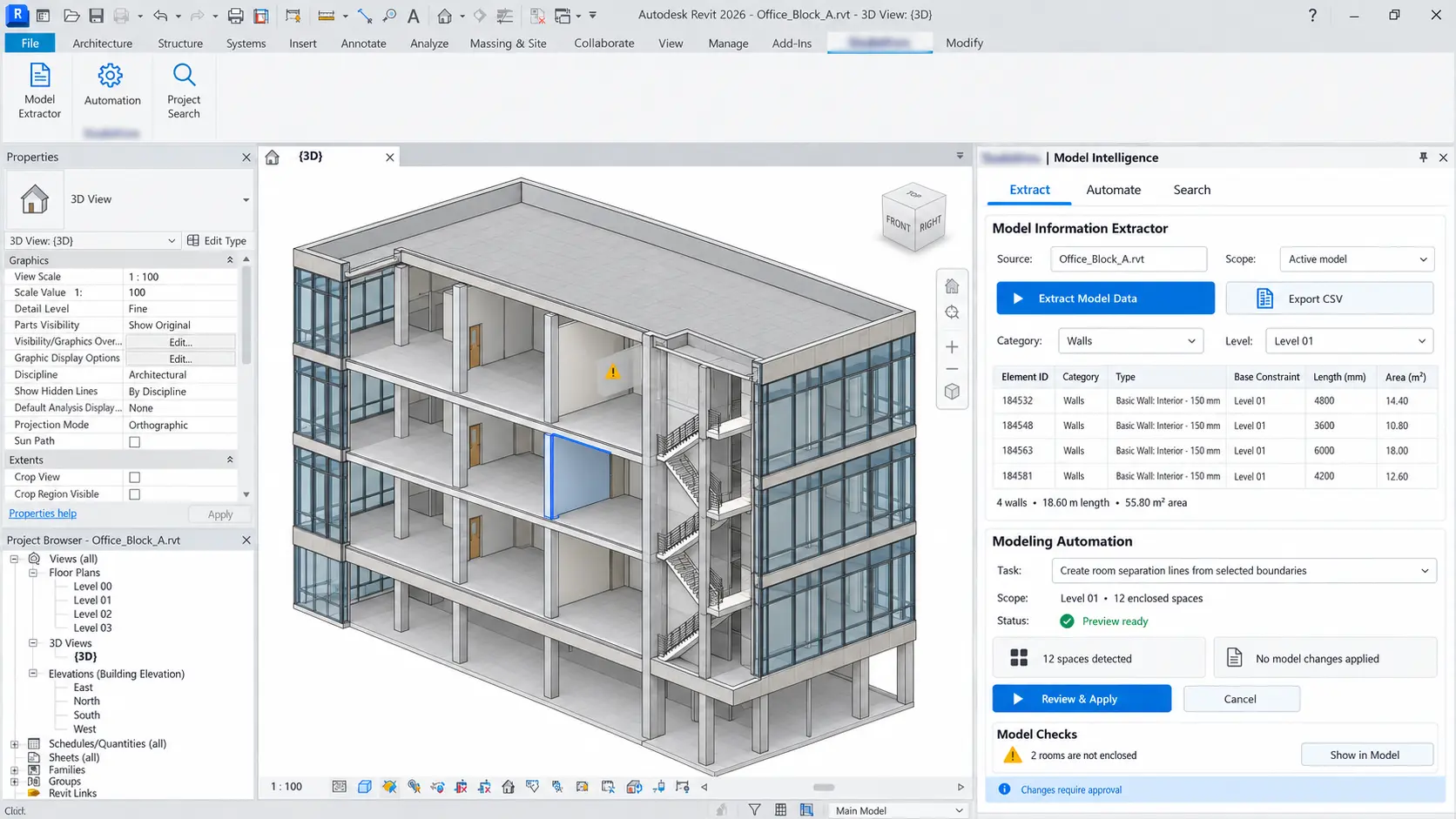
Explore RAG developmentAgents for architecture and engineering teams that run model checks, draft coordination reports, and answer questions about project standards, working alongside our Revit automation tools. Our first client agent runs inside Revit; see the proof section below.
Explore AI Revit automationFor larger workflows, we design systems where specialized agents hand work to each other: one gathers information, one drafts, one checks, and a coordinator tracks the whole task. We use this only when a single agent cannot cover the workflow reliably, because every extra agent adds cost and complexity to monitor.
An agent is only as useful as the tools it can reach. We connect agents to the systems your team already uses, with permissions set per tool.
An agent that can act needs limits that are designed, tested, and watched. These are standard in every build.
Before launch
Permissions by tool: what the agent can read, write, and never touch
Approval gates on every action that costs money, changes a record, or reaches a customer
An evaluation set of real cases, run on every change to the agent's instructions or model
Prompt-injection and data-leak testing against your own documents and tool outputs
In production
Logs of every step, tool call, and decision, with the reasoning kept for review
Cost controls: token budgets per task and per day, with alerts before limits
Quality tracking: resolution rate, escalation rate, and human-override rate
Model updates tested on the evaluation set before they reach users
We are not tied to one model vendor. The model is chosen for the task, the budget, and where your data is allowed to go.

| Platform | When it fits | Where it runs |
|---|---|---|
| OpenAI and Azure OpenAI | Strong general reasoning and broad tool support; Azure for teams already on Microsoft contracts and compliance | OpenAI's cloud, or your own Azure tenant |
| Anthropic Claude | Long documents, careful instruction-following, and agent workflows with many tool calls | Anthropic's cloud |
| Open-source: Llama, Mistral, Qwen | Data that cannot leave your network, high-volume tasks where per-token cost matters, and fine-tuning on your own data | Self-hosted on your servers or private cloud |
| Mixed | Most production agents: a capable model for planning, a smaller model for routine steps | Any combination of the above |
Self-hosted means the model runs on infrastructure you control, so prompts and documents never leave it. For OpenAI-specific builds, see our OpenAI development services.
We map the workflow with the people who do it today, define what done looks like, and agree which actions need approval. The output is a one-page agent brief.
We choose the model, define the tools the agent can call and their permissions, and design the approval and escalation paths.
A working agent runs against anonymized real cases within the first weeks, so you see how it behaves before we build further.
We build a test set from real cases and measure accuracy, escalation rate, and cost per task, then fix what fails.
The agent runs on live work with a person approving every important action. We tune instructions and tools from what the pilot shows.
Launch with monitoring, cost limits, and alerts. Under a support agreement, we handle model updates, new tools, and keeping the evaluation set current.
Two agents with the same name can differ by weeks of work once the integrations, the approval rules, and the test coverage are on the table. So we quote fixed-scope projects after scoping, and the written proposal reaches you within 48 hours of your inquiry.
Quoted after scoping
One workflow, defined tools, agreed approval rules, and an evaluation set.
Request Proposal$18 to $55 per hour
Agent, LLM, and integration capacity added to your own team.
$15,000 to $40,000 per month
Several agents or a multi-agent system, built and run by a team that stays with you.
Quoted after scoping
Monitoring, cost control, model updates, and evaluation upkeep once the agent is live.
Our first client agent runs in production inside Autodesk Revit. Alongside it, the conversational AI and LLM products below are the parts every agent is made of: grounded conversation, tool connections, and memory at scale.


Every build starts with the question of what a person must sign off, not what the model can do.
OpenAI, Claude, or open-source, chosen for your task and your data rules, not for a partnership.
12+ years building apps and software that connect to CRMs, ERPs, and APIs, which is most of the work in an agent. See our AI software development services.
If a chatbot or a plain automation solves it, we say so in the proposal.
Chicago, Oakville, New Delhi, and Dubai, with overlap across US, UK, and Gulf working hours.
Teams adding agent features to their own product, or making it usable by agents through tools and MCP.
Companies with high ticket volumes where routine cases can be resolved end to end with oversight.
Teams reconciling records across systems and chasing documents by hand.
Design and engineering teams that want agents working alongside Revit and BIM automation.
Common questions from CTOs, product leads, and operations heads weighing an agent. Have a workflow in mind? Talk to our team.
Describe the task, the systems involved, and who approves what today. We will send a scoped written proposal within 48 hours, and we will say plainly if a chatbot or a simple automation would serve you better.
Request Proposal