
Picking the company that will build your mobile app is one of those decisions that looks simple from a distance and gets complicated the moment you start comparing real proposals. Two vendors quote the same feature list. One comes in at a third of the price. Another won’t give you a number until after three discovery calls. A fourth has a beautiful portfolio but goes quiet for two days every time you email them.
Somewhere in that noise sits the partner who will actually ship your product, and the ones who will quietly drain your budget while your launch date slips by quarter after quarter.
We have been on the building side of this conversation for over a decade, and we have also been brought in to rescue projects that started with the wrong vendor. This guide is written from both vantage points. It is meant to help you ask sharper questions, read between the lines of a polished pitch, and make a choice you won’t regret six months into development. Whether you end up working with a freelancer, an in-house hire, or a full-service mobile app development company, the way you evaluate them stays the same.
Why the Vendor Decision Matters More Than the Idea
Founders tend to obsess over the idea and underestimate the execution. In practice, the reverse is closer to the truth. A strong team can take an average idea and turn it into a product people actually use. A weak team can take a brilliant idea and bury it under technical debt, missed deadlines, and a codebase nobody wants to touch.
The vendor you choose determines your architecture, your time-to-market, your ongoing maintenance costs, and, crucially, whether you even own clean, transferable code at the end of it. Those consequences compound. A shortcut taken in month two becomes a three-week refactor in month eight. A vendor who never wrote tests becomes the reason your app crashes the week you get featured.
This is why the selection process deserves real diligence rather than a quick scan of a few portfolios and a gut call on the cheapest quote.
Start With Clarity on What You Actually Need
Before you evaluate a single vendor, get honest about your own project. The clearer your brief, the easier it becomes to separate vendors who understand your problem from those who are simply nodding along to win the contract.
Ask yourself a few grounding questions. What is the core problem your app solves, stated in one sentence without jargon? Who is the user, and on which platforms do they live? Is this a lean MVP meant to test a hypothesis, or a feature-complete product headed straight to a competitive market? What does success look like in the first ninety days after launch, in numbers?
You don’t need a technical specification to start these conversations. You need a clear product vision and a sense of your constraints around budget, timeline, and risk tolerance. The right development partner, whether that is an agency or a team of dedicated app developers you bring on board, will help you translate that vision into a technical plan. But they can only do that well if you arrive with clarity about the destination, even if the route is still open.
A useful exercise: write down the three things your app absolutely must do at launch, and the three things you are tempted to include but could live without. Vendors who push back thoughtfully on that second list, rather than promising to build everything, are usually the ones worth taking seriously.
The Core Criteria for Evaluating an App Development Company
Once you know what you need, you can hold each candidate up against a consistent set of standards. The following criteria separate a reliable build partner from an expensive lesson.
Relevant Technical Expertise, Not Just a Long Tech List
Every vendor’s website lists the same stack: Swift, Kotlin, React Native, Flutter, Node, and a few cloud logos. A list proves nothing. What matters is depth in the specific technologies your project demands, and the judgment to recommend the right approach rather than the one they are comfortable with.
If you are building a graphics-heavy or animation-rich app, native development in Swift and Kotlin may be the better call. If speed to market across two platforms matters more than squeezing out every frame, a cross-platform framework can save you months. A vendor with genuine expertise will explain the trade-offs in plain language and tie the recommendation back to your goals, not theirs. If you want to go deeper into this specific decision, our breakdown of React Native versus Swift and Kotlin, and on-device AI in Mobile Apps, is a good place to understand what a competent vendor should weigh.
The tell is in how they answer “why.” A vendor who says, “We’d use Flutter because that’s what we do,” is showing you their constraint. A vendor who says, “For your case, here’s why cross-platform makes sense, and here’s the one scenario where we’d reconsider,” is showing you their judgment.
A Portfolio You Can Actually Verify
Screenshots are easy to assemble and hard to trust. Treat a portfolio as a starting point, not proof. The questions that matter come after you have looked at the pretty case studies.
Are the apps in their portfolio still live on the app stores? Pull a few up and read recent reviews, paying attention to crash complaints and how the team responds to them. Did they build the entire product or just one screen? Have they worked in your domain, whether that is fintech, healthcare, enterprise operations, or consumer brands? Domain context shortens the learning curve and reduces the number of expensive misunderstandings.
A vendor with a strong track record will be comfortable walking you through a real project end-to-end, including what went wrong and how they handled it. You can browse the depth we mean in our portfolio of shipped work, but apply the same scrutiny to everyone you evaluate. The vendors worth hiring welcome the questions.
Communication and Process, Tested Before You Sign
The single most reliable predictor of how a project will go is the vendor’s communication before any money changes hands. Response times, the quality of their questions, whether they actually listen or simply wait for their turn to pitch, all of it is data.
Look for a defined process rather than vague reassurances. How do they run discovery? What does a typical sprint look like? How often will you see working software rather than status decks? Who is your day-to-day point of contact, and in which time zone do they operate? A vendor who can describe their workflow concretely and who assigns you a dedicated project manager rather than routing you through a rotating cast has done this many times before.
Be wary of the team that dazzles during the sales call but slows down the moment you ask a detailed technical question. That gap rarely closes after the contract is signed. It widens.
Pricing That Reflects Value, Not Just the Lowest Bid
The cheapest quote is almost never the cheapest project. Underpriced bids get recovered somewhere, usually through cut corners, junior developers learning on your budget, or a pile of change-order invoices once you are too far in to walk away.
That said, the most expensive vendor is not automatically the best either. What you want is pricing you understand. Ask exactly what is included, what counts as out of scope, how change requests are handled, and what happens to the rate if the timeline extends. A transparent vendor will give you a clear answer. An evasive one is telling you something, too.
It also helps to arrive with realistic expectations about what apps actually cost to build, so you can spot a quote that is suspiciously low or padded. Our guide to mobile app development costs lays out the variables that move the number, from feature complexity to platform choice to backend requirements.
Engagement Models That Fit Your Stage
Not every project should be a fixed-scope, fixed-price contract, and not every team should be billed hourly. The right structure depends on how well-defined your scope is and how much flexibility you need.
A tightly specified MVP with clear boundaries can work well as a fixed-price engagement. A product that will evolve based on user feedback is often better served by a dedicated team you can direct sprint to sprint. If you already have in-house engineers and simply need to add specialized skills, a model in which you hire dedicated app developers and integrate them into your existing process may be the most efficient path. A flexible vendor offers multiple models and helps you pick the one that best fits your reality, rather than forcing you into one that suits their billing.
Security, Compliance, and Code Ownership
This is the section founders skip and later regret. Before you sign, settle three things in writing.
First, code ownership. You should own the source code, the repositories, and all associated assets outright at the end of the engagement, with no strings. Confirm it in the contract, not the conversation. Second, intellectual property and confidentiality are covered by an NDA and a clear IP assignment. Third, security and compliance practices appropriate to your domain, whether that means data encryption standards, secure authentication, or regulatory frameworks like HIPAA for healthcare or financial data rules for fintech.
A professional vendor treats these as routine and will have answers ready. Hesitation here is a serious warning sign.
Post-Launch Support and the Long Relationship
Shipping the app is the midpoint, not the finish line. Operating systems update, devices change, users report bugs, and your roadmap keeps moving. Find out what happens after launch before you choose. Does the vendor offer a maintenance and support agreement? What are their response times for critical issues? Will the same team that built the app be available to evolve it, or does knowledge evaporate the day the invoice is paid?
The most valuable vendor relationships are long ones, where the team accumulates deep knowledge of your product and can move quickly because they understand the history. Optimizing purely for the lowest build cost often sacrifices exactly this.
A Practical Step-by-Step Selection Process
Knowing the criteria is one thing. Running a disciplined process is another. Here is a sequence that consistently surfaces the right partner.
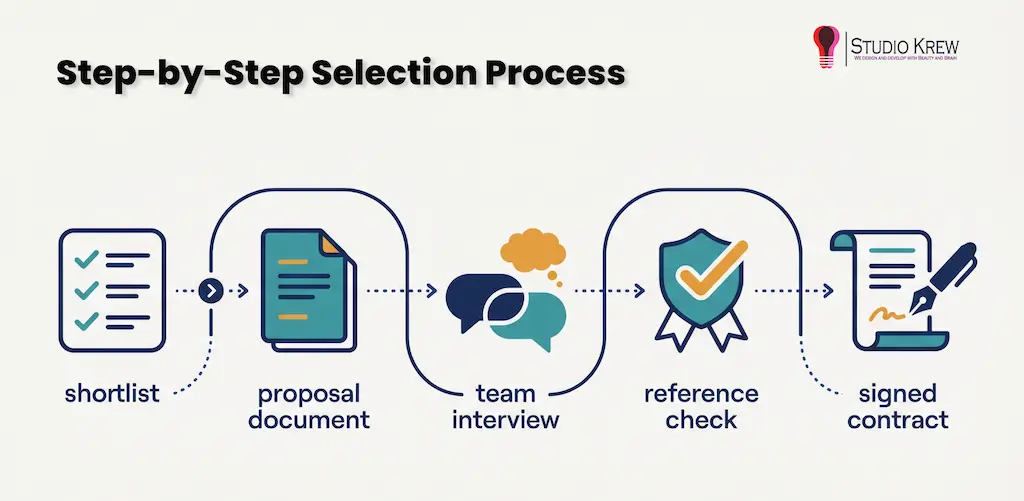
Step one: build a shortlist. Start broadly using referrals, marketplace listings, and search, then narrow to four or five vendors whose portfolios and stated expertise genuinely fit your project. Resist the urge to evaluate twenty at once. Depth beats breadth here.
Step two: send a focused brief and request proposals. Give each shortlisted vendor the same brief so you can compare like with like. Watch how they respond. The good ones ask clarifying questions before quoting. The ones who fire back a number and a timeline within an hour have not understood your project.
Step three: interview the actual team. Insist on speaking with the people who will do the work, not only the sales lead. Ask about a project that went sideways and how they recovered. Their answer reveals more than any case study.
Step four: check references and verify claims. Talk to at least two past clients. Ask the questions that matter: Did the project finish on time and on budget? How did they handle problems? Would you hire them again? Then go pull their shipped apps and read the reviews yourself.
Step five: run a small paid pilot if the stakes are high. For a significant engagement, a short paid discovery phase or a small first milestone tells you more about a vendor than any amount of talking ever could. You see their real communication rhythm, code quality, and reliability before committing the full budget.
Step six: Read the contract properly. Confirm code ownership, IP assignment, payment milestones tied to deliverables, scope boundaries, and exit terms. If anything is vague, fix it before signing, not after.
Red Flags That Should Give You Pause
Some signals are worth treating as near-disqualifying. A vendor who guarantees a fixed price and timeline before understanding your requirements is either inexperienced or setting up for change orders later. A portfolio that cannot be verified, or apps that are no longer live, suggest either exaggeration or work that did not survive contact with real users.
Communication that is sluggish or evasive during the sales process will not improve once you are a paying client. Reluctance to put code ownership and IP terms in writing is a problem you do not want to discover at handover. Pressure tactics and artificial urgency, the “this rate is only good until Friday” approach, rarely come from teams confident in their own value. And a quote dramatically below every other bid is not a bargain. It is a question you need answered.
None of these on their own is necessarily fatal, but each deserves a direct question. How a vendor responds to being asked about a red flag is often more telling than the flag itself.
Matching the Vendor to Your Specific Domain
Generic mobile development skills are necessary but not always sufficient. Different app categories carry different risks and require different instincts, and a vendor who has lived in your domain will anticipate problems a generalist discovers the hard way.
If you are a consumer brand, the priorities are polish, performance, and engagement mechanics that keep users coming back. If you are building for the enterprise, the harder problems are integration with existing systems, role-based access, scalability, and security, which is where enterprise application development experience earns its keep. If your product lives in a specialized vertical such as construction and architecture, with its field operations and BIM-adjacent requirements, or media and entertainment, with its streaming and content demands, domain familiarity dramatically reduces back-and-forth and costly assumptions.
When you interview vendors, probe their experience in your specific category. A team that has solved your class of problem before will ask better questions and propose more realistic solutions from the very first call.
Does the Vendor Understand Where Apps Are Heading?
The best build partners are not just executing today’s brief; they are building in a way that won’t be obsolete by your second release. Mobile is moving quickly, and a vendor’s grasp of where it is going is a quiet but reliable indicator of quality.
Ask how they think about on-device intelligence, AI-driven features, and the shift toward apps that do more than display screens and forms. A team that can speak fluently about integrating AI capabilities, or about the architectural choices behind on-device versus cloud AI, is a team thinking past the immediate deliverable. You are not obligated to put cutting-edge features in version one. But you want a partner who builds with enough foresight that adding them later doesn’t mean tearing down what you’ve already paid for.
The same logic applies to performance, accessibility, and platform updates. A forward-looking vendor designs for the app stores and devices of next year, not just this quarter. That mindset is hard to fake in a sales call, which is exactly why asking about it is so revealing.
In-House Team, Freelancer, or App Development Company?
It is worth stepping back to acknowledge that hiring a vendor is only one of three broad paths, and the right answer depends on your situation.
Building an in-house team gives you maximum control and is ideal if mobile is core to your business long term, but it is slow to assemble, expensive to maintain, and hard to scale up or down. Hiring individual freelancers can be cost-effective for small, well-defined projects, but coordination, continuity, and accountability fall to you, and a single freelancer’s absence can stall an entire project.
A development company sits in the middle. You get a coordinated team across design, development, and quality assurance, established processes, and a single point of accountability, without the overhead of recruiting and retaining specialists yourself. For most startups and growing businesses, this balance of speed, capability, and manageable cost is why an established vendor is the default choice. The key is choosing one that operates with the transparency and ownership terms of a true partner rather than a faceless outsourcing shop.

Frequently Asked Questions
What should I look for specifically in a mobile app development company?
The same fundamentals apply as with any vendor: relevant technical depth, a verifiable track record, clear communication, transparent pricing, and written code-ownership terms. The advantage a good company offers over a lone freelancer is a coordinated team and a single point of accountability, so weigh whether their process and team structure actually match the scale of what you are building.
How long does it take to choose the right vendor?
For a serious project, plan on three to six weeks from shortlist to signed contract. Rushing the selection to save two weeks routinely costs months later when a poor fit reveals itself mid-build.
Should I always pick the vendor with the lowest quote?
No. Price matters, but the lowest bid frequently signals cut corners, junior staffing, or change orders waiting to appear. Evaluate cost against demonstrated expertise, process, and ownership terms. Understand what drives app development cost so you can judge whether a quote is realistic.
How do I make sure I own the code?
Get it in the contract. Specify that you own all source code, repositories, and assets at the end of the engagement, with an NDA and a clear IP assignment. A reputable vendor agrees to this without friction.
Do I need a full technical specification before approaching vendors?
Not a full spec, but you should arrive with a clear product vision, your target platforms, your must-have features, and your constraints. A strong vendor helps you turn that into a technical plan during discovery.
What is the safest way to test a vendor before a full commitment?
A small paid pilot or a first milestone. It lets you observe real communication, code quality, and reliability before you commit the entire budget, and the cost is trivial against the risk it removes.
Bringing It Together
Choosing a mobile app development vendor is, at its heart, an exercise in reading signals. The portfolio, the price, and the pitch tell you something, but the sharper signals live in how a vendor asks questions, how they explain trade-offs, how quickly and clearly they communicate, and how willing they are to put the important terms in writing.
Get clear on your own needs first. Evaluate each candidate against consistent criteria around expertise, verifiable track record, process, transparent pricing, security, and post-launch support. Run a disciplined process rather than trusting a gut call on the cheapest quote. And weigh red flags honestly, because the cost of ignoring them is always paid later, with interest.
Do that, and you move from hoping you picked well to knowing why you did.
If you are weighing your options and want a straight conversation about your project, the team at StudioKrew is happy to talk through the trade-offs with you. You can explore our mobile app development services or look at how we structure engagements when you hire dedicated developers. Either way, ask us the hard questions. The right partner will welcome them.





 INDIA
INDIA CANADA
 USA
USA UAE
UAE