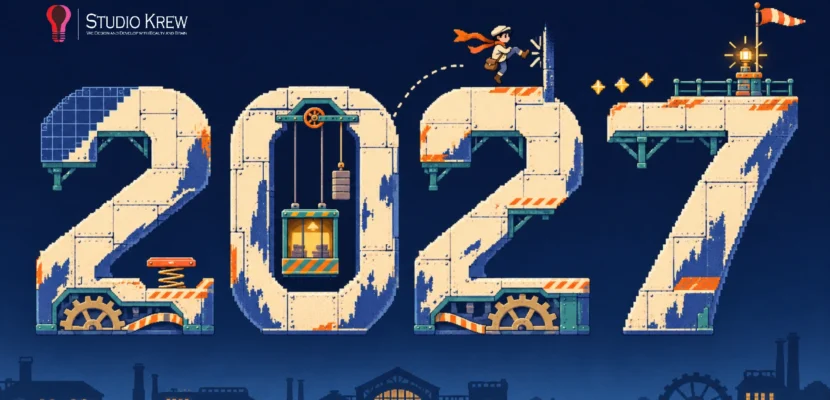
The biggest game development trends 2027 will bring are a console transition year, PC becoming the default platform, Nintendo Switch 2 turning into a serious target, new engine generations from Epic and Unity, generative AI moving from hype into production policy, mobile growth shifting from installs to monetization, Roblox and Fortnite maturing into real distribution channels, a more selective approach to live service, and co-development becoming the normal way to staff a game.
2027 will not look like an ordinary year. PlayStation and Xbox are nearing the end of their cycle, Unreal Engine 6 and Unity 7 are on the roadmap, and mobile revenue now depends on monetization, not installs. Every trend below ends with the decision it forces on your project.
We have shipped 700+ games since 2013 with 100+ specialists, and this is the planning advice we give our clients.
Last updated: November 2026
Game Development Trends 2027 at a Glance
| Trend | The evidence | What to decide in 2027 | Where we can help |
|---|---|---|---|
| 1. Console transition year | Only 10% of developers are building for the next PlayStation and 8% for Project Helix (Shattered, GDC survey) | Scope for current consoles and document a path to next-gen hardware | console game development |
| 2. PC is the default platform | 81% of developers are building for PC (Shattered, GDC survey) | Make PC a launch platform and plan for Steam Deck and Steam Machine | PC game development, game porting services |
| 3. Switch 2 is a serious target | 26.35 million Switch 2 units sold as of 30 September 2026 (Gematsu) | Decide between a day-one Switch 2 version and a planned port | Covered under PC and console |
| 4. Engine roadmaps | Unreal use fell to 35% from 42% as proprietary engines rose to 23% (Shattered, GDC survey) | Pick the engine you will ship on, with a written upgrade path | Unity game development company, Unreal Engine game development |
| 5. Generative AI policy | 40% of game professionals use generative AI at work (Tech Times, GDC survey) | Write an AI use policy and plan for Steam disclosure | AI-integrated game development |
| 6. Mobile monetization over installs | Mobile game downloads fell 7.2% in 2025, while hybrid-casual IAP grew 20% (Sensor Tower via GameDev Reports) | Choose a hybrid monetization model and a web shop plan | mobile game development company |
| 7. UGC platforms as distribution | Roblox paid creators about $1.7 billion through DevEx in 12 months (IBTimes UK) | Treat a Roblox or Fortnite launch as a funded product with a plan | Roblox game development company |
| 8. More selective live service | Highguard shut its servers about 45 days after launch (God is a Geek) | Prove retention before you commit to a long content roadmap | game LiveOps services |
| 9. Co-development as standard | 45% of studios used co-development services in the past 12 months (Game Developer, GDC survey) | Decide what your core team owns and what a partner owns | game co-development services |
Planning a game for 2027? Send us your brief and get a scoped written proposal within 48 hours.
1. 2027 Is a Console Transition Year
In short: PwC expects 2027 to bring a cyclical downturn in console sales, and only 10% of developers in GDC’s November 2026 survey are building for the next PlayStation, with 8% working on Microsoft’s Project Helix (GamesBeat, Shattered).
PwC’s Global Entertainment & Media Outlook 2026-2030 sees PlayStation and Xbox entering their final year before the next-generation relaunches it expects in 2028. It also flags tariffs and higher memory chip prices, driven by AI demand, as extra pressure on hardware (GamesBeat).
Microsoft has confirmed it will ship alpha hardware of its next Xbox, Project Helix, to developers beginning in 2027 (TechRadar). Sony has not officially announced the next PlayStation, so any date you read is speculation. Meanwhile, GTA 6 is set for release on 19 November 2026 (FOX10), and Newzoo expects full-game spending to reach 17.5% of the market, helped by that launch (GameDev.net).
What this means for your 2027 project
- Do not build a 2027 business case on next-generation consoles. Alpha hardware is not an installed base. Ship on PS5 and Xbox Series X|S, where the players already are.
- Write a next-gen path into your technical design now, covering rendering scalability and platform abstraction, so a later upgrade stays cheap.
- Leave slack in hardware budgets, since dev kits and test devices face the same cost pressure.
Our console game development team scopes current-generation builds with that upgrade path built in.
2. PC Is Now the Default Platform, and the PC Itself Is Changing
In short: 81% of developers in GDC’s November 2026 survey are building for PC, far ahead of the 45% building for PS5 and PS5 Pro (Shattered).
The money is following. Newzoo projects PC revenue growing 6.6% a year against 4.4% for console from 2025 to 2028, with the PC player base passing 1 billion by 2028 (PC Gamer). Steam alone grew revenue 13% to $11.7 billion in 2025, according to Sensor Tower (GameDev Reports).
What counts as “PC” is also widening. In the same GDC survey, 32% of developers are building for Steam Deck and 21% for Valve’s Steam Machine (Shattered). The Steam Machine launched on 30 June 2026 at $1,049 for the 512GB model, running SteamOS 3 (Gematsu). A PC game in 2027 is increasingly expected to work as a handheld game and on a box under the TV.
What this means for your 2027 project
- Make PC a launch platform, not a later port, and plan the Steam page and wishlist building from pre-production.
- Treat SteamOS as a target: controller-first input, UI that reads at handheld and TV distance, and stable Steam Deck performance.
- Already own a successful mobile game? Our guide on how to port a mobile game to PC and Steam covers the steps.
Our PC game development teams build for Steam from day one, and our game porting services bring existing titles to PC, Steam Deck, and console.
3. Nintendo Switch 2 Has Become a Serious Target Platform
In short: Nintendo had sold 26.35 million Switch 2 units and 73.21 million Switch 2 games as of 30 September 2026 (Gematsu).
Developers have noticed. In GDC’s November 2026 survey, 29% of respondents are building for Switch 2, well ahead of the 10% working on the next PlayStation (Shattered). Engine vendors are treating it as a first-class platform too. Epic’s Unreal Engine 5.8 aims Lumen dynamic global illumination at 60 fps on Switch 2 and PC (God is a Geek).
The constraint is performance. Switch 2 has a tighter memory and performance budget than a high-end PC, and pre-production choices decide whether its version is a straightforward build or a long optimization project.
What this means for your 2027 project
- Decide now whether Switch 2 is a day-one platform or a planned port. That single choice sets texture budgets, memory targets, and how much detail your artists can spend.
- Profile early on handheld-class hardware such as Steam Deck.
- Put Nintendo’s certification time into the schedule from the start, especially for a simultaneous launch.
4. Engine Roadmaps Change the Engine Decision: Unreal Engine 6, Unity 7, and In-House Engines
In short: Unreal Engine use among GDC survey respondents fell to 35% from 42%, while proprietary engines rose to 23% from 19% (Shattered).
The shift is clearest at the top end. At AAA studios, 53% now use an in-house engine and 41% use Unreal, compared with 44% and 47% a year earlier (AUTOMATON). Unity dipped to 28% from 30%, and among indie respondents Godot climbed to 11% from 7% (Shattered).
Epic is targeting early access for Unreal Engine 6 around the end of 2027, with a full release about 12 to 18 months later. UE6 merges Unreal Engine 5 and Unreal Editor for Fortnite into one product, and gameplay programming moves to Verse. UE 5.8 is described as the last planned large UE5 release, bringing MegaLights, Iris, and other features to production-ready, plus an experimental Model Context Protocol plugin that connects AI models to Unreal projects (God is a Geek).
Unity 7 enters early beta from December 2026, with full release expected in early 2027 (Game Developer).
| If you start production in 2027 | Engine path to consider | Why |
|---|---|---|
| Mobile or cross-platform casual and mid-core | Unity 6, moving to Unity 7 | Unity describes Unity 7 as a direct continuation of Unity 6, with existing projects carrying forward (Game Developer) |
| High-fidelity PC and console | Unreal Engine 5.8, with a planned UE6 decision point | UE 5.8 is the last planned large UE5 release, and UE6 early access is targeted for around the end of 2027 (God is a Geek) |
| Fortnite (UEFN) or Roblox experience | UEFN with Verse, or Roblox Studio | The platform decides the tools, and Verse skills carry into UE6, where gameplay programming moves to Verse (God is a Geek) |
| Small 2D or indie budget | Godot or Unity | Godot use among indie respondents rose to 11% from 7%, and both suit small 2D teams; choose on team experience and target platforms (Shattered) |
What this means for your 2027 project
- Choose the engine version you will actually ship on: for most 2027 starts, UE 5.8 or Unity 6 moving to 7.
- Write the upgrade path into your technical design, including the milestone where you decide on UE6 or Unity 7.
- Only go in-house if you can fund an engine team for the life of the project.
- Still torn? Our Unity vs Unreal Engine comparison walks through the tradeoffs.
We work as both a Unity game development company and an Unreal Engine game development partner, so our engine advice is not tied to one roadmap.
5. Generative AI Moves From Hype to Production Policy
In short: 40% of game professionals in GDC’s November 2026 survey use generative AI at work, up from 36% in January 2026 (Tech Times).
Adoption is uneven. It reaches 70% at mobile-only studios and 58% at free-to-play developers, but only 32% at premium developers, and 57% of users work with it daily. Sentiment runs the other way: 55% of respondents say generative AI has a negative effect on the industry and just 8% say positive. Pressure differs too, with 27% of AAA workers feeling encouraged or pressured to use it against 9% at indie studios (Tech Times).
Players can see it as well. Steam has required AI disclosure since January 2024, and a mid-2025 count by developer Ichiro Lambe (Totally Human) found 7,818 titles disclosing generative AI use, about 7% of the Steam library and about one in five 2025 releases. About 60% of those disclosures covered visual assets (Tom’s Hardware). For 2027, the question is less whether to use AI and more where, under whose sign-off, and how you disclose it. We cover the tool side in our post on how AI is reshaping the game development pipeline.
What this means for your 2027 project
- Write an AI use policy before production: where AI is allowed, where final output must be human-made, and who approves exceptions.
- Track AI use per asset so your Steam disclosure is accurate, and make the same policy binding on every external partner.
If you want generative AI or smarter NPCs inside the game itself, our AI-integrated game development team can scope it with you.
6. Mobile Growth Now Comes From Monetization, Not Installs
In short: Mobile game downloads fell 12% to 24 billion in the first half of 2026, while in-app purchase revenue slipped only 2% to $40 billion, according to Sensor Tower (PocketGamer.biz).
Newzoo forecasts mobile at $121.1 billion in 2026, about 57% of the global games market, with 3.10 billion players (GameDev.net). In 2025, Sensor Tower measured mobile game IAP revenue at $81.75 billion, up 1.3%, while downloads dropped 7.2% to 50.41 billion. Hybrid-casual was the only segment with meaningful IAP growth, at 20% (GameDev Reports).
A GDC and Appcharge report estimates mobile direct-to-consumer revenue at $17 billion in 2026, about 15% of the $113.3 billion mobile IAP economy, and 92% of publishers expect D2C revenue to grow. App store fees run from 15% to 30%, against 2% to 5% in payment processing on web shops (FoxData). Newzoo reports that 96% of studios operate or plan a direct-to-consumer web store (GameDev.net). GDC’s 2026 Trends Report adds that mobile developers are combining monetization models and focusing on retention over acquisition (GDC, PocketGamer.biz).
What this means for your 2027 project
- Pick a hybrid model on purpose, such as ads with IAP, and design the economy around it from the first prototype.
- Plan the web shop early, from account linking to payment flow, within each store’s rules.
- Prove retention in a soft launch before spending on content or user acquisition. Our posts on hybrid-casual games vs traditional mobile games and mobile game monetization models in 2026 go deeper.
As a mobile game development company, we design the monetization and retention plan alongside the game, not after it.
If your 2027 mobile plan needs a monetization rethink, tell us about your game and we will scope it with you.
7. UGC Platforms Are a Real Distribution Channel: Roblox and Fortnite
In short: Roblox paid creators about $1.7 billion through DevEx in the 12 months to 30 June 2026, up about 50% (IBTimes UK).
That money is not spread evenly. The top 10 creators averaged $65.7 million each, while the median creator earned about $1,500 across more than 42,000 participants (IBTimes UK). The channel is hit-driven. A Roblox experience should be treated as a product with a plan, not a lottery ticket.
Fortnite is following a similar path. Epic has paid more than $1 billion to Fortnite creators since UEFN launched, and Unreal Engine 6 will merge UEFN with Unreal Engine 5 into a single product (God is a Geek). For publishers and brands, that makes UGC a distribution decision, not a marketing experiment.
What this means for your 2027 project
- Scope a Roblox or Fortnite experience like any other game: target player, core loop, monetization, and an update plan for the months after launch.
- Budget for regular post-launch updates, since discovery on these platforms rewards them.
- Brand teams should define the goal first. Revenue, reach, and engagement lead to quite different designs.
Our Roblox game development company team plans experiences around that kind of goal from the first brief.
8. Live Service Gets More Selective
In short: Wildlight Entertainment’s Highguard launched on 26 January 2026 and shut its servers on 12 March 2026, about 45 days later, saying it could not build a sustainable player base (God is a Geek).
Live service games need a large, steady audience to cover ongoing costs, and the money to wait for one is harder to find. In GDC’s November 2026 survey, 49% of respondents said their employer cut jobs in the past 12 months, rising to 68% at AAA studios, and 34% had been laid off in the past two years (Tech Times).
Premium games are also showing strength. Newzoo expects full-game spending to reach 17.5% of the market in 2026, the strongest growth of any business model (GameDev.net). Live service still works for the right game. It is just no longer the default answer.
What this means for your 2027 project
- Ask whether your game needs to be live service at all. A premium release with a planned update schedule may fit better and cost less to run.
- If you go live, tie content spending to retention data from closed tests.
- Write the LiveOps plan before launch: event cadence, tools, analytics, and post-launch team size.
Our game LiveOps services cover that planning as well as running events and updates after launch.
9. Co-Development Becomes the Standard Way to Staff a Game
In short: 45% of studios used co-development services in the past 12 months, according to GDC’s November 2026 State of the Game Industry survey of more than 2,600 professionals in 69 countries (Game Developer).
The reason is mostly financial. GDC’s 2026 Trends Report found that more studios co-develop because funding and publishing deals are harder to secure (GDC, PocketGamer.biz). After a long run of layoffs, many teams would rather keep a lean core and bring in specialists for production peaks than hire permanently for every stage.
Unlike classic outsourcing, the partner works inside your production, in your tools and sprints, owning specific features or content while you keep creative direction.
What this means for your 2027 project
- Decide which features or content a partner should own, and keep the systems that define your game with your core team.
- Choose a partner that can work in your engine, source control, and sprint cadence, with one named owner on each side.
- Start with a scoped pilot milestone before you commit full production to any partner.
Our game co-development services slot into an existing team on those terms.
How to Plan a Game Project for 2027: A Checklist
- Platforms: PC by default, Switch 2 assessed on purpose, Steam Deck and Steam Machine in scope.
- Console generation: Ship on current PlayStation and Xbox hardware, with a documented next-gen path.
- Engine: The version you will ship on, plus a written upgrade path to Unreal Engine 6 or Unity 7.
- AI policy: A generative AI policy for your team and partners, with per-asset tracking for Steam disclosure.
- Monetization: Premium, free-to-play, or hybrid, and a decision on a direct-to-consumer web shop.
- Retention test: Proven in a soft launch or closed test before you scale content or user acquisition.
- LiveOps: Event cadence, tools, analytics, and post-launch team defined before release.
- UGC: Whether a Roblox or Fortnite experience belongs in the plan, with its own budget.
- Team model: What your core team owns, what a co-development partner owns, and who that partner is.
- Launch window: A release window away from the biggest launches on your platforms.
How StudioKrew Is Preparing for 2027
Our own project requests are a useful signal. In 2026, the requests that grew most for us were promotional games, offline games, ultra-realistic GPU-driven games built for 8K, and simulation and training games.
A promotional game turns a brand message into something people choose to play, which is the heart of promotional game development. Simulation and training projects reward realism, which is where simulation game development and training and eLearning games come in. And the 8K work pushes the same high-end rendering that PC and console projects now expect. We cover all of it as a full-cycle game development company.
On AI, our approach is practical. We use AI tools to stress-test project plans and find weak points early, to make delivery estimates more predictable, to speed up prototyping, to visualize concepts, and to support security reviews and audits.
Two projects show the range. For Abu Dhabi Marine Sports Club and F1H2O, we built an 8K speedboat simulation game with real physics and boat mechanics, integrated with Logitech racing gear for a hardcore, true-to-life powerboat experience. We also built TopChamps, a card boxing game where every bout rewards real strategy and quick decisions.
Ready to plan your 2027 game? Share your brief with our team and we will send you a scoped written proposal within 48 hours.
Frequently Asked Questions
What are the biggest game development trends for 2027?
The biggest trends are a console transition year, PC as the default platform, Switch 2 as a serious target, new engine generations in Unreal Engine 6 and Unity 7, generative AI moving into formal policy, mobile monetization over installs, Roblox and Fortnite as distribution channels, more selective live service, and co-development. In GDC’s November 2026 survey, 81% of developers were building for PC.
Is 2027 a good year to launch a game?
It can be, with the right plan. PwC expects a cyclical downturn in console sales in 2027 as PlayStation and Xbox near the end of their cycle, while Newzoo projects PC revenue growing 6.6% a year to 2028. That points many launches toward PC and Switch 2. Choose a window away from the biggest releases and prove retention before you scale content.
Which game engine should I use for a new project in 2027?
Choose the engine you will ship on, not the one being announced. For high-fidelity PC and console games, Unreal Engine 5.8 with a planned UE6 decision point is the common route. For mobile and cross-platform casual games, Unity 6 carries forward into Unity 7. Small 2D teams often consider Godot, now used by 11% of indie respondents in GDC’s survey.
Will generative AI replace game developers?
We do not expect it to. In GDC’s November 2026 survey, 40% of game professionals used generative AI at work and 55% said it has a negative effect on the industry. In practice, it speeds up prototyping, code assistance, and concept work, while people still own design, art direction, and quality. Steam also requires developers to disclose generative AI use.
Should a new game launch on PC, console, or mobile first in 2027?
It depends on genre and audience, but PC is the safest default for most premium games: 81% of developers in GDC’s November 2026 survey are building for PC. Mobile remains the largest segment at about 57% of the market in Newzoo’s 2026 forecast, which suits free-to-play. Console launches in 2027 should target current hardware, with Switch 2 as a strong candidate.
What is game co-development?
Game co-development is when an external studio works inside your production as an extension of your team, owning features or content, rather than delivering a finished game on its own. It is now common: 45% of studios used co-development services in the past 12 months, according to GDC’s November 2026 survey. It lets you scale for production peaks without permanent hiring.
Sources
- Newzoo: Global Games Market to Generate $213.9bn in 2026, Up 6.1% YoY, GameDev.net, 25 August 2026
- PC Games Revenue Will Outgrow Consoles by 2028, Analyst Predicts, PC Gamer, 12 March 2026
- The U.S. Game Industry Will Hit a Cyclical Downturn in 2027 Despite GTA VI Launch: PwC Analysis and Interview, GamesBeat, 2026
- Microsoft Confirms Its Next Xbox, Project Helix, Will Go Out to Studios Next Year, TechRadar, March 2026
- GTA 6 Locks Nov. 19 Release Date After Delays, FOX10, 16 October 2026
- Layoffs, AI, and Next-Gen: What 2,600+ Game Professionals Told GDC This Year, Game Developer, 12 November 2026
- GDC: AI Use Hits 40%, Next PlayStation Only 10%, Shattered, 13 November 2026
- GDC State of the Game Industry Survey: Engine Use at AAA Studios (in Japanese), AUTOMATON, 13 November 2026
- Game Industry Layoffs and AI Use: GDC Survey Results, Tech Times, 17 November 2026
- 2026 GDC Trends Report: 5 Insights on the Future of Game Development, GDC, May 2026
- D2C, Co-Development and Volume Over Viability: GDC 2026 Trends Revealed, PocketGamer.biz, 28 May 2026
- Switch 2 Worldwide Sales Top 26.35 Million, Gematsu, 5 November 2026
- Steam Machine Launches June 30, Starting at $1,049, Gematsu, June 2026
- Sensor Tower: State of Gaming 2026, GameDev Reports, 19 March 2026
- Epic Outlines Unreal Engine 6 and UEFN Creator Payouts, God is a Geek, June 2026
- Unity Unveils Unity 7 Roadmap With Update Path That Won’t Break Your Build, Game Developer, 21 July 2026
- 1 in 5 Steam Games Released in 2025 Use Generative AI, Tom’s Hardware, 16 July 2025
- Mobile Gaming IAP Dipped 2% as Ad Spend Climbed in H1 2026, PocketGamer.biz, 30 July 2026
- Mobile Game D2C Revenues Hit $17 Billion: Why Publishers Are Pushing Beyond App Stores, FoxData, 25 June 2026
- Roblox Top Creators and DevEx Payouts in 2026, IBTimes UK, 13 September 2026
- Highguard Shuts Down 45 Days After Launch, God is a Geek, March 2026
Written by the StudioKrew Game Development Team. Our game teams have shipped 700+ games since 2013 across mobile, PC, console, Roblox, and simulation projects.



 INDIA
 CANADA
 USA
 UAE