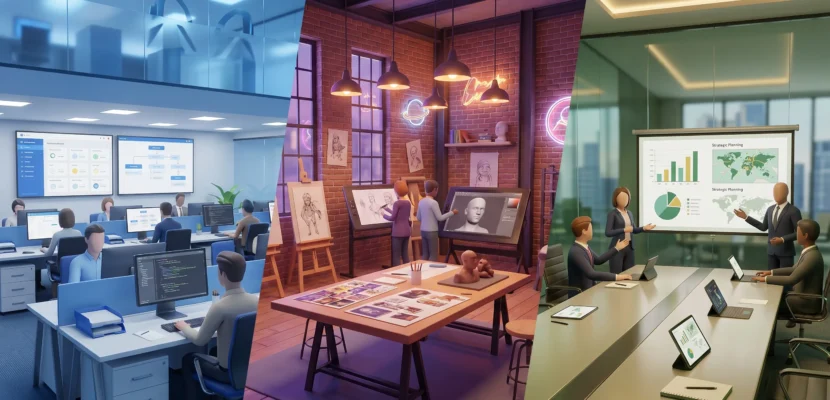
You send your project brief to four companies: a game development studio, a game development company, a creative game agency, and a game development outsourcing firm. Each claims to build games, has a portfolio, and replies with a quote.
Which one do you hire? And more importantly, what is actually different between them?
The problem isn’t that these terms are meaningless. Each conveys distinct connotations, represents a different business model, and outlines a fundamentally different client relationship. However, the lack of industry-standard definitions leads to interchangeable use on websites and during sales calls. Buyers make significant financial commitments based on terminology they may not fully understand.
This post unpacks the real differences between a game development company, a game development studio, and a game development agency. It covers how each is structured, what each does best, where each model falls short, and how to identify which type of partner fits your specific project before you sign anything.
The global gaming market is approaching $282 billion in value. The number of active studios and agencies has grown in proportion, and the terminology has only gotten more tangled as every type of operation adopts whichever label sounds most credible to its target buyer. Getting clear on these distinctions is the first step toward choosing the right partner.
Why These Terms Are So Confusing And Why Getting Them Right Matters
Truthfully, the game industry has not standardized these terms. A ten-person indie team in Warsaw may call itself a game development company, a 400-person production operation in Los Angeles a studio, and a two-person consultancy in London an agency. None is technically wrong, so labels are meaningless unless you know what lies beneath.
The confusion has a measurable cost. According to Clutch buyer research, 72% of first-time game buyers report confusion about terminology differences before making their first hire. That confusion directly affects the quality of decisions they make. Buyers end up evaluating the wrong type of partner for their project, asking the wrong questions during discovery calls, and ultimately making choices based on surface signals, portfolio aesthetics, website design, and client logos, rather than structural fit.
Newzoo’s Global Games Market Report identifies over 3,000 active game development studios worldwide. Factor in agencies, freelancer collectives, consultancies, and hybrid operations, and the total number of entities offering game development services runs into the tens of thousands. Making sense of that landscape requires understanding what each model actually is, not what each calls itself.
The sections below take each term in order, define it clearly, and give you a practical framework for identifying which model a given partner actually operates within, regardless of what they put on their homepage.
What Is a Game Development Company? The Full-Cycle Model Explained
A game development company in the fullest sense of the term is an organization that owns and manages the complete lifecycle of game production. That means concept design, narrative and game design documentation, UI and UX design, 2D and 3D art production, programming, backend systems, multiplayer infrastructure, QA, platform certification, store submission, post-launch monitoring, LiveOps, and ongoing product evolution. Every phase of the process sits under one roof.
The defining characteristic of a full-cycle game development company, as distinct from the other two models, is accountability across the entire process. When you engage a game development company that operates this way, there is a single point of responsibility from the initial brief to a live, maintained game product. There are no handoffs between specialist contractors who have never spoken to each other. There is no gap between the people who designed the game and the engineers who built it.
The business model is typically project-based or retainer-based. You pay for production milestones, post-launch support contracts, or ongoing platform management. Ownership of the final product, code, art, audio, and all associated assets, transfers to the client on completion. This is the model for founders, enterprises, and publishers who lack an in-house development function and need an external team to own end-to-end production.
Full-cycle companies have overhead that studios or agencies often do not, including producers, QA leads, backend engineers, technical architects, and platform specialists. This is reflected in the cost. Still, for complex projects, this infrastructure is crucial in reducing production risk and preventing budget overruns.
The most common mistake buyers make is choosing a cheaper model for a complex project and paying twice, once for the initial build and again for the fixes.
StudioKrew operates as a game development company delivering full-cycle production across mobile, PC, multiplayer, and live-service titles for startups, publishers, and enterprises globally.
What Is a Game Development Studio? The Creative Production Model
The word studio carries specific connotations: in entertainment, a film studio produces movies; a recording studio captures audio; a design studio creates visual concepts. In game development, a studio is defined as an organization focused on creative production—art direction, design philosophy, gameplay vision, and the aesthetic identity of its projects. Game development studios also develop their own intellectual property (IP) alongside client work, and this dual focus shapes their approach to every project.
There are three broadly distinct types of game development studios in practice.
Independent studios, commonly called indie studios, are small to mid-size teams that develop and publish their own games, sometimes alongside commercial client work. They bring deep creative ownership and genuine investment in making a great game rather than simply delivering a specification. Indie games account for approximately 35% of all games released on Steam each year, reflecting the dominance of this model at the creative end of the market.
Mid-tier studios, also known as AA studios, sit between indie and AAA in scope, budget, and team size. They typically have defined genre expertise, established production pipelines, and the capacity to deliver complex multi-platform titles without the overhead structures of major publishers. These studios are often ideal partners for publishers and larger developers who need category-specific depth and genuine creative collaboration.
AAA studios are the largest operations in the industry and produce the most technically ambitious titles. The average AAA game now costs between $80 million and $150 million to develop, according to Game Developer Magazine. Working with an AAA studio as an external client is realistically only viable for large publishers and enterprise organizations with production budgets to match.
The key distinction between a studio and a full-cycle company lies in their creative orientation. Studios are often driven by a creative vision that they carry into every project. Companies are driven by production accountability. Both can produce outstanding games. The question is which orientation your project actually requires.
For high-budget cinematic game production, explore StudioKrew’s AAA game development capabilities and our approach to large-scale production for enterprises and publishers.
What Is a Game Development Agency? The Service-Led Model Explained
A game development agency is a client-service-focused organization that emphasizes project delivery, client communication, rapid prototyping, and efficient execution of defined briefs. Agencies prioritize delivering on objectives rather than internal creative ownership.
Agencies are often the right choice for brands and enterprises that want a game product built to a specific commercial brief: a branded promotional experience, an educational game, a gamified loyalty platform, or a campaign title with a well-defined scope and a fixed deadline. The agency model values responsiveness, brief adherence, and the ability to manage scope against a budget, rather than deep technical specialization in any single platform or genre.
The structural distinction matters practically. Agency-model operators often subcontract specialist work, 3D art to one vendor, backend engineering to another, QA to a third, and act as coordinators rather than builders. This arrangement can work well for projects with clean, well-defined scopes and limited technical complexity. It introduces measurable risk when a project requires deep integration between systems built independently by different subcontractors.
The agency model also tends toward shorter-term engagements. Agencies are less likely to offer structured LiveOps retainers or long-term product partnerships than full-cycle companies, because their business model is built around project completion rather than product stewardship. Once the deliverable ships, the relationship typically ends.
For niche game types like Roblox game development or rapid concept validation through game MVP development, understanding whether you need agency-speed delivery or full-cycle depth is the decision that shapes everything else downstream.
Company vs Studio vs Agency: Which Model Is Right for Your Project?
The comparison below maps the three models against the criteria that actually matter in a hiring decision. It is designed to be read before you start evaluating specific partners.
Game Development Company vs Studio vs Agency: Key Differences Table
| Game Development Company | Game Development Studio | Game Development Agency | |
| Production scope | Full cycle, end to end | Creative production focus | Project and brief delivery |
| IP ownership | Client owns all assets | Often develops own IP alongside client work | Client owns deliverables |
| Best for | Founders, enterprises, publishers without an in-house team | Partners who value creative vision and genre expertise | Brands needing a defined deliverable on a fixed timeline |
| Post-launch support | Yes, typically included or available as a retainer | Varies by studio | Less common, usually a separate engagement |
| Technical depth | High across all systems | Deep in specific areas | Varies; often uses subcontractors |
| Engagement model | Project milestone or retainer | Project or revenue share | Fixed price or project |
| Risk profile | Lower for complex or technically ambitious scope | Medium | Higher for technically complex projects |
Four Buyer Scenarios
Scenario 1: First-time founder building a mobile game
A full-cycle game development company is almost always the right choice. You need a single team accountable for the entire product, from design to submission to post-launch iteration. The mobile game development market is projected to reach $272 billion by 2030, according to Grand View Research, and the volume of options can make this feel like an even harder decision. The full-cycle model provides the accountability structure that a complex first project requires.
Scenario 2: Brand building a campaign or promotional game
A game development agency with campaign experience is likely your best fit here. The scope is defined, the timeline is fixed, and a deep creative partnership on IP ownership matters less than delivery efficiency and client responsiveness. Agencies built for brief delivery are well-suited to this engagement type.
Scenario 3: Publisher co-developing a title with an existing internal team
A studio with specific genre expertise is typically the right partner. You are not looking for full-cycle accountability because you have that internally. You are looking for a creative and technical collaborator who can operate at your level and contribute meaningfully to a project that already has direction.
Scenario 4: Enterprise adding gamification or a live-service game product
A full-cycle game development company with enterprise experience and post-launch LiveOps capability is the right fit. The complexity of integrating a live game product into an enterprise stack and maintaining it through updates, events, and player retention cycles requires end-to-end ownership rather than project delivery.
StudioKrew provides full-cycle game development services for founders, publishers, and enterprises, and operates as a mobile game development company for iOS and Android titles requiring end-to-end production and post-launch support.
Three Differences Between Studios, Companies, and Agencies That Nobody Mentions
The comparison table provides a structural overview. What it does not give you is the ground-level reality of how these models actually behave when a project encounters friction. The following three differences are the ones most buyers only discover after signing.
Who Owns the Risk When Scope Changes
Companies operating under milestone-based contracts distribute risk between the parties. Studios working on creative partnerships often incorporate scope evolution into the creative process; it is baked into how they work. Agencies on fixed-price contracts typically charge for every scope change because their margin depends on delivering exactly what was quoted and no more.
According to Clutch, 87% of game development projects experience scope changes mid-production. That is not an exception; it is the norm. Understanding how your chosen model handles that reality before you sign a contract is more important than comparing hourly rates on a discovery call.
Where the Senior Talent Actually Sits
In a large agency, senior talent is frequently involved in pitching and rarely involved in building. They appear on the pitch call, set the direction, and then hand the project to a mid-level team. In a studio, senior designers and engineers are typically on the tools building the product, because that is the culture that attracted them to a studio in the first place. In a full-cycle company, the answer varies, and it should be explicitly confirmed before you sign anything.
Ask to meet the lead developer and art director who will be on your project. Not the business development lead who ran the pitch call. The answer to that request tells you more about the model than any amount of case study content.
What Happens at Launch and After
This is the most consequential hidden difference, and the one that costs the most when overlooked. Agencies deliver and disengage. Studios often move on to their next internal IP project once client work is complete. Full-cycle companies are the model most likely to offer structured post-launch support, LiveOps management, and ongoing product evolution, because their business model depends on long-term client relationships rather than project throughput.
The game development outsourcing market is growing at a 9.2% CAGR through 2028, according to Allied Market Research, reflecting the growing number of organizations choosing external partners over building in-house teams. Understanding which external model you are actually engaging is the question that shapes whether that partnership continues to deliver after the initial launch.
For projects requiring sustained post-launch management, game LiveOps and post-launch support are distinct capability that needs to be confirmed before any development contract is signed, regardless of whether your partner calls itself a company, studio, or agency.
How to Actually Use These Definitions When You Are Evaluating Partners
Understanding the models is one thing. Knowing how to apply that understanding when you are on a call with a studio that uses all three terms in the same sentence is another. The label a partner uses on its website tells you very little. What reveals the model is the questions you ask and the specificity of the answers you receive.
Ask any potential partner five diagnostic questions before any contract conversation begins.
Question 1: Do you develop your own IP alongside client work, or are you exclusively work-for-hire?
A yes to own IP signals, studio-model thinking, and orientation. A clear no-signals company or agency orientation toward client delivery.
Question 2: Who handles backend infrastructure and post-launch server management on a typical project?
A specific, confident answer from an in-house team signals full-cycle company capability. Vague answers, mention of subcontractors, or “we bring in specialists for that” signal agency-model limitations that will matter at launch. Follow up by asking who specifically owns the server architecture decisions on your project and whether that person will be available after go-live. A studio or agency that cannot name that person in the conversation has already told you that post-launch infrastructure is not their core responsibility. It will become yours.
Question 3: What percentage of your active projects are from repeat clients?
High repeat rates indicate a company or studio model with genuine long-term client relationships. Low repeat rates often indicate project-throughput agency thinking, where every new project is a new relationship.
Question 4: What does your engagement look like six months after launch?
A detailed, specific answer that describes ongoing product management signals real LiveOps and post-launch capability. “We hand off the build and provide a warranty period,” signals a delivery-only model. The difference matters more than most buyers anticipate. A warranty period covers product defects. It does not cover analytics-driven feature changes, player retention improvements, monetization tuning, or the content updates that keep a game commercially relevant beyond its launch window. Ask the partner to describe what a typical month of post-launch engagement looks like for a game they currently manage. A studio with genuine post-launch capability will answer that question with specifics. A delivery-only partner will struggle to describe a month without a critical bug.
Question 5: Can you show me a game that is still live and receiving updates, shipped more than 2 years ago?
This question cuts through all terminology and asks for proof of sustained product stewardship. It is the real differentiator between a long-term product partner and a project vendor.
StudioKrew game development services cover the complete production lifecycle with post-launch support, LiveOps, and ongoing product management as standard engagement options for all project types and scales.
Where StudioKrew Sits in This Landscape
Based on the definitions above, StudioKrew operates as a full-cycle game development company. The complete production lifecycle from concept through post-launch LiveOps sits in-house under single accountability. No subcontracted backend. No agency-model project handoffs. No creative ownership of client IP.
At the same time, StudioKrew brings specific studio-level depth across defined areas: multiplayer architecture, real-money gaming systems, mobile-first production, AR and VR experiences, and Roblox platform development. That depth is typically the kind of specialization you find in a studio, not a generalist company. The combination of full-cycle accountability with category-specific expertise is what the full-cycle company model delivers at its best.
Clients range from first-time founders building their initial title to global brands adding a gamified product to their ecosystem, to publishers scaling existing live-service games, to enterprises building internal training and simulation experiences.
Explore StudioKrew’s game development services and portfolio of 700+ shipped titles across mobile, PC, multiplayer, and live-service platforms to evaluate whether our model fits your project scope and timeline.
The Label Is Not the Answer – The Model Is
The distinction between a game development company, a game development studio, and a game development agency matters because each model is built for different outcomes. A studio is built for creative production. An agency is built for brief delivery. A company is built for product lifecycle ownership.
None of these is universally better. All three serve real needs. The mistake is hiring one when you actually need another – because you evaluated portfolios and pricing rather than asking which model fits the accountability structure your project requires.
Now that you understand the difference, the next step is to identify which model your project needs, then use the five diagnostic questions above to confirm which category any given partner actually operates in, regardless of what they call themselves on their website.
Ready to work with a full-cycle game development company with 12 years of experience across mobile, PC, multiplayer, and live-service titles? Share your brief with the StudioKrew team and receive a scoped approach, relevant portfolio references, and a timeline estimate within 24 hours.
Explore our game development services or get in touch directly to start the conversation.






 INDIA
INDIA CANADA
 USA
USA UAE
UAE