Imagine this — you begin a thrilling match on your iPhone during your morning commute, continue the same session on your PC at home, and later jump into the same lobby with your console-playing friends.
This smooth, borderless experience is what cross-platform game development is all about. It brings together devices, ecosystems, and players into one shared gaming world.
Today’s players don’t want limitations. They expect continuity, shared progression, and instant connectivity. Developers, on the other hand, face mounting challenges: device fragmentation, rising costs, and the pressure to reach audiences everywhere — fast.
Cross-platform development solves these problems by letting studios build once and release everywhere. This approach delivers consistent gameplay across iOS, Android, web, PC, and consoles.
At StudioKrew, we’ve been at the forefront of this evolution.
For over a decade, our Game Development Services team has empowered startups, enterprises, and global brands to launch games that transcend platforms — seamlessly blending technology, creativity, and performance.
Whether it’s a multiplayer mobile game or a AAA cross-play experience, StudioKrew makes sure each game feels right on its platform. At the same time, a unified codebase makes updates, LiveOps, and monetization easier.
Why Cross-Platform Development Is More Relevant Than Ever
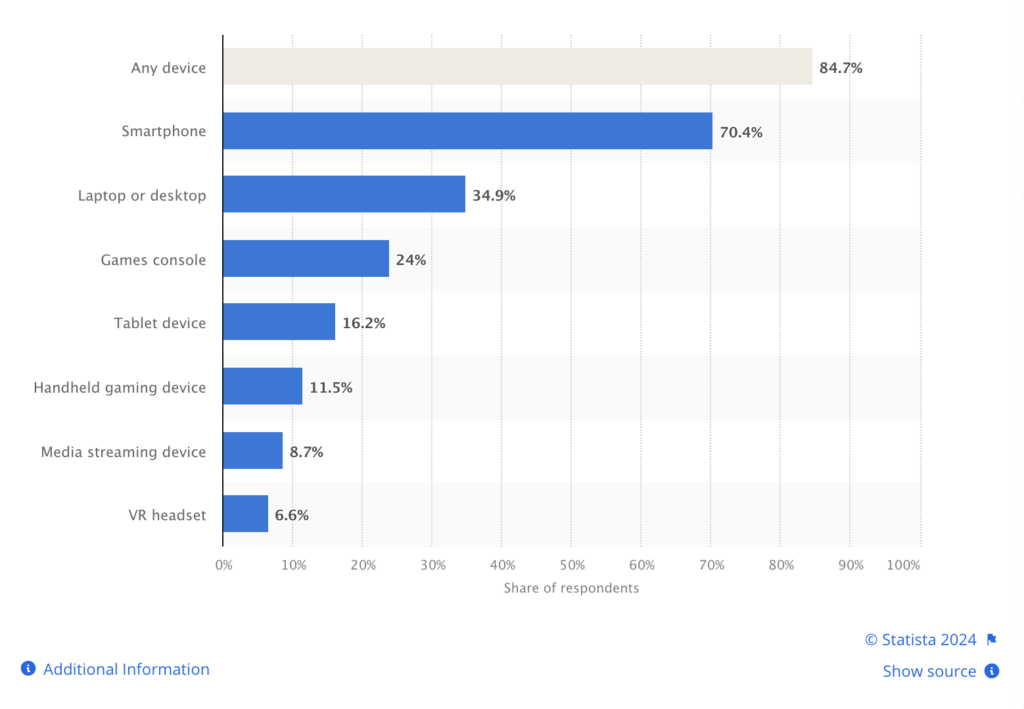
- Global gaming audiences are fragmented — players are spread across PC, console, and mobile ecosystems.
- In 2025, 70% of players prefer games that support cross-play and shared progression.
- With cloud gaming, WebGPU, and 5G, hardware limitations are fading — making cross-platform design a necessity, not a luxury.
Cross-platform game development has gone from a niche idea to a common strategy, powering top games like Fortnite and Genshin Impact. With the right technology, even indie studios can reach a billion screens using a single codebase.
At StudioKrew, we call it “Gaming Without Borders.”
TL;DR:
Cross-platform game development allows studios to build once and release everywhere, creating smooth experiences on iOS, Android, web, PC, and consoles. StudioKrew looks at how unified codebases, AI-driven LiveOps, and multi-device ecosystems are changing gaming in 2025 and beyond.
Let’s define what cross-platform game development really means in practice.
In simple terms, cross-platform game development is the process of creating a single game that runs flawlessly across multiple devices — iOS, Android, Web, PC, and consoles — while delivering a native experience on each platform.
Instead of keeping separate versions of a game, developers now use a unified codebase, which is one set of source code that adapts to each platform’s user interface, input system, and performance needs. This ‘build once, ship everywhere’ approach saves time, cuts costs, and gives players a consistent experience.
At StudioKrew, we specialize in building and optimizing cross-platform games that balance performance, scalability, and creativity. Whether it’s a casual mobile title, an immersive multiplayer experience, or an AAA-grade console game, our engineering and LiveOps teams ensure your game behaves like one seamless ecosystem across devices.
The Philosophy Behind “Build Once, Ship Everywhere”
Traditional workflows treat each platform as its own project, which means unique builds, UI changes, and extra code maintenance.
Cross-platform game development replaces that with a smarter approach:
- Unified Architecture: A shared codebase (common programming code for all devices) controls core logic, gameplay systems, and backend APIs (interfaces that allow software to communicate with back-end servers).
- Platform Adapters: These are software layers that handle device-specific inputs (ways players interact like touch or controllers), graphics settings (how games display visually on various devices), and SDK integrations (connecting with Software Development Kits, or developer tools, provided by platform owners).
- Dynamic Asset Management: The engine automatically loads optimal textures, resolutions, and shaders based on hardware capacity.
- Centralized Backend: One cloud system manages authentication, purchases, and data syncing across all devices.
This method greatly reduces QA time and update cycles, so studios can release updates at the same time on all major platforms.
At StudioKrew, we’ve refined this model into a Cross-Platform LiveOps Framework that simplifies content rollouts, analytics, and event synchronization.
Explore how we handle this under our Online Game Development Company services.
Core Pillars of Cross-Platform Game Development
- Single Codebase, Multi-Target Builds
Using engines like Unity, Unreal Engine, and Godot, we craft games with one shared logic layer.
Custom scripts and compiler directives help create optimized builds for each platform, so there’s no need to rewrite code.
StudioKrew’s Unity specialists use Addressables and Asset Bundles to reduce memory usage and patch sizes across mobile, PC, and console. - Shared Services & Cloud Backends
Authentication, profiles, leaderboards, inventories, and cloud saves all live on a unified backend, so players can switch between devices without losing progress.
This ties directly into our Software Development Company expertise, where APIs and databases are designed for multi-device communication. - Cross-Play and Cross-Progression
Games today are social ecosystems. Cross-play lets users on different platforms compete or work together in the same world. Cross-progression means their achievements, cosmetics, and currencies move with them.
StudioKrew integrates these seamlessly using Photon Fusion, AWS Gamelift, or custom socket backends. - Automated CI/CD and Sim-Ship Releases
Our DevOps pipelines build, test, and deploy games simultaneously across multiple stores — reducing human error and ensuring consistent releases.
This automation not only improves time-to-market but also helps maintain top-tier store ratings with stable, synchronized updates.
Why It’s a Game-Changer for Studios
Cross-platform game development is more than a technical upgrade; it also boosts business growth:
- Wider Market Reach: Publish on multiple devices simultaneously, capturing audiences across regions and age groups.
- Lower Maintenance Costs: A single update applies across all platforms, reducing overhead and post-launch friction.
- Consistent Branding & UX: Unified gameplay and visual fidelity strengthen your studio’s identity.
- Data-Driven Growth: Centralized analytics track user behavior globally, enabling smarter LiveOps and marketing decisions.
- Faster Scaling: With modular builds and shared APIs, scaling to new devices or regions becomes effortless.
In 2025, with cloud gaming, 5G, and AI-assisted optimization, cross-platform games are no longer the exception; they’re the expectation.
And with the right development partner, achieving it can be smoother than you think.
Why Cross-Platform Development Matters (For Studios & Players)
In 2025 and beyond, cross-platform game development has become more than just a convenience — it’s a strategic advantage.
Whether you’re a publisher, a startup, or an established studio, the ability to build once and reach everywhere defines who stays ahead in the global gaming race.
For players, cross-platform gaming removes the barriers between devices. For studios, it opens up new revenue, better retention, and a unified player base, all without increasing development costs.
At StudioKrew, we’ve seen firsthand how launching a single game across multiple platforms creates compounding benefits — both technically and financially.
For Players: Freedom, Flexibility & Friendship
Players don’t think in “platforms” anymore — they think in experiences.
Cross-platform development allows them to start a game on one device and continue on another, creating a frictionless connection between play sessions.
Benefits for players:
- Seamless Continuity
With cross-progression, players can continue right where they left off, whether on console, mobile, or desktop. Their achievements, inventory, and currencies go with them. - Play With Anyone, Anywhere
Cross-play features remove barriers between different player communities.
PC gamers can now face off against mobile users, and console players can team up with their friends on other devices.
This leads to stronger engagement, more active lobbies, and longer-lasting games. - Equal Experience, Unique Optimization
With dynamic scaling, adaptive controls, and device-aware user experience, each platform feels natural to the player.
StudioKrew ensures this by implementing platform-tuned shaders, UI layouts, and input systems in each build.
At StudioKrew, our Online Game Development Company team focuses on player parity, making sure every version is fair, stable, and consistent in features.
For Studios & Publishers: Scalability Meets Profitability
For developers and publishers, multi-platform game development is attractive because it scales easily. One codebase supports many storefronts and audiences, maximizing ROI and reach.
1. Wider Market Reach
Launching simultaneously on iOS, Android, Web, PC, and consoles exposes your game to millions of new players from day one.
This unified approach allows studios to amplify discovery, increase organic installs, and build larger communities faster.
Example: A multiplayer strategy game we delivered at StudioKrew gained 3x faster adoption after launching its mobile and PC versions under a shared backend and account system.
2. Reduced Development & Maintenance Costs
Cross-platform pipelines minimize redundant coding, QA, and patch management.
A single update, whether it’s a new event, feature, or bug fix, can be rolled out to all devices at once, cutting operational costs by up to 40%.
3. Unified Analytics & LiveOps
Data-driven insights power modern LiveOps.
With a centralized backend, your team can track player behavior, retention curves, and in-app performance across platforms — enabling personalized offers, targeted events, and A/B tests that actually scale.
If you’re building games with ongoing content cycles or LiveOps-driven economies, our Game Development Services include integrated dashboards for real-time event scheduling, reward automation, and server-side configuration.
4. Better Player Retention & Community Growth
Cross-platform communities are larger and more active.
As matchmaking pools grow, queue times get shorter, which improves gameplay satisfaction and retention rates.
According to a 2025 Newzoo Insight Report, games that support cross-play show 27% higher long-term engagement and 31% stronger monetization stability.
This is the kind of steady growth every publisher wants.
StudioKrew Insight: “One Game, Infinite Reach”
At StudioKrew, we treat every project as a multi-platform opportunity from the start.
Whether we’re designing a hyper-casual mobile game or an AAA multiplayer title, we architect scalable systems that can effortlessly expand to new devices or regions.
We handle:
- Multi-store release pipelines (Google Play, App Store, Steam, Epic, Console Stores)
- Cloud-sync player profiles with real-time telemetry
- Multi-device leaderboards and ranking systems
- Cross-platform matchmaking powered by Photon Fusion, Socket.IO, or PlayFab
See how we do this on our Hire Game Developers page, where we explain how the right technical foundation can help your game grow from a local launch to global success.
Challenges in Cross-Platform Game Development (and How to Overcome Them)
Cross-platform game development offers great reach and efficiency, but creating a smooth experience can be challenging.
Each platform—mobile, web, PC, or console—has its own hardware quirks, store rules, and user expectations. For most teams, the main challenge is keeping things consistent without losing performance or delaying the launch.
At StudioKrew, we know that success comes from planning for portability, performance, and parity from the beginning. Here are the most common challenges and how our experts solve them.
1. Input & Control Parity
The challenge:
Touchscreens, controllers, keyboards, and VR gestures all demand different interaction logic. A mechanic that feels intuitive on a joystick might frustrate mobile players.
Our solution:
We build an Input Abstraction Layer that detects the device type and dynamically maps inputs.
- On mobile: adaptive joystick UI with aim assist and touch sensitivity curves.
- On console: fine-tuned dead zones and haptic feedback integration.
- On PC: fully re-bindable keys and precision-based targeting.
This ensures every player enjoys a native-feeling control experience, no matter their platform.
Explore this design approach further on our Game Development Services page.
2. Performance Optimization Across Devices
The challenge:
Mobile devices have limited memory and GPU power, while PC and consoles require high-fidelity graphics.
Balancing both without separate builds can quickly spiral into complexity.
Our solution:
StudioKrew employs dynamic asset tiering, shader LODs, and device-specific compression pipelines (ASTC, ETC2, BC7).
We also use:
- Unity Addressables / Unreal Asset Chunks for incremental content delivery.
- Real-time performance profiling via internal telemetry dashboards.
- Adaptive resolution scaling for older devices.
The result is smooth 60 FPS gameplay on all types of hardware and, on average, 40% smaller build sizes.
Related insight: Our Software Development Company vertical applies similar optimization logic for enterprise apps, proving scalability beyond games.
3. Networking & Synchronization
The challenge:
Different platforms handle latency, packet loss, and matchmaking differently.
If not carefully engineered, cross-play can lead to unfair gameplay or desync issues between players.
Our solution:
We integrate rollback netcode, client-side prediction, and edge-based relay routing using technologies such as Photon Fusion, Quantum, Nakam, PlayFab Multiplayer Servers, and custom Socket.IO frameworks.
This approach ensures:
- Consistent state synchronization across devices.
- Regional routing for fair ping distribution.
- Secure session management with JWT-based validation.
These systems are stress-tested in our internal LiveOps sandbox, ensuring competitive fairness even at scale.
Learn more on our Online Game Development Company page.
4. Platform Compliance & Store Certification
The challenge:
Each store (App Store, Play, Steam, PlayStation, Xbox, Switch) enforces unique Technical Requirements Checklists (TRCs/TCRs), SDK versions, and privacy mandates. Failing to do so can delay or block your launch.
Our solution:
StudioKrew’s CI/CD pipeline includes automated pre-flight validation that scans builds for compliance errors before submission.
- Metadata checks (icons, privacy, localization).
- API version alignment and dependency management.
- Automated screenshots and package signing.
This helps prevent mistakes and keeps releases consistent across all stores.
5. Monetization & Cross-Store Entitlements
The challenge:
Purchases made on one platform often don’t carry over to another, causing player dissatisfaction and revenue fragmentation.
Our solution:
We design a platform-agnostic wallet backed by a unified entitlement service.
All purchases are verified via each platform’s receipt system, then mirrored to the player’s global profile.
This guarantees fairness, prevents double-spending, and keeps monetization compliant with App Store, Google Play, and console policies.
6. Multi-Device QA & Automated Testing
The challenge:
Testing across so many devices can overwhelm QA budgets.
Manual verification is slow and prone to inconsistency.
Our solution:
Our QA automation framework runs cloud-based device-farm tests covering hundreds of hardware variations simultaneously.
Paired with continuous integration, every update triggers regression checks for gameplay logic, UI scaling, and performance budgets — ensuring stability before deployment.
7. Data Privacy & Security Compliance
The challenge:
Cross-platform titles must respect regional data laws (GDPR, COPPA, etc.) while maintaining shared databases.
Our solution:
We isolate personal data through region-based partitioning, encrypt at rest and in transit, and maintain tokenized session management across all endpoints.
This protects player trust and also helps publishers get approvals more easily in the EU and MENA regions.
StudioKrew’s Proven Framework: “Build Smart, Scale Everywhere”
Our process is not just about fixing problems; it’s about spotting them early.
By building cross-platform architecture from the start, we make QA cycles shorter, cut costs, and prepare games for cloud gaming, WebGPU, and 5G.
From Unity and Unreal to Photon and AWS, we deliver battle-tested pipelines that allow our partners to scale globally with confidence.
Best Engines & Frameworks for Cross-Platform Game Development
Choosing the right game engine is one of the most critical decisions in cross-platform game development. It determines not only your game’s visual fidelity and performance but also how efficiently you can deploy across platforms such as iOS, Android, the Web, PC, and Consoles.
At StudioKrew, we don’t just select an engine — we strategically align it with the project’s vision, target audience, and monetization goals. Our team has extensive experience in Unity, Unreal Engine, Godot, and Cocos, giving us the flexibility to deliver the perfect balance between creative freedom and technical scalability.
Unity – The All-Rounder for Cross-Platform Excellence
When it comes to multi-platform game development, Unity Engine remains the industry leader.
Unity’s small build sizes, large plugin library, and real-time rendering let developers build once and release everywhere, from mobile to consoles and even AR/VR.
Why Unity Shines
- Platform Reach: Supports 25+ platforms, including iOS, Android, Windows, macOS, WebGL, PlayStation, and Xbox.
- Extensive Ecosystem: Unity Asset Store, third-party SDKs, and cloud build tools accelerate development.
- Performance Optimization: Addressables, Burst Compiler, DOTS, and URP/HDRP pipelines ensure balanced performance.
- Cross-Platform LiveOps: Integrated analytics, ad networks, and in-app purchase APIs for unified monetization.
StudioKrew Insight
Our Unity developers, under our Unity Game Development Services, specialize in optimizing games with Addressables and Adaptive Quality Management, reducing update sizes by up to 35% and improving mobile frame rates by 20%.
Whether you’re making multiplayer games or casual mobile titles, Unity gives you the flexibility, scalability, and cost savings to deliver results quickly.
Discover more about our Unity-based projects at Hire Game Developers.
Unreal Engine – The Powerhouse for AAA & Realistic Worlds
When visual fidelity, cinematic quality, and raw power are the goal, Unreal Engine is unmatched.
It’s the preferred choice for AAA games, 3D simulations, and real-time environments requiring cutting-edge detail.
Why Unreal Excels
- Photorealistic Rendering: Nanite and Lumen enable lifelike detail with real-time global illumination.
- Blueprint System: Visual scripting for faster prototyping and iteration.
- High-End Multiplayer: Native replication tools, NetDriver, and scalable session management.
- Cross-Platform Strength: Works on PC, console, mobile, VR, and now supports WebAssembly with Unreal’s new web exporters.
StudioKrew Insight
Our Unreal Engine development service team has delivered projects with up to 4K real-time rendering, optimized physics simulations, and seamless cross-platform gameplay.
We particularly recommend Unreal for genres like:
- FPS and racing games,
- Action RPGs,
- Large-scale multiplayer simulations.
See how our AAA Game Development Company leverages Unreal to deliver blockbuster-grade experiences.
Godot – The Open-Source Marvel
For teams that value open-source flexibility, modularity, and lightweight builds, Godot is an increasingly powerful option.
It’s perfect for 2D and 2.5D projects, mobile-first titles, and educational or indie projects where performance and cost efficiency are top priorities.
Why Godot Works
- Lightweight Builds: Small footprint ideal for mobile and web games.
- Customizable Engine: Access to the core source code allows deep optimization.
- Node-Based Scene System: Simplifies development and modular design.
- Web Export Support: HTML5/WebAssembly integration for browser-based play.
StudioKrew Insight
Our team under Godot development services uses this engine for fast prototyping and lean cross-platform deployment.
For startups, indie studios, or educational platforms, Godot provides freedom without heavy licensing costs, making it a smart long-term investment.
Cocos (Cocos2d-x / Cocos Creator) – The Mobile Champion
Cocos is a powerhouse for 2D mobile game development and hyper-casual titles.
It delivers native performance with minimal overhead, making it ideal for projects targeting massive mobile audiences in regions such as India, MENA, and Southeast Asia.
Why Cocos Excels
- Native Rendering Engine: Built in C++ for near-zero latency and optimized frame times.
- Cross-Platform APIs: Seamless deployment across Android, iOS, and WebView.
- Perfect for Casual Titles: Minimal resource usage, quick loading, and rapid monetization integration.
- Open Source: Fully customizable and free to use.
StudioKrew Insight
We’ve used Cocos for multiple lightweight multiplayer games, achieving APK sizes under 50MB while maintaining excellent performance and retention metrics.
For clients prioritizing speed-to-market and scalability, Cocos remains one of the smartest choices.
Learn more about our lightweight mobile projects at the Mobile Game Development Company page.
Choosing the Right Engine – StudioKrew’s Evaluation Framework
At StudioKrew, engine selection isn’t guesswork — it’s guided by our “4C Framework”:
| Criterion | Focus | Example Engine |
| Content Type | 2D, 3D, AR/VR, or Web | Unity / Unreal / Godot |
| Complexity & Scale | Indie, Midcore, or AAA | Cocos / Unity / Unreal |
| Community Support & Licensing | Ecosystem maturity, plugin availability | Unity / Godot |
| Cross-Platform Performance | Build efficiency, optimization, and portability | Unity / Unreal |
This analytical approach ensures we pick an engine that matches budget, timeline, and long-term scalability — not just the hype.
Need help identifying the best engine for your game idea? Visit our Hire Game Developers page and let our experts guide your technical strategy.
StudioKrew’s Approach to Cross-Platform Game Development
At StudioKrew, we believe that cross-platform success isn’t accidental — it’s engineered.
Our development philosophy is built on a simple idea: create once, adapt intelligently, and scale infinitely.
With over a decade of experience in game design, engineering, and LiveOps, we’ve refined a framework that blends creative innovation, technical precision, and business strategy — ensuring your game performs flawlessly across iOS, Android, Web, PC, and consoles.
Our 6-Stage Cross-Platform Development Pipeline
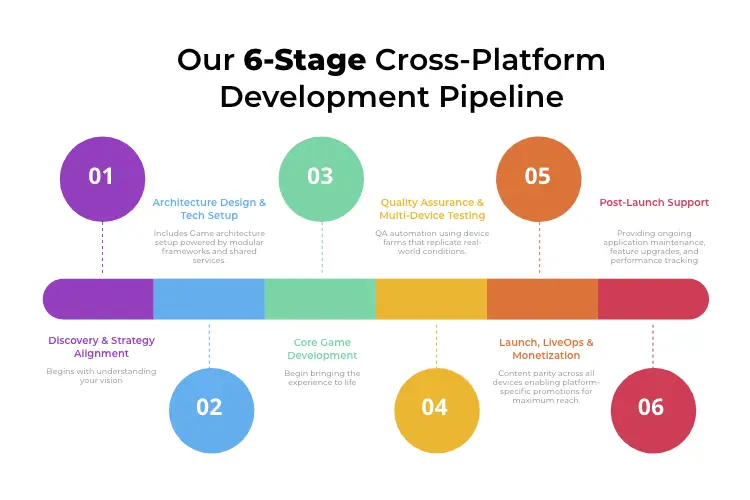
1. Discovery & Strategy Alignment
Every great game begins with understanding your vision.
We conduct deep-dive workshops to define:
- Core game mechanics
- Monetization strategy
- Target platforms and regions
- Scalability roadmap
Our product and design leads collaborate with clients to outline a cross-platform architecture blueprint that details feature priorities, performance targets, and backend integrations.
Explore how our planning process mirrors best practices from our Game Development Services.
2. Architecture Design & Tech Stack Setup
We design a platform-agnostic architecture powered by modular frameworks and shared services.
Depending on the project scope, we use:
- Unity / Unreal Engine / Godot for gameplay and rendering.
- Node.js, Photon Fusion, or AWS GameLift for multiplayer and backend logic.
- Redis / DynamoDB / MongoDB for data persistence and performance.
- CI/CD pipelines for automated multi-store builds.
This phase ensures your game can scale efficiently — with cross-play and cross-progression built right from the start.
Our backend and API engineering practices are detailed under the Software Development Company.
3. Core Game Development
Once architecture is locked, our cross-functional teams — game designers, artists, and engineers — begin bringing the experience to life.
Key highlights of this phase:
- Unified codebase: shared gameplay logic and assets.
- Platform adapters: handling input variations, device resolutions, and UI layouts.
- Optimized rendering paths: URP/HDRP (Unity) or Nanite/Lumen (Unreal).
- Performance tuning: dynamic asset loading, LOD systems, and shader optimization.
Our in-house testing tools benchmark each build across device categories, ensuring steady frame rates and zero memory leaks.
4. Quality Assurance & Multi-Device Testing
We conduct QA automation using device farms that replicate real-world conditions — from low-end Android phones to next-gen consoles.
- Automated test scripts verify FPS, memory usage, and UI consistency.
- Regression and compliance testing ensure stability before submission.
- Store certification pre-checks guarantee smooth approvals across Google Play, App Store, Steam, and consoles.
This rigorous testing process allows us to reduce QA cycles by up to 30% while maintaining unmatched stability.
5. Launch, LiveOps & Monetization Integration
A game’s success doesn’t end at launch — it evolves with the community.
Our LiveOps and monetization layer includes:
- Event scheduling and A/B testing.
- Cross-platform in-app purchases and virtual economy management.
- Server-driven configurations for dynamic balancing.
- Integration with ads, analytics, and CRM tools.
We maintain content parity across all devices while enabling platform-specific promotions for maximum reach.
Learn how we run continuous LiveOps on our Game LiveOps and Monetization Service Company page.
6. Post-Launch Support & Continuous Optimization
StudioKrew doesn’t disappear after deployment.
We provide ongoing application maintenance, feature upgrades, and performance tracking.
Our analytics-driven approach allows us to:
- Optimize retention through behavioral insights.
- Launch new modes and seasonal events.
- Adapt monetization models as markets evolve.
For long-term success, we maintain your cross-platform game as a living ecosystem, supported by data-backed decisions and timely updates.
For full-cycle lifecycle management, explore our Application Maintenance and Support services.
StudioKrew’s Core Principles for Cross-Platform Success
| Principle | Description |
| Unified Vision | Every team — from art to backend — aligns on a single cross-platform goal. |
| Performance Discipline | We treat optimization as part of design, not an afterthought. |
| Automation First | CI/CD, analytics, and QA are automated to minimize errors. |
| Data-Driven Decisions | Post-launch adjustments are guided by telemetry, not guesswork. |
| Player Parity | Every platform offers equal content, fairness, and fun. |
Why Clients Choose StudioKrew
- End-to-End Expertise: From prototyping to LiveOps, everything is handled in-house.
- 10+ Years of Experience: Proven across 2D, 3D, AAA, and multiplayer genres.
- Global Reach: Serving clients in the USA, UK, UAE, and Europe.
- Cross-Functional Excellence: UI/UX, backend, analytics, and monetization under one roof.
- Future-Ready Solutions: Designed for 5G, Cloud Gaming, and XR expansion.
Ready to bring your game to every screen? Connect with our experts via Hire Game Developers.
The Business Edge – Monetization & LiveOps Across Platforms
Cross-platform success isn’t just about reach — it’s about sustainable revenue and player retention.
Once your game runs seamlessly on every device, the real question becomes:
How do you monetize fairly and keep players engaged long after launch?
That’s where LiveOps and cross-platform monetization strategies take center stage.
At StudioKrew, we build more than games — we build ecosystems.
Our monetization and LiveOps frameworks ensure your title not only launches strongly but continues to thrive through data-driven engagement and event cycles that resonate across mobile, PC, console, and web audiences.

Unified Monetization Across Devices
Players today switch between platforms constantly — and they expect their purchases, progress, and rewards to follow.
That means your monetization must be synchronized and compliant, not fragmented by platform policies.
StudioKrew’s Approach:
- Cross-Store Entitlement System: We create a platform-agnostic wallet backed by secure backend APIs that verify in-app purchases across all stores (App Store, Play, Steam, and consoles).
- Unified Virtual Economy: Player balances, currencies, and inventories remain consistent across devices — preventing redundancy and improving trust.
- Dynamic Pricing Models: Our analytics tools adapt pricing based on player region, platform, and in-game behavior.
This ensures fair monetization and reduces churn due to inconsistent in-app experiences.
Discover how we build these ecosystems under our Online Game Development Company services.
Smart LiveOps: Keeping Games Alive, Engaging, and Profitable
LiveOps (Live Operations) is where a good game becomes a long-term business.
It involves continuous updates, community events, challenges, and limited-time content that keep players emotionally invested and engaged in the game.
Our LiveOps Toolkit:
- Centralized Control Panel: Real-time content management for events, offers, and server-side updates — no rebuilds required.
- Behavioral Segmentation: Targeted campaigns and rewards for specific cohorts (new players, high-spenders, inactive users).
- Event Scheduling & Automation: Sync live events globally, adjusting to time zones and platform availability.
- Dynamic Rewards & A/B Testing: Optimize engagement by testing reward structures, drop rates, and event pacing.
- Cross-Platform Parity: Ensure fairness between platforms — mobile and PC users receive equivalent experiences and opportunities.
With this system, our partners have reported up to 28% higher ARPDAU and 35% improvement in day-30 retention.
We apply the same principles across our Game Development Services to ensure longevity and profitability from day one.
Integrating Ads, Subscriptions & Battle Passes
Monetization is not one-size-fits-all. Different genres and audiences demand tailored approaches.
At StudioKrew, we integrate multi-layer monetization systems that respect gameplay balance while maximizing revenue opportunities.
Recommended Models:
- Ad-Driven Revenue: Rewarded video and interstitial ads for casual and hyper-casual titles.
- Battle Pass Systems: Seasonal unlocks that create engagement loops while maintaining fairness.
- Subscription Models: For long-term users who value exclusivity and premium experiences.
- IAP Bundles & Microtransactions: Optimized store presentation and psychological pricing to boost conversion.
We design these systems with compliance-first logic, ensuring they meet global standards (GDPR, COPPA, App Store Guidelines, and console restrictions).
See similar work in our Custom Game Development Company projects.
Data-Driven LiveOps Optimization
Numbers tell the real story.
StudioKrew’s LiveOps architecture integrates advanced analytics dashboards that visualize every KPI in real time:
- DAU/MAU Growth Trends
- Retention and Churn Rates
- In-App Purchase Behavior
- Event ROI and Engagement Metrics
- Cross-Platform Economy Health
By aligning game telemetry with user sentiment data, we can predict engagement dips and preemptively deploy events or content drops to re-engage users.
We also apply AI-assisted LiveOps forecasting, which analyzes patterns to auto-suggest event timing, reward types, and pricing adjustments — ensuring continuous optimization even post-launch. Check out our Game LiveOps service page to learn more about the same.
StudioKrew Case Insight
A recent project (name under NDA) — a multiplayer trivia game launched on mobile, Smart TV, and web — achieved:
- +52% increase in player lifetime value (LTV) within 90 days.
- 3.4x growth in ARPDAU due to synchronized battle pass and event scheduling.
- 40% lower churn after implementing AI-based reward segmentation.
This success came from unifying content cadence across platforms — a hallmark of StudioKrew’s LiveOps excellence.
Why StudioKrew Leads in Cross-Platform Monetization
| Core Strength | StudioKrew Advantage |
| Unified Wallet Systems | One player, one balance across platforms. |
| LiveOps Automation | Real-time event and reward control from a centralized panel. |
| Economy Balancing | Dynamic adjustment of currencies, items, and offers. |
| Predictive Analytics | AI-driven insights for revenue optimization. |
| Global Compliance | Adherence to international store and data privacy regulations. |
StudioKrew’s cross-platform LiveOps management doesn’t just boost short-term monetization — it builds long-term brand loyalty, ensuring your game remains profitable, scalable, and relevant for years to come.
Ready to integrate smart monetization into your next title? Connect with our experts at Hire Game Developers.
The Future of Cross-Platform Gaming
As technology, networks, and devices evolve, cross-platform gaming is entering a new era — one where boundaries between hardware, players, and ecosystems will disappear entirely.
In the coming years, Cloud Gaming, WebGPU, AI-driven LiveOps, and 5G will redefine how players experience games, making “one game, infinite platforms” not just a concept but the new global standard.
At StudioKrew, we’re already building the foundations for that future. From AI-powered development pipelines to streaming-ready game architectures, our goal is to help studios, startups, and publishers stay ahead of this transformation.
1. Cloud Gaming: Hardware No Longer Matters
Cloud technology is eliminating one of gaming’s biggest barriers — device dependency.
Services like NVIDIA GeForce Now, Xbox Cloud, and Google Cloud Streaming are proving that AAA-quality gameplay can run on any screen, from a low-end smartphone to a smart TV.
StudioKrew’s Vision:
We’re integrating cloud-compatible architectures in every new cross-platform project — designing games that scale dynamically with streaming servers and low-latency backend protocols.
This ensures that whether your players are on mobile data or fiber broadband, they experience smooth gameplay, near-zero lag, and instant access.
Explore our approach to streaming-ready projects at Online Game Development Company.
2. 5G & Edge Computing: Ultra-Low Latency, Real-Time Experiences
The global rollout of 5G networks and edge computing infrastructure is revolutionizing how multiplayer and LiveOps systems function.
5G’s low latency (<10ms) and high bandwidth enable near-instant response times — crucial for real-time multiplayer, AR/VR, and cloud-synced gameplay.
StudioKrew’s Implementation:
- Edge-based matchmaking to connect players to their nearest data center.
- Adaptive streaming protocols that adjust frame rates and resolutions per connection quality.
- Real-time data capture for dynamic balancing and event updates.
This combination is already shaping next-generation multiplayer experiences that feel faster, fairer, and more immersive — no matter where you play.
3. AI-Driven Game Development & LiveOps
The rise of AI-native game development platforms marks the next major shift.
From AI-assisted coding to player behavior forecasting, artificial intelligence is becoming an active collaborator at every stage of development.
StudioKrew’s Approach:
We use AI not only for development acceleration but also for LiveOps intelligence:
- Predicting churn and engagement spikes using ML-based behavioral models.
- Automatically adjusting difficulty, event timing, and in-game offers.
- Personalized player journeys — dynamic storylines or challenges driven by AI learning loops.
These systems make games adaptive, personalized, and sustainable — improving both player satisfaction and studio profitability.
Learn how we’re integrating AI into development and analytics under the Software Development Company.
4. AR, VR & Mixed Reality Integration
Cross-platform isn’t just about screen types anymore — it’s expanding into immersive dimensions.
With ARKit, ARCore, and headsets like Meta Quest and Apple Vision Pro, the line between physical and digital worlds is blurring.
StudioKrew’s Future Roadmap:
Our Mixed Reality Game Development Company vertical focuses on hybrid experiences that work seamlessly across AR, VR, and flat-screen devices.
Imagine a racing game that you can play on your phone in AR mode — then continue on your PC in full 3D, all with the same progress and data continuity.
That’s the future StudioKrew is actively building.
Learn how we’re integrating native AR libraries like ARKit for iOS and ARCore for Android development services under the AR VR Game Development Company.
5. WebGPU & WebAssembly: The Browser Becomes a Console
The future of instant-play games lies in the browser — and WebGPU and WebAssembly (WASM) are leading that charge.
They bring console-level performance directly to the web, removing download barriers and improving accessibility.
We’re developing engines and toolchains optimized for WebGL → WebGPU transitions, allowing our clients to:
- Launch instantly from ads, websites, or social links.
- Support cross-progression between web and app clients.
- Achieve near-native performance on Chrome, Safari, and Edge.
This not only enhances reach but also opens new marketing channels — where discovery and engagement happen instantly.
The Next Era: One Game, Infinite Platforms
In the near future, the distinctions between platforms will fade entirely.
Players will move fluidly between mobile, console, web, AR, and cloud, with their progress, friends, and rewards following them wherever they go.
For developers, this means one thing: adapt or be left behind.
And for those ready to innovate, cross-platform universes offer limitless potential — both creatively and commercially.
At StudioKrew, we’re not just adapting to this shift — we’re driving it.
By combining AI, cloud scalability, and real-time analytics, we’re crafting gaming experiences that evolve alongside technology itself.
The future is cross-platform, intelligent, and inclusive.
Partner with StudioKrew to build your next-generation game today — visit Hire Game Developers.
Why Choose StudioKrew for Cross-Platform Game Development
Behind every successful cross-platform title lies a team that knows how to balance art, engineering, and player psychology.
At StudioKrew, that’s exactly what we do.
For over a decade, we’ve been helping startups, publishers, and enterprises transform game ideas into scalable, high-performing, multi-platform ecosystems.
From real-time multiplayer to immersive AAA experiences, our team blends cutting-edge technology, robust infrastructure, and player-first design to make games that transcend devices — and expectations.
1. A Decade of Cross-Platform Expertise
StudioKrew isn’t new to this space — we’ve been building cross-device experiences long before “cross-platform” became a buzzword.
Our portfolio spans:
- Multiplayer games connecting Android, iOS, and Smart TV users.
- Console-grade titles adapted for mobile and web audiences.
- Cloud-ready architectures designed for instant play and global scalability.
Our developers are certified in Unity, Unreal Engine, Godot, and Cocos, with specialized expertise in optimizing performance across every hardware class.
Learn more about our core capabilities at Game Development Services.
2. Full-Cycle Development — From Concept to LiveOps
We manage the entire lifecycle of your game, ensuring consistency and quality at every stage:
- Ideation & Market Research – understanding your genre, audience, and monetization fit.
- Design & Prototyping – UI/UX, gameplay loops, and engagement systems.
- Engineering & Deployment – single codebase optimized for multiple platforms.
- QA Automation & Certification – ensuring compliance and stability across all stores.
- Monetization & LiveOps – synchronized content updates and cross-platform economies.
This end-to-end structure means you get one accountable partner from blueprint to growth.
See how we scale games from the time of Game Concept to post-launch under Full Cycle Game Development Services.
3. Technology That Scales, Experiences That Last
We use proven technologies to deliver high-performance and resilient games:
- Engines: Unity, Unreal, Godot, Cocos.
- Backends: Node.js, Photon Fusion, AWS, Redis, MongoDB.
- Analytics & Monetization: Firebase, PlayFab, AppsFlyer, custom dashboards.
- DevOps: CI/CD automation with Jenkins, GitHub Actions, and device-farm testing.
By combining this stack with our proprietary optimization framework, StudioKrew ensures your game runs at peak performance across all devices — with build size reduced by up to 40% and load time improved by up to 25%.
4. Global Delivery, Local Understanding
With operations across India, UAE, USA, and UK, StudioKrew understands both global scale and local market nuances.
We tailor each game’s UI, monetization, and LiveOps cadence for regional audiences — helping publishers:
- Maximize user engagement.
- Localize payments and offers.
- Expand faster into new territories.
Our approach across regions helps clients get faster adoption and better revenue when launching in multiple markets.
Explore how we tailor solutions for different geographies at our Gaming Studio.
5. Data-Driven Decisions, Player-Centric Results
Our analytics-driven development ensures that every update, event, and offer is guided by player data, not assumptions.
We integrate real-time dashboards and AI-based retention modeling, allowing publishers to:
- Track player sentiment and churn risk.
- Optimize content cadence and difficulty.
- Increase ARPDAU, LTV, and retention predictability.
Great games aren’t just made once; they’re improved over time using real insights.
6. Transparent Partnership Model
We don’t just do one-time projects. We build lasting partnerships.
Every StudioKrew collaboration includes:
- Clear milestones and transparent reporting.
- Direct access to project managers and developers.
- Post-launch optimization and tech support.
- 100% IP ownership for clients.
Our clients see us not as vendors but as strategic allies who care as much about player delight as about business ROI.
Looking for a long-term partner? Let’s talk — Hire Game Developers.
StudioKrew in Numbers
| Metric | Value |
| Years of Experience | 12+ |
| Platforms Covered | iOS, Android, Web, PC, Console, OTT |
| Avg. Performance Gain | +30% across multi-platform benchmarks |
| Global Deliveries | 200+ game projects |
| Client Retention | 90% repeat business |
7. The StudioKrew Promise
When you partner with StudioKrew, you’re not just hiring a game studio — you’re gaining a technology partner committed to your success.
We promise to deliver:
- Native-grade performance across all devices.
- Faster time-to-market through automation and CI/CD.
- Data-backed LiveOps strategies for sustained engagement.
- Compliance and security assurance for every store and region.
Ready to bring your game vision to every screen?
Connect with us today — Hire Cross-Platform Game Developers.
Conclusion: One Code, Infinite Worlds
The gaming world is no longer split by devices; it’s brought together by shared experiences.
In this new era, players expect continuity, studios demand scalability, and the most successful games seamlessly connect every platform and every player.
That’s the promise and the power of cross-platform game development.
By following a ‘build once, ship everywhere’ approach, studios can create games that feel right on every device and work as one connected world. To achieve this, you need a partner who understands both the technology and the business side of gaming.
At StudioKrew, we make that happen.
Our approach combines:
- Unified architectures for multi-platform scalability.
- Performance-first engineering across Unity, Unreal, and Godot.
- Cross-platform monetization and LiveOps frameworks built to grow your audience.
- Global delivery experience with deep domain expertise in gaming, cloud, and interactive entertainment.
The future of gaming isn’t about just one device; it’s about every device.
StudioKrew is here to help your game stand out on every platform.
Take the Next Step
Are you ready to break the platform barrier?
Partner with a studio that combines creativity, engineering, and LiveOps expertise to build the next big global game.
Start your cross-platform journey today:
Hire Cross-Platform Game Developers or Explore Game Development Services






 INDIA
INDIA CANADA
 USA
USA UAE
UAE