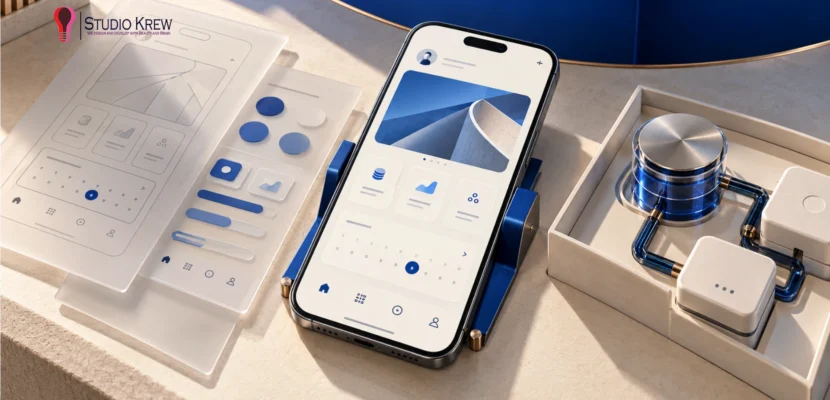
A mobile app development company turns a product idea into a working iOS or Android app, from discovery and design through development, QA, store launch, and maintenance. Realistic app development company cost in 2026: tightly scoped builds from $10,000, most apps between $20,000 and $80,000, and complex multi-platform products from $80,000 to $150,000 or more. Realistic timeline: eight to twelve weeks for a small first release, three to nine months for most products. This guide explains what mobile app development services include, what they cost by region, and how to hire a mobile app development company without regretting it.
We have been doing this work at StudioKrew since 2013, with more than 250 apps and software products delivered, so the advice below comes from projects that shipped, stalled, and occasionally had to be rescued. Our mobile app development company page lists what we build and how we price it. Everything else here applies whether you work with us or with someone else.
What a mobile app development company does, stage by stage
When a founder asks us what an app development company actually delivers, we start with the stages, because the gaps between vendors hide in the stages they skip.
Discovery
Discovery is where someone with product and engineering experience interrogates the idea before anyone writes code. It produces a prioritized feature list, user flows, a technical approach, and a budget range that means something. Done well, it takes one to three weeks. Skipped, it tends to reappear in month four as a rebuild.
UX and UI design
UX covers how the app is structured and how people move through it. UI covers how it looks. A competent team delivers wireframes first, then a clickable prototype, then final screens with a component library the developers can build from. Expect two to six weeks depending on screen count.
Development
The longest stage and the one buyers understand best. Engineers build the iOS and Android apps in two-week sprints, with demo builds you can install on your own phone at the end of each. If you don’t see working builds by week four or five, something is wrong.
Backend and APIs
Almost every useful app needs a server side: user accounts, data storage, payments, notifications, admin tools. The backend is where most of the engineering risk sits, and it is routinely underestimated in quotes from vendors who only think in screens. We come back to this in the evaluation section.
QA
Quality assurance means testing on real devices across OS versions, automated coverage for critical flows, performance testing, and a security review before launch. A team that says “our developers test their own code” is describing the absence of QA.
Store launch
Launching involves developer accounts, store listings, screenshots, privacy disclosures, age ratings, and compliance with platform rules that change every year. Apple’s upcoming requirements page confirms that as of April 28, 2026, every app uploaded to App Store Connect must be built with Xcode 26 using the iOS 26 SDK or later. On the Android side, Google Play’s target API policy requires new apps and updates to target Android 16 (API level 36) or higher, and existing apps must target at least Android 15 to stay visible to new users on newer devices. Google is also rolling out developer identity verification for all apps on certified Android devices, which Android Authority reports went live in Brazil, Indonesia, Singapore, and Thailand in September 2026 ahead of a global rollout in 2027. Your development partner should handle all of this without being asked.
Maintenance and growth
Apps are not finished at launch. OS updates break things, libraries get deprecated, and the store requirements above arrive annually. A healthy maintenance arrangement covers monitoring, bug fixes, dependency updates, and a feature roadmap, typically priced at 15 to 20 percent of the build cost per year.
Types of app development companies
“App development company” covers very different businesses. The right type depends on budget, how much management you can take on, and how much the app matters to your core business.
| Type | Typical cost | Risk profile | Best fit |
|---|---|---|---|
| Full-service agency | Mid to high; project or retainer | Low to medium. Covers every stage in-house, so fewer handoffs. Risk sits in overhead and whether senior people stay on your project after the sale. | Companies that want one accountable partner from idea to maintenance. |
| Product studio | Mid to high; often milestone-based | Medium. Strong on strategy and design, sometimes thinner on backend scale and long-term support. | Startups building a first product who need product thinking as much as code. |
| Platform specialist | Mid to high for the specialty | Medium. Deep on one platform or stack, weaker outside it. | Teams that already know their platform and need expert execution on it. |
| Offshore team | Low to mid; usually hourly or dedicated-team | Medium to high without strong process. Time zones and communication quality decide the outcome. | Budget-constrained builds with an experienced product owner on your side. |
| Freelancers | Lowest hourly, highest coordination cost | High. Single points of failure, no bench, no QA or design unless you assemble them yourself. | Small, well-defined pieces of work, or an MVP you will rebuild. |
Regulated sectors add a layer. A healthcare app needs people who understand clinical workflows and data rules, not just mobile engineers. We staff those projects with in-house medical experts and doctors alongside the engineering team, which is why healthcare app development is a distinct practice for us rather than a line item.
Mobile app development services explained
Here is what each service in a proposal should mean in practice.
Native iOS and Android. Native means separate codebases written in each platform’s own language: Swift and SwiftUI for Apple, Kotlin and Jetpack Compose for Android. It gives the best performance and the earliest access to new OS features. Our iOS app development company and Android app development company pages describe how we approach each platform, and our native app development page covers the combined option.
Cross-platform. One codebase for both stores, usually in Flutter or React Native. The ecosystem has matured: as Shorebird’s 2026 architecture comparison notes, React Native’s New Architecture became the default in version 0.76 and the old bridge has since been removed entirely, while Flutter’s Impeller renderer is now standard on iOS. Our cross-platform app development page goes deeper. We will not re-argue native versus cross-platform here because we have a separate decision guide; the short version is that cross-platform suits most business apps on a budget, and native wins when you need heavy graphics, deep hardware access, or the last few percent of polish.
Backend and cloud. APIs, databases, authentication, file storage, push notifications, and the infrastructure that runs them. This is often the larger half of the engineering effort.
Integrations. Payments, maps, analytics, CRM, ERP, identity providers, wearables, and whatever internal systems your business already runs. Each integration is a small project with its own failure modes.
UX and UI. Research, flows, prototypes, visual design, and a design system that keeps the app consistent as it grows.
QA and security. Manual and automated testing, device coverage, penetration testing for anything that touches money or health data, and secure handling of secrets and user data.
App store optimization. Listing copy, keywords, screenshots, and review management so that the app can be found once it is live.
Maintenance. Everything in the maintenance stage above, on a predictable monthly or annual basis. If your app has fallen behind on these fronts, our app modernization guide explains how to bring it current without starting over.
How much a mobile app development company charges in 2026
You will meet three pricing models. Fixed price suits tightly defined scope and offers budget certainty, but at the cost of flexibility. Time and materials bills hourly against an estimate, which suits evolving products but needs active management. A dedicated team gives you a fixed monthly cost for a named group of people, the right choice once an app becomes an ongoing product. Many engagements mix them: a fixed-price discovery phase, then time and materials for the build.
Here is how our pricing bands map to app types. We publish them because vague “it depends” answers waste everyone’s time.
| App type | Typical cost | Typical timeline |
|---|---|---|
| Tightly scoped single-purpose app or MVP | From $10,000 | 8 to 12 weeks |
| Most business, consumer, and service apps | $20,000 to $80,000 | 3 to 6 months |
| Complex multi-platform products with heavy backend | $80,000 to $150,000+ | 6 to 12 months |
| Developer rates (hourly) | $18 to $55 per hour | Depends on role and seniority |
| Annual maintenance | 15 to 20 percent of build cost | Ongoing |
What moves a project between bands is rarely the number of screens. It is the number of user roles, custom backend logic, third-party integrations, offline support, real-time features, compliance requirements, and whether you need one platform or both. Design ambition matters too; custom motion costs more than a clean standard interface. For a full breakdown with worked examples, see our app development cost guide.
Looking for a mobile app development company?
StudioKrew has delivered 250+ apps and software products since 2013 and publishes its pricing. Tell us what you are building and get a scoped proposal within 48 hours. Start the conversation.
How location affects cost and how to work with a company in your region
Where the people doing the work sit is the biggest driver of hourly rate. The ranges below come from several 2026 rate surveys; they disagree at the edges because each mixes freelancers, agencies, and seniority levels differently, so treat them as a map rather than a price list.
| Region | Typical mid-level rate (USD/hour) | Source |
|---|---|---|
| United States and Canada | $65 to $150+ | 2026 developer-rate survey; ZipRecruiter puts the average employed US mobile developer at about $55 per hour before agency overhead |
| United Kingdom and Western Europe | $50 to $120 | Same survey; a second 2026 survey shows UK senior rates reaching $150 |
| Australia | $60 to $110 | 2026 rates-by-country report |
| Eastern Europe | $25 to $70 | 2026 developer-rate survey |
| India and South Asia | $20 to $55, with seniors to $80 | 2026 survey; a by-country report finds native specialists cost 15 to 25 percent more than cross-platform |
Higher rates buy time-zone overlap, easier contracts, and sometimes stronger regulatory familiarity. Lower rates buy more engineering hours for the same budget, provided both sides have a strong process. The question isn’t which region is best, but what you need to put in place for each.
Buyers in the USA. Working with a mobile app development company in the USA gives you domestic contracts, same-day communication, and no payment friction. Many US-based companies, including ours, run delivery teams overseas and keep account and architecture leadership in the US; ask exactly who sits where before you sign.
Buyers in the UK. A mobile app development company in London will typically contract under English law and work in GMT or BST, with convenient overlap to both North American mornings and South Asian afternoons, which makes blended teams practical.
Buyers in India. Choosing a mobile app development company in India means access to the largest mobile engineering talent pool at the most competitive rates. The variance in quality is wide, so the evaluation checklist in the next section matters more here than anywhere else.
Buyers in Australia. Australian rates sit close to Western European levels. Time zones are the practical issue: an Indian delivery team overlaps well with Australian afternoons, while North American overlap is thin. Agree on standing meeting times before kickoff.
Buyers in Canada. An app development company in Canada offers North American time zones with contracts under Canadian provincial law. Confirm whether pricing is in CAD or USD, and check data residency if your app will store personal information on Canadian users.
Across all five regions, three contract points protect you: a clause confirming you own all code and design assets on payment, a defined acceptance process for each milestone, and a written statement of who is responsible for store compliance after launch.
How to evaluate a mobile app development company
A polished portfolio proves a design team exists. It does not prove the company can ship. These are the checks we would run on ourselves if we were the buyer.
- Apps you can download and test. Install three of their live apps. Check launch speed, crashes, and whether the app has been updated in the last six months.
- Store ratings and review responses. Low ratings on apps they built, or reviews complaining about bugs that never got fixed, tell you about their maintenance practice.
- References you choose. Ask for a client from two years ago, not last month, and ask that client what happened after launch.
- Code ownership and repositories. You should own the code, hold the store accounts, and have repository access from the first sprint.
- Security practices. Ask how secrets are stored, how user data is encrypted, and whether they have shipped anything that passed a third-party penetration test.
- Post-launch support terms. Get the warranty period, the response time for critical bugs, and the maintenance price in writing before the build starts.
Then ask about the backend, because that is where buyers get surprised. One of our solutions architects puts it this way: “The screens are what a client imagines, so they are what gets specified. What rarely gets specified is the decision about where state lives, how the API versions over time, how authentication works across devices, and what happens when a third-party service is down. Those four decisions decide whether the app still works in year three. If a vendor’s proposal has twenty pages on UI and two lines on the backend, you have learned something.”
Ask the vendor to walk you through their proposed architecture in a thirty-minute call. You do not need to follow every detail; you need to see whether they have one.
What the first 90 days of a healthy engagement look like
Weeks one to three: discovery. Workshops, user interviews (if the budget allows), a prioritized backlog, a technical plan, and a budget tested against the plan. We charge for this phase, and we are open about why. Our project lead explains: “A paid discovery phase is the cheapest money a client spends with us. For a few thousand dollars, we find the three features that actually matter, the two integrations nobody mentioned, and the compliance requirement that would have forced a rewrite. A free discovery is a sales conversation. A paid one is engineering.”
Weeks four to seven: design and foundations. Wireframes become prototypes, the backend skeleton and continuous integration pipeline go up, and the first installable build appears, even if it only shows a login screen.
Weeks eight to thirteen: core build. Two-week sprints with a demo at the end of each. You should use the app on your own device, log feedback in a shared tool, and see that feedback addressed in the next sprint. Scope changes are normal; what matters is that each one comes with a stated cost and timeline impact.
Warning signs: demos that are slides rather than builds, a single point of contact who cannot answer technical questions, and invoices that do not match delivered milestones.
How StudioKrew works
StudioKrew was founded in 2013 and has delivered 250+ apps and software products, plus 700+ games. We build native iOS apps in Swift and SwiftUI, native Android apps in Kotlin and Jetpack Compose, and cross-platform apps in Flutter and React Native, along with the backends, APIs, and cloud infrastructure that support them. Clients have included Hyundai, for whom we built an enterprise learning platform serving 1.4 million users, as well as Hero and Panasonic. We staff healthcare projects with our in-house medical experts and doctors.
Our offices are in Chicago and Oakville, Ontario, with delivery teams in New Delhi and Dubai, serving clients across the USA, UK, India, UAE, Australia, and Canada. Pricing is published: tightly scoped builds from $10,000, most apps $20,000 to $80,000, complex multi-platform products $80,000 to $150,000 and up, developers at $18 to $55 per hour, and maintenance at 15 to 20 percent of build cost per year. Every inquiry receives a scoped written proposal within 48 hours.
Get a real proposal, not a sales call
Share your app idea and receive a scoped proposal with timeline and budget within 48 hours, from a team with 250+ apps delivered. Get a Free Proposal
Frequently asked questions
What does a mobile app development company do?
A mobile app development company designs, builds, tests, launches, and maintains iOS and Android apps. A full-service firm handles discovery and planning, UX and UI design, front-end and back-end development, API integrations, quality assurance, app store submission, and ongoing post-launch maintenance.
How much does a mobile app development company charge?
Tightly scoped builds start from $10,000. Most apps cost between $20,000 and $80,000. Complex multi-platform products run from $80,000 to $150,000 or more. Developer rates range from $18 to $55 per hour, and annual maintenance is typically 15 to 20 percent of the original build cost.
How long does it take to build an app with a development company?
A tightly scoped app or MVP usually takes eight to twelve weeks. Most business and consumer apps take three to six months from discovery to store launch. Complex multi-platform products with heavy backend requirements take six to twelve months.
Should I hire an app development company or freelancers?
Freelancers cost less per hour and suit small, well-defined tasks, but you take on coordination, QA, and continuity risk yourself. An app development company costs more but provides design, engineering, testing, and maintenance under one contract with a bench behind each role. For a product your business depends on, a company is usually the safer choice.
What should I look for in a mobile app development company?
Look for live apps you can download and test, healthy store ratings, references from clients two or more years old, written confirmation that you own the code and store accounts, documented security practices, a clear backend and architecture plan, and post-launch support terms agreed before the build starts.





 INDIA
INDIA CANADA
 USA
USA UAE
UAE