
App development cost in the USA in 2026 runs from $10,000 for a focused MVP to $150,000 and beyond for enterprise builds, and most serious first versions we quote land between $20,000 and $80,000. The rest of this article explains why the spread is so wide and how to figure out where your project sits before an agency does so with you.
To write this, I did something slightly unusual for a company blog. I booked time with our developers, our delivery manager, our QA lead, and our leadership team and asked each of them the same question: what actually drives an app’s price? Their answers did not always agree. Where they disagreed, I kept both views in. As a mobile app development company that has delivered 250+ apps and 700+ games since 2013, handling iOS app development and Android app development from our Chicago office every week, the numbers below are the ones we actually quote, not numbers borrowed from someone else’s pricing page.
What Actually Changed in 2026, and What Did Not
Every cost article this year claims AI made development cheaper. Our numbers do not fully support that.
The research is split. Controlled experiments summarized in Keyhole Software’s 2026 cost analysis found developers completing well-defined tasks up to 55 percent faster with AI assistance, and DORA’s survey work found roughly three-quarters of nearly forty thousand professionals reporting gains. Then GitClear analyzed around 153 million changed lines of code and found rising duplication and what its founder called AI-induced technical debt. An arXiv study last year found experienced developers on mature codebases could go slower, because reviewing generated code cost more than writing it.
Both things are true at once. Boilerplate collapsed in price. Judgment did not. The parts AI genuinely accelerates- scaffolding, CRUD endpoints, test stubs, standard UI states- were never the expensive parts. They were maybe a fifth of a typical project. Architecture, data modeling, integration edge cases, and security review are exactly where generated code needs the most human correction.
Our CTO puts it this way: “AI moved our floor, not our ceiling. A four-week module might now be three. But the decisions that actually determine what an app costs still happen in a room with a whiteboard, and nothing has made those decisions faster. If a vendor quotes you 40 percent below market and credits AI, ask them which specific phase got shorter. Usually they cannot name one.”
Two other 2026 shifts move real money. First, privacy compliance. Roughly twenty US states have comprehensive consumer privacy laws in effect, and Byte Back’s tracking notes a 2026 legislative wave pushing that toward twenty-four. With no federal statute, a consumer app with nationwide users inherits a multi-state obligation that did not exist for the same product in 2021. Consent flows, deletion handling, opt-out signals, and data mapping are engineering work now, not legal paperwork. Second, store economics. Apple’s loss on anti-steering opened US external payment links. Optional, but the lower commission means building and maintaining a second checkout path. That is a feature, and features cost money.
Why Two Agencies Quote 3x Apart for the Same App
Send an identical brief to five agencies, and you will get quotes from $20,000 to $120,000. Buyers assume someone is lying. Usually nobody is.
The spread comes from three honest differences. First, location: professional agencies bill $75 to $250 per hour, according to the GoodFirms 2026 developer survey, with US firms concentrated at the top of that range, while offshore-blended teams like ours start at $18 per hour. Second, scope interpretation. “User login” can include email forms, social sign-in, two-factor authentication, and account recovery flows. One reading is 20 hours; the other is 90. Third, what the quote silently excludes. Plenty of low quotes leave out QA, project management, or post-launch fixes, and you discover that at invoice time.
There is a fourth difference we hold a minority opinion on: contract structure. We think fixed-bid contracts hide more risk than they remove, and we say so in sales calls. A fixed bid feels safe. In practice, it forces the agency to price every unknown at its worst case, then defend the original scope against every good idea you have after week three. That is why we still offer fixed-price MVPs when founders need budget certainty to raise money, but for anything mid-complexity and up, a scoped team with a monthly rate and a change process is usually cheaper than the fixed number would have been.
Our CEO is blunt about this in sales calls: “If a client cannot afford the app they described, we tell them in the first call. It costs us some deals. It saves everyone a bad year.”
App Development Cost by Complexity Tier
We scope every project into one of three tiers. The table shows how the price bands split; the sections that follow explain what each tier contains, because the labels alone hide more than they reveal.
| Complexity Tier | Cost Range | Timeline | Best For |
| Simple MVP | $10,000 to $20,000 | 2 to 4 months | Founders validating one core idea |
| Mid-complexity | $20,000 to $80,000 | 4 to 6 months | Funded startups and SMBs launching a real product |
| Enterprise | $80,000 to $150,000+ | 6 to 12 months | Compliance-heavy, high-scale, or multi-system products |
One ground rule before the details: every figure in this article is a 2026 planning band drawn from our delivery history. Bands, not promises. A written estimate from us is always itemized against your actual scope, and your actual scope is the only thing that can price your app.
Simple MVP: $10,000 to $20,000
A simple MVP has one job: prove that people want the thing. It contains a clean onboarding flow, the single core feature your product exists for, basic profiles, and analytics so you can see what users actually do. Built in Flutter or React Native, so a single codebase covers both stores. It does not include an admin dashboard with every imaginable filter, six user roles, or offline sync. Founders fight us on this constantly. Then they launch, look at the data, and quietly thank us for the features we talked them out of.
Mid-Complexity: $20,000 to $80,000
This is where most of our US work lives. Payments, real-time features like chat or live tracking, third-party integrations, a proper backend with an admin panel, and design that has to compete with venture-funded products on the same app store page. AI features increasingly sit here too, and they bring their own line items: model usage fees, monitoring, and evaluation work that did not exist in most budgets three years ago, so we now scope them explicitly. For market context, Business of Apps’ 2026 research places medium-complexity builds at $50,000 to $120,000 at typical US rates. That is exactly why our hybrid model can start this tier at $20,000 without cutting the scope that matters.
Buyers rarely see how a tier number is assembled, so here is what a typical mid-complexity budget looks like from the inside. The exact split moves with every project, but the shape stays remarkably stable:
| Where the Budget Goes | Typical Share |
| Development (frontend, backend, integrations) | 50 to 60% |
| UI and UX design | 10 to 15% |
| QA and device testing | 10 to 15% |
| Project management and DevOps | 8 to 12% |
| Contingency for unknowns | 5 to 10% |
Notice that roughly a third of the budget is not development. When a competing quote comes in dramatically lower, this table is usually where the missing money is. A US-only agency runs the same shape with the same shares. The only variable that changes is the hourly rate underneath, which is why their version of the same app starts at three to five times ours.
Enterprise: $80,000 to $150,000+
Enterprise pricing is not about more screens. It is about consequences. HIPAA, SOC 2, financial audit trails, single sign-on into corporate identity systems, penetration testing, and uptime commitments with real penalties. A logistics client came to us with a scope that looked mid-tier until their security team sent the compliance questionnaire. Audit logging, data residency, and role-based access controls added roughly $35,000 that no one had scoped, because the first agency they talked to never asked. That $35,000 was not padding; it was the actual cost of the app being legal to operate.
Cost by Team Model: US-Only vs Offshore vs Hybrid
The same mid-complexity app costs wildly different amounts depending on who builds it, and each model has tradeoffs worth stating plainly. First, compare the US-only model. Then look at offshore. Finally, weigh the hybrid option.
A US-only agency offers time zone overlap, easy legal recourse, and face-to-face workshops. You pay for all of it. At $75 to $250 per hour, that $50,000 app becomes $150,000 or more. For some enterprise buyers with strict vendor requirements, that premium is rational. For most startups, it is fatal to the runway.
Pure offshore is the opposite bet. Rates from $18 to $40 per hour can cut the budget by two-thirds, and the best offshore teams are genuinely excellent. Ours is the proof; most of our 250+ apps were built by them. The risk is not where the developers sit. The risk is buying offshore without local leadership: timezone friction with no one bridging it, requirements lost in translation that resurface as rework, and no single owner in your timezone when priorities clash. Unmanaged offshore is where the horror stories come from. Managed offshore is where the value is.
If you do go pure offshore, vet for process, not portfolios. Portfolios are easy to inflate. Ask instead who owns communication on their side, how often you will see working builds, and what happens when you report a bug at 9 pm your time. The teams that answer those three questions crisply are usually the ones worth hiring. The teams that answer with adjectives are the reason offshore has a mixed reputation.
The hybrid model is the one we run and, unsurprisingly, the one we recommend most often, so weigh our bias accordingly. It gives you US-based leadership and accountability from our Chicago office at 111 North Wabash Ave, delivery talent across our global offices, and blended rates starting at $18 per hour. Clients get someone in their timezone who owns the outcome, without the full US price tag. As an app development company in the USA with offshore delivery muscle, we exist precisely because both pure models fail a predictable group of buyers.
The Five Cost Drivers Our Team Sees Most
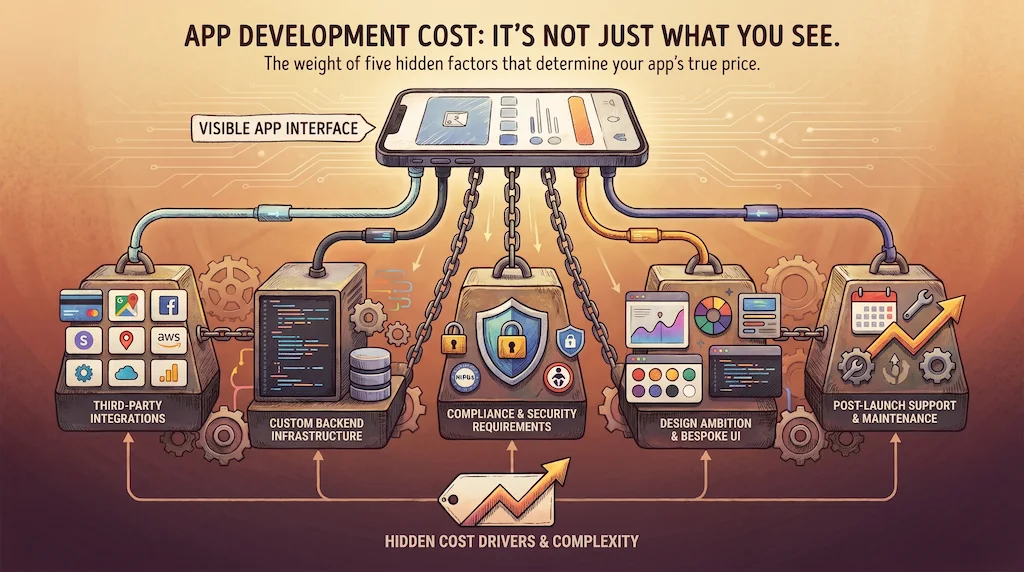
Ask our engineering leadership what makes one app cost triple another, and the answer has nothing to do with screens. It starts with the systems the app has to talk to.
“The screen count never predicts the price. The number of systems your app has to talk to does. Every integration is a negotiation with someone else’s code.”
Our CTO, StudioKrew
So, integrations first. Payment processors, mapping, CRMs, insurance APIs, banking rails. Each one adds development time, error handling when the other side fails, and ongoing maintenance. Two integrations are routine. Nine integrations are a project in their own right.
Custom backend is the second driver. An app that reads content is cheap. An app where thousands of users create, share, and sync data needs real server architecture, and that work is invisible in every screenshot, which is exactly why buyers under-budget it.
Compliance is third and binary in the worst way. Either your app touches health, financial, or children’s data, or it does not. If it does, budget for security review, encryption standards, and documentation from the first sprint. Retrofitting compliance costs double.
Design ambition is fourth. A clean, standard interface using platform conventions is affordable. Custom animations, branded illustration systems, and bespoke component libraries can add $10,000 to $40,000. Sometimes that spend is the product strategy. Sometimes it is vanity. We tell clients which one we think it is.
Post-launch support is fifth, and the most ignored. Our delivery manager Swasthi Parekh sees the pattern weekly: “Projects rarely slip because engineers are slow. They slip because decisions are slow. And the same clients who delayed decisions during the build are the ones who never budgeted for month seven, when the OS update lands and something breaks.”
The Change Order Problem Nobody Prices
Here is a cost driver that almost never appears in a proposal. The same change costs wildly different amounts depending on when you ask. Adding a user role in week two is a conversation and a schema edit. In week fourteen it means design updates, permission logic across every screen, backend authorization changes, test data migration, a full regression pass and updated documentation. Our rule of thumb, from tracking scope changes across projects, is that a structural change costs four to six times more in the back half of a build than in the first two weeks.
This is why we push hard on discovery and ask uncomfortable questions early. It is the cheapest hour you will ever buy. It is also why a fixed-price contract with no change mechanism traps both sides. The vendor either absorbs the change and quietly cuts QA to pay for it, or refuses it and you ship a product you no longer believe in. Insist on a defined change process with transparent pricing instead of pretending scope will hold.
The Hidden Costs Buyers Forget
The build is 60-70% of your actual first-year cost. The rest of the bill looks like this.
Store fees are small but perpetual: Apple lists its Developer Program at $99 per year, Google lists a one-time $25 Play Console registration, and the 15 to 30 percent commission on in-app revenue dwarfs both. Analytics starts as a free SDK and quietly grows into a data project: event tracking, consent handling, attribution, dashboards. Marketing is the big one nobody lets us scope for them: a launch without user acquisition budget is a launch to an empty room.
Then maintenance. Plan 15 to 20 percent of your build cost per year. A marketplace founder we worked with skipped it entirely, disappeared after launch, and came back eight months later with an app that crashed on the new iOS version and a one-star review average to match. The repair cost more than a year of maintenance would have. Every product we deliver includes a minimum of three months of support and warranty, which exists precisely to bridge founders past that cliff, but three months is a bridge, not a bypass.
Our QA lead adds the cost nobody sees coming: “People think testing means one iPhone and one Samsung. Our standard matrix comprises 14 devices across 4 OS versions. Every device you skip is a one-star review waiting.” Device coverage is also why iOS and Android are scoped as distinct QA efforts even on a shared Flutter codebase. The code is shared. The bugs are not.
How to Get an Accurate Quote (Prepare This First)
The quality of your quote is set before the first call, by what you bring to it. Vague briefs get padded quotes, because agencies price uncertainty as risk. Here is the one list in this article, and it is the preparation that separates a real estimate from a guess:
- A one-page description of the problem your app solves and for whom, written in plain language, no feature names.
- Your feature list split into two columns: launch essentials and everything else. Be ruthless. The second column is your roadmap, not your quote.
- Three existing apps you admire, with a sentence each on what specifically you admire. This calibrates design ambition faster than any mood board.
- Your real budget range and hard deadline, stated up front. Hiding your budget does not get you a better price. It gets you a proposal shaped for the wrong project.
- Any compliance context: do you touch health, money, or minors’ data? Say so on day one.
Bring that, and any competent app development partner can give you a line-item estimate instead of a shrug with a number attached. A fintech founder came to us last year with a $30,000 budget and a feature list that honestly needed $90,000. Because his brief was sharp, we could cut with a scalpel rather than an axe: single currency at launch, no budgeting or analytics, payments and identity verification only. He shipped at $42,000, used the live product to raise his round, and funded the rest of the list six months later. That outcome was built in the preparation, not the code. And it points to the test we would apply to any proposal you receive, ours included: a good quote should make you understand your own product better. If it does not, it is a number, not an estimate.
Why StudioKrew Is a Strong Fit for App Development
We deliberately held this section until the end because a cost guide that opens with a sales pitch is not a cost guide. But since you have read this far, here is the case in the same plain terms as everything above. We have been building since 2013, delivering 250+ apps and 700+ games, which means the expensive lessons in this article were learned on projects that were not yours. Our model is the hybrid one described in this article: leadership and accountability in Chicago, delivery talent across our global offices, blended rates starting at $18 per hour, and typical delivery in 3 to 6 months. We work across Swift, Kotlin, Flutter, React Native, and AI integrations, so the stack recommendation you get is based on your product, not on the one framework we happen to sell. Every product ships with at least 3 months of support and a warranty. And we publish our numbers, including in this article, because we would rather lose clients who need a fantasy price than those who need a real one.

What We Would Tell You Over Coffee
The honest 2026 number for app development cost in the USA is $10,000 to $150,000+, and the honest advice is that where you land in that range is mostly decided by choices you control: scope discipline, team model, and whether compliance surprises you or you surprise it. We publish our rates because we are comfortable defending them line by line. Send us your one-pager, even a rough one, and we will come back with a real estimate, what we would cut, and what we would refuse to cut. If the answer is that you are not ready to build yet, we will say that too.
Frequently Asked Questions
What is the cheapest way to build an app in the USA?
A tightly scoped MVP on a cross-platform framework like Flutter or React Native, built by a hybrid team with US leadership and offshore delivery. That combination realistically starts around $10,000 for a tightly scoped first version. Going cheaper usually means template builders or unmanaged freelancers, which works for prototypes but rarely survives real users, payments, or an app store rejection.
Why do US agencies quote 3x more than offshore teams?
Labor cost, mostly. US agencies bill $75 to $250 per hour to cover US salaries, office space, and overheads, while offshore rates start at under $25 per hour. The US premium buys timezone overlap and legal accountability, not automatically better code. Hybrid models exist to maintain accountability while reducing the blended rate to a fraction of US-only pricing.
How much does monthly app maintenance cost?
Budget 15 to 20 percent of your original build cost per year, which for a $60,000 app means roughly $750 to $1,000 per month. That covers bug fixes, OS and library updates, and store compliance. Apps with heavy integrations, real-time features, or growing user bases sit at the higher end, plus server hosting costs that scale with usage.
Can you build an app for $10,000?
Yes, at the entry of our MVP band, if the scope is disciplined. $10,000 buys a cross-platform build with one core feature, standard design components, and basic analytics. It does not buy custom animations, a heavy backend, or multiple integrations. The moment your feature list grows past one clear job, you are shopping in the $20,000 to $80,000 mid-tier, and an honest agency will say so before signing.





 INDIA
INDIA CANADA
 USA
USA UAE
UAE