
What will it actually cost to build my mobile game? We hear some version of that question every week, and the honest answer is $15,000 to $250,000 or more. A hyper-casual title sits at the bottom of that range, a story-driven RPG at the top, and most commercial games we scope land somewhere between $30,000 and $120,000. Those ranges vary because a game budget is really five smaller decisions wearing a trench coat: your genre, how much art it needs, whether players connect to a server, how long you plan to run it after launch, and where your team sits.
Before publishing this guide, we did something most agencies skip. We pulled the numbers from our own delivery history, more than 700 games shipped since 2013, then sat down with our producers, our backend leads, and our leadership team and pressure-tested every band you are about to read. Where a figure felt optimistic, we raised it. The rates below are the same as on our website: Unity and Godot developers from $18 to $35 per hour; senior Unreal and multiplayer backend engineers from $30 to $55 per hour; dedicated teams from $15,000 per month; and fixed-price MVPs from $20,000.
Most of our competitors hide pricing behind a contact form and a discovery call. We think that wastes your time. So here are the actual budget bands we quote to clients in the USA, the UK, India, the UAE, and Australia, genre by genre and what drives each range.
Mobile Game Development Cost by Genre: 2026 Summary Table
| Genre | Budget Range | Typical Timeline |
| Hyper-casual | $15,000 to $40,000 | 6 to 10 weeks |
| Casual and puzzle | $30,000 to $80,000 | 3 to 5 months |
| Card and board (real-time multiplayer) | $50,000 to $120,000 | 4 to 7 months |
| Mid-core and multiplayer | $80,000 to $200,000 | 6 to 10 months |
| RPG and story-driven | $100,000 to $250,000+ | 8 to 14 months |
Hyper-Casual Games: $15,000 to $40,000
Hyper-casual is the cheapest entry point into mobile gaming because the format stays deliberately small. One core mechanic, one or two art styles, no server backend, and monetization handled entirely by ad SDKs. A two-person squad, one Unity or Godot developer at $18 to $25 per hour plus a part-time artist, can take a validated concept to store-ready in 6 to 10 weeks. At roughly 600 to 1,200 combined hours, the math lands you squarely in the $15,000 to $40,000 band.
What drives the cost: iteration count, not features. Hyper-casual lives or dies on cost per install and day-one retention, so studios that do this well build several prototypes and kill the weak ones early. Our hyper-casual game development team typically budgets 30 to 40 percent of hours for prototyping and marketability testing rather than polish.
Cost-saving decision: test three cheap prototypes with $500 ad campaigns each before polishing any of them. Spending $3,000 to learn a concept fails is far cheaper than spending $30,000 to learn the same thing after launch.
Casual and Puzzle Games: $30,000 to $80,000
Match-3, merge, word, and simulation-lite games need what hyper-casual skips: content depth. A commercially serious puzzle game launches with 100 to 200 levels, a meta layer (collections, decorations, progression), polished 2D art, and analytics wired in from day one. That means a dedicated team of developers, designers, QA, and a project manager working for 3 to 5 months. At our dedicated team rate of $15,000 to $25,000 per month for this configuration, you arrive at $30,000 to $80,000 depending on content volume and meta complexity.
What drives the cost: level content and the tooling to produce it. The single biggest budget mistake we see is hand-building levels instead of investing early in a level editor. Art volume is the second driver, since casual audiences expect polish that hyper-casual players forgive.
Cost-saving decision: launch with 120-150 strong levels plus a content pipeline, not 500 levels. Players will not reach level 300 in month one, and a good pipeline lets you outrun your fastest players for a fraction of the upfront cost.
Card and Board Games with Real-Time Multiplayer: $50,000 to $120,000
Rummy, poker, ludo, and chess-style games are an interesting middle case. Art volume is low, often the lowest of any genre here, but the engineering bar is high because real money or competitive stakes demand server-authoritative gameplay. You need matchmaking, reconnection handling, anti-cheat logic, and a backend that survives thousands of concurrent tables. That work sits with senior multiplayer engineers at $30 to $55 per hour, which is why this genre costs more than casual, despite looking simpler on-screen.
What drives the cost: the backend, full stop. Client-side card logic is a few weeks of work. Authoritative servers, wallet integration, and compliance (especially for real-money formats in markets like India) consume 50 to 60 percent of the budget. Timeline runs 4 to 7 months.
Cost-saving decision: build on a proven multiplayer backend service such as Photon, Nakama, or PlayFab instead of custom netcode. Custom infrastructure only pays off past several hundred thousand daily players, and you can migrate later if you get there. That is a good problem to have.
Mid-Core and Multiplayer Games: $80,000 to $200,000
Shooters, strategy, battle, and synchronous PvP titles combine the content demands of casual with the backend demands of card games, then add real-time netcode, balancing, and LiveOps infrastructure on top. Expect a five- to seven-person team for 6 to 10 months: two developers (one senior at $30 to $55 per hour), an artist or two, a designer, QA, and a project manager. That is $20,000 to $30,000 per month in dedicated team terms, which compounds to the $80,000 to $200,000 range.
What drives the cost: three things stack up. Real-time netcode and lag compensation are genuinely hard engineering. Balancing a competitive economy takes months of playtesting. And mid-core games are LiveOps products from day one, so events, seasons, and store systems must ship in version 1.0, not version 1.5.
Cost-saving decision: launch with asynchronous multiplayer first. Ghost racing, replay-based battles, and turn-based PvP deliver 80 percent of the competitive feel at 40 percent of the backend cost, and you can add synchronous modes once retention proves the game deserves them.
RPG and Story-Driven Games: $100,000 to $250,000+
RPGs are content machines. Characters, environments, items, skill trees, quests, dialogue, and cutscenes all add up to far more art and design hours than in any other mobile genre. An 8- to 14-month production with a full team, often including senior Unreal engineers for 3D titles, puts serious projects at a $100,000 minimum, and $250,000+ is realistic for games with deep narrative branching or gacha-style live economies. For context, several 2026 industry surveys place mid-core RPG budgets even higher, with NextApp’s 2026 breakdown citing $300,000 to $1.5 million at the top end for Western studio productions. Working with a hybrid team is how you land in the lower band without cutting scope.
What drives the cost: art and content volume above all, then systems depth (combat, inventory, progression all interact, and all need QA), then narrative production. Story-driven games also carry the heaviest testing burden because every quest permutation is a potential bug.
Cost-saving decision: fund a vertical slice, the first chapter built to final quality, before greenlighting the full game. It costs 20 to 30 percent of the total budget and tells you whether the core loop, art direction, and narrative tone actually work together. This is the model our full-cycle game development engagements follow by default.
The Cost Factors That Cut Across Every Genre
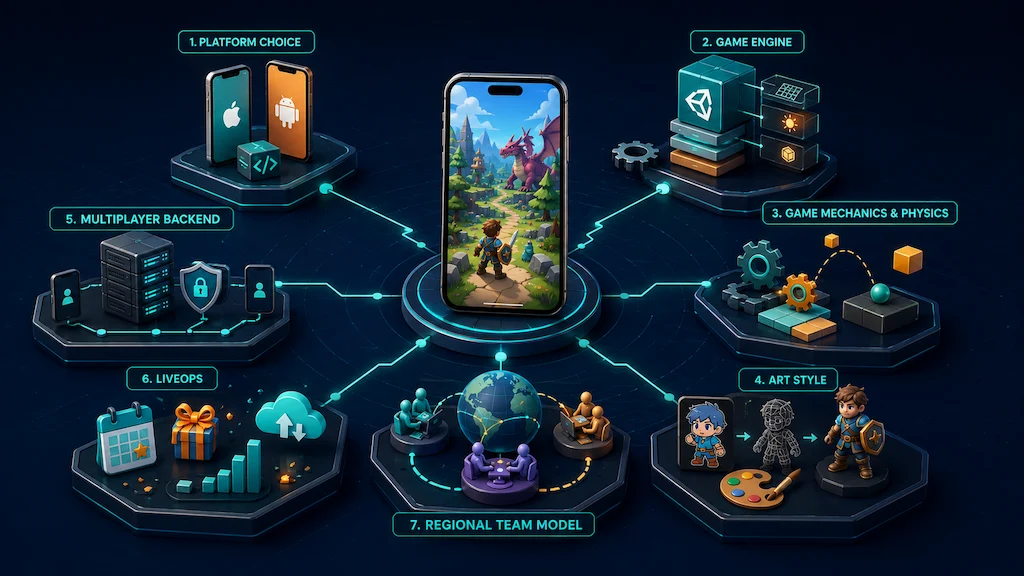
Platform choice
Building native iOS and Android apps separately nearly doubles engineering costs. Cross-platform engines ship one codebase to both stores, which is why they dominate mobile development. Budget iOS-first plus Android from the same codebase unless you have a specific reason not to.
Game engine
Unity and Godot are the workhorses of casual and mid-core mobile games, which is why our rates start at $18 per hour. Unreal buys you high-end 3D rendering and is the right call for graphically ambitious mid-core and RPG titles, but Unreal specialists bill at $30 to $55 per hour, build sizes grow, and your minimum supported device climbs. The engine decision alone can swing a budget by 20 to 40 percent, so let genre expectations pick the engine, not developer preference.
Game mechanics and physics
The depth of your core gameplay logic is a cost driver most buyers never price in. A hyper-casual game with a single-tap controller has one input and one physics interaction, and it takes days to tune. A match-3 looks equally simple on screen but hides cascading match resolution, board generation rules, and booster interactions that must all work together, which is weeks of engineering and QA. Physics-heavy mechanics such as vehicles, ragdolls, or projectile trajectories add another layer because they require constant tuning to feel right and must maintain frame rate on low-end devices. A useful rule of thumb from our producers: cost scales with the number of systems that communicate, not with the number of features on the list.
Art style
Stylized 2D is the budget workhorse. Moving to 3D adds modeling, rigging, animation, and optimization for low-end devices, typically increasing the total cost by 30 to 60 percent. Realistic 3D on mobile is a premium decision that should be driven by genre expectations rather than taste.
Multiplayer backend
Any real-time multiplayer feature adds a second product to your budget: the server. Plan for senior backend rates, hosting costs that scale with players, and ongoing maintenance. Single-player and async games skip all of it, which is the single largest cost fork in mobile development.
LiveOps
Games built to retain players for years need event systems, remote config, A/B testing, and a content cadence. Budget 15 to 20 percent of your development cost per year for basic maintenance, and 25 to 40 percent for active LiveOps. Also plan marketing honestly: TekRevol’s 2026 analysis pegs first-six-months marketing at 100 to 200 percent of development cost, with casual cost per install around $2.50 to $4.00.
Worth knowing before you compare quotes,
Every product StudioKrew delivers includes a minimum of three months of support and warranty, so early bug fixes and stability work cost you nothing extra. Many agencies start billing for fixes the day after launch, which quietly inflates their real price. Connect with our business team if you want the full terms. Connect Now
Regional team rates: US agency vs offshore vs hybrid
Location moves your budget more than any feature decision. Per 2026 regional rate data, US onshore development runs $100+ per hour, Eastern Europe $35 to $70 per hour, and India and South Asia $15 to $45 per hour. A pure US agency will quote three to five times the amount shown in this guide. A pure, low-cost freelancer team saves money until communication and quality overhead eat away at the savings. The hybrid model, US-facing project leadership with delivery talent in lower-cost regions, is how StudioKrew prices from our Chicago office, and it is why you can hire game developers from us at $18 to $55 per hour with US-timezone accountability.
How to Budget Your Game: A Practical Framework
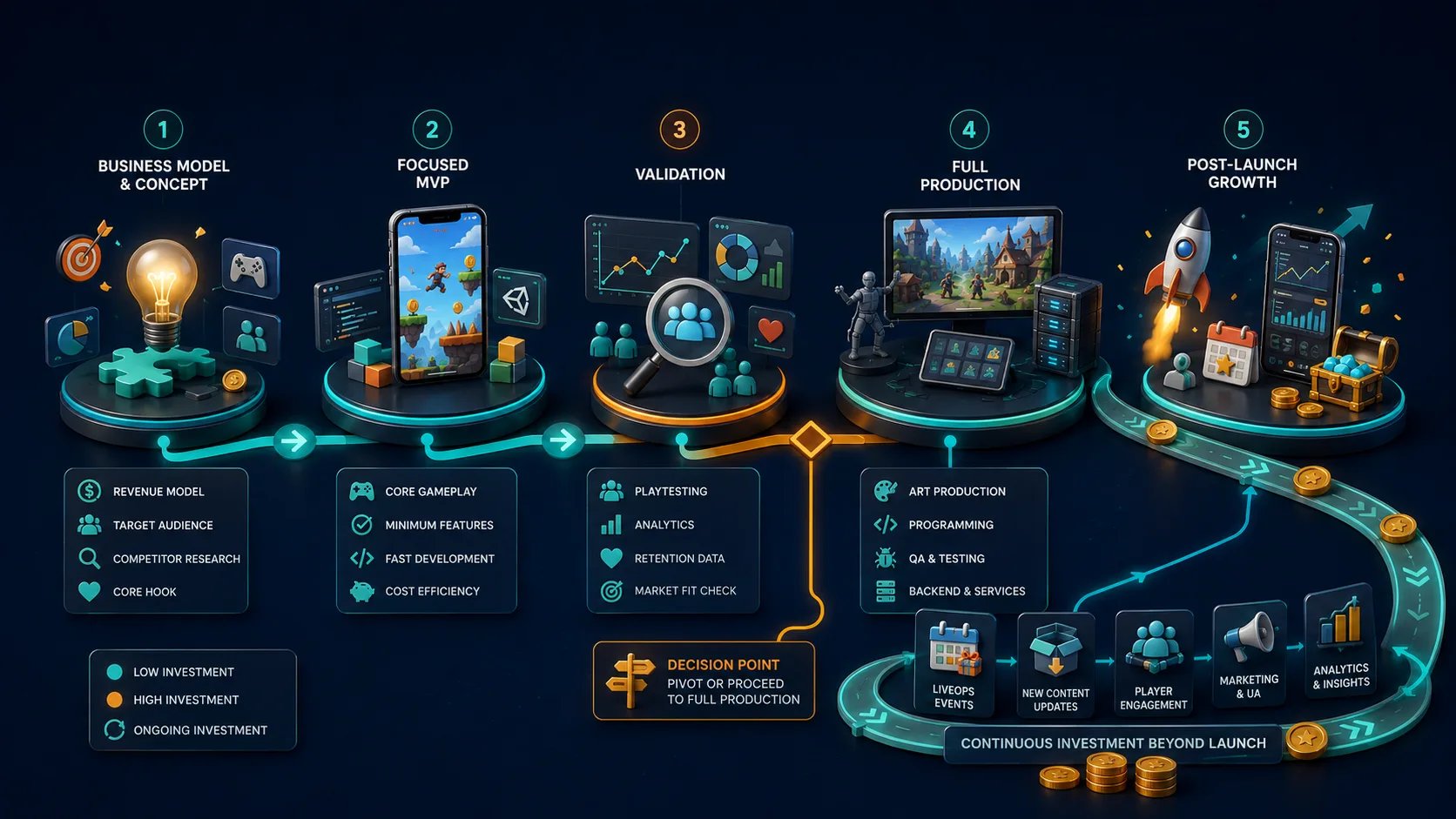
When a founder or studio head asks us where to start, this is the sequence we walk them through, in this order, every time:
- Start from the business case, not the feature list. Decide your revenue model (ads, IAP, hybrid) first, because it dictates genre, and genre dictates budget.
- Fund the MVP, not the dream. A playable MVP from $20,000 in 8 to 12 weeks proves your core loop with real retention data before you commit six figures.
- Reserve 40 to 50 percent of total capital for post-launch. Marketing, LiveOps, and updates decide success more often than the build does.
- Compare quotes on scope, not totals. A $60,000 quote including QA, LiveOps setup, and 3 months of support can be cheaper than a $45,000 quote that excludes all three.
- Pick a partner who has shipped your genre. Familiarity with a genre’s known problems is worth more than any difference in hourly rate.
Get a Real Number for Your Game
The honest answer to how much mobile game development costs in 2026 is $15,000 to $250,000+, but the honest next step is a scoped estimate for your specific game, not a generic band. As a mobile game development company that publishes its rates, we are comfortable being held to them. Send us your concept, and we will come back with a line-item budget built on the exact numbers in this article, usually within 48 hours, along with where we think you can save and where cutting would hurt the game. Our rates are already on this page. The estimate simply applies them to your scope.
Frequently Asked Questions
What is the cheapest type of mobile game to build?
Hyper-casual games are the cheapest to build, starting around $15,000 with a lean team and a 6- to 10-week timeline. They use minimal art, a single core mechanic, and no server backend, which keeps engineering hours low. The trade-off is that they depend heavily on ad monetization and marketing spend after launch.
How much does it cost to maintain a mobile game after launch?
Plan for 15 to 20 percent of your original development budget per year for basic maintenance, covering bug fixes, OS updates, and store compliance. Games with LiveOps, events, and regular content drops typically spend more, often 25 to 40 percent of the build cost annually, plus server hosting for multiplayer titles.
Why do agencies quote such different prices for the same game?
Quotes differ because of team location, seniority mix, and what is actually included in scope. A US agency billing $100 or more per hour can quote three times as much as an offshore team for identical work. Some quotes also exclude QA, LiveOps setup, or post-launch support, so always compare the scope line by line, not just the total.
Should I build an MVP or a full game first?
Build an MVP first in almost every case. A playable MVP lets you validate your core loop with real players before you commit to full production. At StudioKrew, fixed-price MVPs start at $20,000 and ship in 8 to 12 weeks, letting you test retention data and then invest the larger budget with evidence rather than guesswork.






 INDIA
INDIA CANADA
 USA
USA UAE
UAE