The Death of the “Download-and-Forget” Era
Hybrid-casual games are redefining the mobile gaming economy. As acquisition costs rise and player attention spans shrink, studios and publishers are shifting toward formats that combine instant accessibility with long-term monetization. This transformation is not merely a trend; it is a structural evolution of the mobile gaming industry.
According to Newzoo, the global games market surpassed $188.8 billion in 2025, with mobile accounting for over $103 billion, making it the largest and most competitive segment. Meanwhile, reports from Data.ai and Sensor Tower highlight that hybrid-casual games consistently outperform traditional hyper-casual titles in retention, lifetime value (LTV), and monetization efficiency.
This blog explores why hybrid-casual games are rapidly becoming the dominant mobile format in 2026, how they scale across global markets, and what studios must build to succeed. From monetization architecture and LiveOps readiness to analytics-driven balancing and scalable production pipelines, this playbook provides founders, publishers, and product teams with a strategic roadmap to build sustainable, high-performing mobile games.
In this guide: what hybrid casual games actually are, why they outperform traditional models across retention and monetization benchmarks, how the economics work, and what studios must build to compete in 2026.
What Exactly Are Hybrid Casual Games?
Hybrid casual games represent the convergence of simplicity and economic depth. They look light on the surface, often built around a single intuitive mechanic, yet underneath, they are supported by progression systems, monetization layers, and retention mechanics typically found in more complex games.
Unlike pure hyper casual titles that rely almost entirely on ad impressions, hybrid casual games are designed as scalable engagement ecosystems. They aim to preserve instant accessibility while extending player lifetime value through structured progression, LiveOps, and hybrid monetization models.
To understand why hybrid casual has become such a dominant development direction, we need to break it down structurally.
1. The Market Evolution That Created Hybrid Casual
Mobile gaming has gone through three major commercial phases:
- Download-driven hyper casual growth
- Monetization-heavy mid-core expansion
- Retention-driven hybrid architecture
As acquisition costs rose across major markets and ad eCPMs became less predictable, studios faced shrinking margins in pure hyper casual models. At the same time, traditional mid-core games required larger production teams, longer timelines, and greater financial risk.
Hybrid casual emerged as a response to these structural pressures.
Industry benchmarks consistently show:
• CPI increases between 20 and 40 percent across competitive regions
• Hyper casual Day 30 retention is often below 4 percent
• Increasing reliance on IAP in top grossing casual segments
Studios needed a model that could justify higher acquisition costs without incurring mid core production risk. Hybrid casual became that middle path.
2. Definition: What Is a Hybrid Casual Game?
In 2026, a hybrid casual game can be structurally defined by three pillars:
Low Barrier Entry
Players understand the core mechanic within seconds. Tutorials are minimal. Cognitive load is light. Session length typically ranges between 2 and 5 minutes.
Meta Progression
Beyond the core mechanic, hybrid casual introduces layered systems such as:
• Upgrade trees
• Unlockable content
• Character progression
• Equipment systems
• Competitive leaderboards
These layers transform a short session loop into a long-term engagement cycle.
Monetization Depth
Hybrid casual integrates a dual revenue model:
• Ads, including rewarded and interstitial placements
• In-app purchases, including upgrades, cosmetics, battle passes, and boosters
This blended model increases lifetime value while maintaining accessibility.
This architectural balance is what differentiates hybrid casual from other mobile categories.
3. Hybrid Casual vs Hyper Casual vs Mid Core
To understand its positioning clearly, contrast becomes essential.
Hyper Casual
• Ultra simple mechanics
• Primarily ad monetized
• Minimal progression
• Fast production cycles
• Day 30 retention is often between 2–4 percent
Hyper casual optimized for install velocity.
Traditional Mid Core
• Deep systems and mechanics
• Heavy art production
• Complex onboarding
• IAP dominant monetization
• Higher development cost and timeline
Mid core optimized for long-term monetization but carries a higher risk.
Hybrid Casual
• Simple core loop
• Layered progression
• Ads plus IAP monetization
• LiveOps integration
• Day 7 retention is frequently in the mid-teens
• Day 30 retention is often between 8 and 12 percent, depending on execution
Hybrid casual optimizes for sustainable growth.
Also Read, our earlier analysis of How Hyper-Casual Games Are Driving Growth in the Mobile Game Industry (in 2025)
4. Revenue Shift and Chart Dynamics
Industry analyses of top grossing casual categories indicate a meaningful shift in revenue composition.
Estimates suggest that hybrid structured titles now contribute approximately 35-45% of revenue across high-performing casual segments. The number of hybrid format games entering the top-grossing charts has steadily increased.
Additional observations from market data:
• Hybrid casual ARPDAU consistently exceeds pure hyper casual benchmarks
• Lifetime value can be 3 to 5 times higher than ad-only models
• Revenue stability improves due to IAP diversification
This trend demonstrates a broader structural realignment rather than a short-term genre trend.
5. Why Publishers and Investors Favor Hybrid Architecture
From a publishing standpoint, hybrid casual presents a more balanced risk profile.
Compared to hyper casual:
• Higher LTV justifies increased CPI
• Retention stability supports scaling
• Reduced dependency on volatile ad rates
Compared to mid core:
• Lower art and production overhead
• Faster iteration cycles
• Shorter time to market
For investors, hybrid casual studios demonstrate more defensible economics. They combine scalable retention curves with diversified monetization systems, making long-term growth more predictable.
6. What This Means for Game Development Strategy
Hybrid casual is not simply a design trend. It is an architectural framework.
Building successfully in this model requires:
• Monetization logic embedded into early design
• Analytics infrastructure from the MVP stage
• LiveOps planning before launch
• Backend systems capable of progression scaling
For a hybrid casual game development company, this means designing beyond the core mechanic. The game’s visible simplicity must be supported by invisible structural depth.
This shift in development philosophy is precisely why hybrid casual now defines the strategic direction of scalable mobile game production.
Hyper Casual vs Hybrid Casual: The Strategic Comparison
If hybrid casual is winning attention and revenue, it is not because the core loops are radically different. It is because the business architecture is different. Hyper casual is built to monetize short bursts of novelty. Hybrid casual is built to convert short sessions into a long-term engagement system that can sustain scaling even when acquisition costs rise.
Below is a clear comparison across mechanics, monetization, and retention. These are the exact lenses publishers and investors use while evaluating whether a concept can survive beyond launch-week installs.
Hybrid Casual vs Hyper Casual: Core Mechanics and Gameplay Experience
| Dimension | Hyper Casual Games | Hybrid Casual Games |
| First-time experience | Instant play, almost no tutorial | Instant play, minimal tutorial |
| Core loop | Single mechanic, low complexity | Single mechanic plus layered systems |
| Session design | Very short, repeatable loops | Short loops with progression hooks |
| Depth over time | Limited, novelty-driven | Expands via meta progression |
| Content strategy | More levels, more variants | Systems plus content plus LiveOps |
| Player motivation | Quick dopamine and pass time | Quick dopamine plus long-term goals |
What this means in practice:
Hyper casual optimizes for “play now.” Hybrid casual optimizes for “play now and come back tomorrow.”
Hybrid Casual Monetization vs Hyper Casual: Revenue Model Comparison
| Dimension | Hyper Casual Games | Hybrid Casual Games |
| Primary revenue | Ads, primarily interstitials | Ads plus IAP |
| IAP presence | Rare or minimal | Strong and designed-in |
| Monetization stability | Highly sensitive to eCPM changes | More stable due to diversified revenue |
| Best performing ad type | Interstitials, rewarded | Rewarded, opt-in, blended |
| Purchase drivers | Usually absent | Progression speed, cosmetics, passes, bundles |
| Revenue ceiling | Lower ceiling | Higher ceiling |
Industry trend references consistently show that hybrid monetization can deliver significantly higher lifetime value than ad-only models. Many market analyses estimate that hybrid LTV can be 3 to 5 times higher than pure hyper casual, largely because IAP creates upside that ads alone cannot reach.
What this means in practice:
Hyper casual revenue rises and falls with ad rates. Hybrid casual can defend revenue even when ad markets fluctuate.
Retention Benchmarks and Growth Reality
Retention is where hybrid casual changes the game.
| Metric | Hyper Casual (Typical Range) | Hybrid Casual (Typical Range) |
| Day 1 retention | 35 to 45 percent | 45 to 60 percent |
| Day 7 retention | 5 to 10 percent | 15 to 25 percent |
| Day 30 retention | 2 to 4 percent | 8 to 12 percent |
These ranges reflect widely cited industry benchmarks across mobile analytics reports and publisher portfolios. Exact numbers vary by genre, polish, and LiveOps maturity, but the direction is consistent.
What this means in practice:
Hybrid casual converts early curiosity into a returning habit, which directly improves monetization, organic ranking, and UA payback.
User Acquisition Economics: Hybrid Casual vs Hyper Casual Scaling
| Dimension | Hyper Casual Games | Hybrid Casual Games |
| CPI tolerance | Low | Higher |
| Payback window | Short, fragile | Longer, more predictable |
| Scaling strategy | Volume first | Cohorts and retention first |
| Main bottleneck | eCPM volatility | LiveOps and economy tuning |
| Portfolio approach | Many launches, fast churn | Fewer launches, longer lifecycle |
This is why publishers increasingly greenlight hybrid casual prototypes. A hybrid casual game can justify a higher CPI because it has a better chance of recouping costs through retention and IAP uplift. That becomes critical as CPI rises in the USA, UK, and other competitive regions.
What a Game Development Company Must Build Differently
Hybrid casual is not just “hyper casual with upgrades.” It requires an intentional development approach:
• A progression economy that can scale without breaking balance
• LiveOps hooks planned early, not added after launch
• Analytics-first architecture for tuning difficulty, churn, and monetization
• Remote config and A/B testing capability to iterate quickly
• Monetization placement that does not sabotage the core loop
This is exactly where an experienced mobile game development company can create a measurable advantage. The game may look simple, but the systems underneath must be engineered for retention, monetization, and long-term growth.
For StudioKrew, this is a familiar territory. Hybrid casual success depends on building the right foundations early, especially progression design, scalable architecture, and LiveOps readiness, rather than trying to retrofit depth later.
The Economics: Why Hybrid-Casual Makes Financial Sense
Hybrid casual is not winning because it is more fun. It is winning because it is more financeable.
When a publisher evaluates a game, the core question is simple. Can we acquire users at today’s CPI and still generate profit at scale? For years, hyper casual survived by keeping production cheap and letting ad volume do the work. But as acquisition costs climbed and ad monetization became less predictable, that math stopped working for many studios.
Hybrid casual solves the new economics by expanding the ceiling on lifetime value while keeping development risk lower than traditional mid-core.
CPI Pressure: The Old Growth Model Is Getting Expensive
In competitive markets such as the United States and the United Kingdom, CPI has increased significantly over the last few years. Many industry reports and UA teams cite increases of 20 to 40 percent, depending on genre, seasonality, and targeting. This matters because CPI does not rise alone. It rises while players also become harder to retain.
Hyper casual games struggle here because their monetization is capped. If your revenue per user is mostly ad-driven, you can only tolerate a limited CPI before the payback window breaks.
This is why studios that depend purely on install volume often hit the same wall:
• Great download spikes
• Weak retention after Day 7
• Thin LTV
• Scaling becomes unprofitable
Hybrid casual is built specifically to push that wall outward.
Also Read, The Economics of Game Development in 2025 – How Companies Balance Cost, Quality, and Speed
LTV Expansion: Why Hybrid Models Create 3 to 5x Upside
The biggest economic advantage of hybrid casual is that it simultaneously increases LTV in two ways.
1) It lifts retention
Hybrid casual architecture is designed to keep players returning through meta progression, unlocks, and LiveOps hooks. Industry benchmarks commonly show:
• Hyper casual Day 30 retention around 2 to 4 percent
• Hybrid casual Day 30 retention is more often around 8 to 12 percent
That retention multiplier alone increases ad impressions per user and extends the monetization window.
2) It adds IAP upside
Hyper casual monetization depends heavily on eCPM and interstitial volume. Hybrid casual adds IAP through boosters, battle passes, cosmetics, bundles, and progression accelerators. This is where ARPDAU increases materially.
Market analyses frequently estimate that top hybrid casual titles can outperform pure hyper casual LTV by 3 to 5 times, mainly because IAP introduces a scalable revenue layer beyond ad ceilings.
The result is a format that can tolerate higher CPI without collapsing.
Ads Are Not Dying, But eCPM Volatility Is Real
Ads still matter. Rewarded ads in particular remain powerful because they align monetization with player choice. The problem is dependency.
Hyper casual games often rely on:
• High interstitial frequency
• Short sessions multiplied by volume
• Stable eCPM assumptions
When ad rates fluctuate, the whole model swings with it. That is why many hyper-casual portfolios experience revenue instability even when downloads remain healthy.
Hybrid casual reduces this risk by diversifying revenue sources:
• Ads support the baseline
• IAP drives upside
• LiveOps stabilizes engagement
This is a more resilient revenue design, especially when platforms and privacy changes continue to affect ad targeting performance.
Why Publishers Prefer Hybrid Casual for Funding and Greenlights
Publishers want predictable scaling. Hybrid casual provides clearer confidence signals during testing because it can demonstrate multiple growth levers.
During prototype evaluation, a hybrid casual concept can demonstrate:
• Strong Day 1 and Day 7 retention
• Early evidence of payer intent
• Upgrade economy engagement
• Ad tolerance without churn spikes
• LiveOps readiness for continued iteration
This is why hybrid casual has become increasingly visible in top-grossing casual categories. Industry commentary and chart patterns suggest that hybrid structured titles now contribute a significant share of top-performing casual revenue segments, often estimated at 35-45 percent in recent years.
This is not just a player preference shift. It is a funding shift.
Why Hybrid Casual Is Cheaper Than Mid Core, But Earns Like One
Traditional mid core games often require:
• Larger teams
• Higher art production cost
• More content creation
• Longer development cycles
• Heavier UA budgets
Hybrid casual can achieve meaningful monetization depth without demanding the same production footprint. It uses:
• A simple core mechanic
• System-driven progression instead of content-only depth
• LiveOps events to extend lifecycle
• Economy tuning to drive engagement
That balance makes it attractive to both studios and publishers. You get a stronger LTV curve without the full cost and timeline of mid-core.
To know more about Game Monetization, read Mobile Game Monetization Models That Still Work in 2026
What This Means for StudioKrew and Any Team Building Today
This economic reality changes how games should be built from day one.
If your goal is to scale sustainably, you cannot treat monetization and retention as late-stage features. Hybrid casual games succeed when architecture is designed early:
• Progression economy with tunable parameters
• Analytics instrumentation built into MVP
• Remote config for rapid balancing
• A/B testing hooks for monetization experiments
• LiveOps roadmap planned alongside core loop
This is where experienced teams gain an edge. A hybrid casual game development company and a proven mobile game development company are not only building gameplay; they are also building a business. It is building a business model that survives rising CPI and volatile ad markets.
StudioKrew’s approach matches naturally with this shift. When the foundation is engineered correctly, scaling becomes a product decision rather than a gamble.
The Psychology Shift: Dopamine, Depth, and Daily Habit Loops
Hybrid casual did not win because it discovered a new mechanic. It won because it aligned with how players actually live now.
Mobile play has become a “between moments” behavior. A few minutes while waiting. A quick break between tasks. A short burst before sleep. This reality favors games that deliver reward fast, then quietly build attachment over time. Traditional mobile games often ask for commitment first and reward later. Hybrid casual flips that order. Reward first, commitment later.
That simple inversion explains a lot of what we are seeing across charts and retention curves.
1. Micro Sessions: The 2 to 5 Minute Loop That Fits Real Life
Short-session loops are no longer a creative decision. They are an attention constraint.
Hybrid casual games are designed to:
• Start instantly
• Teach through play
• Deliver a reward within seconds
• End cleanly without fatigue
This is why they fit modern mobile behavior so well. The session is snackable, but it still feels meaningful.
2. Dopamine, Then Depth: Why Layered Progression Works
Instant dopamine is easy to deliver. The real skill is delivering dopamine that scales into a habit.
Hybrid casual typically uses layered progression, where the player experiences depth in stages:
• First layer: instant feedback and quick wins
• Second layer: short-term milestones, upgrades, unlocks
• Third layer: long-term goals, collections, competitive status
• Fourth layer: LiveOps events that refresh motivation
This approach is why hybrid casual often shows stronger long-term retention. Industry benchmarks and publisher portfolios commonly indicate that hybrid casual games can lift Day 30 retention by up to 2x compared to pure hyper casual games, largely because the meta layer provides players with reasons to return beyond novelty.
3. Meta Progression: The Retention Engine Players Do Not Notice
Meta progression is what converts a single good session into a returning behavior.
Players come back because:
• Their progress is saved
• Their upgrades change performance
• Their economy grows
• Their unlocks create identity
This is not just “content.” It is ownership.
And ownership is one of the strongest drivers of repeat play on mobile.
4. Habit Stacking: How Hybrid Casual Becomes a Daily Routine
Habit stacking in game design means attaching gameplay to routines players already have.
Hybrid casual does this through a pattern that is simple but powerful:
• Cue: daily reset, streak reminder, time-limited event
• Action: a quick session that requires minimal effort
• Reward: currency, loot, progress, upgrade
• Investment: stronger character, better tools, improved rank
The investment step is the key difference. It turns a casual action into a reason to return. Over time, the game becomes part of the player’s daily rhythm, not because it is demanding, but because it is easy to repeat.
5. More Sessions, Shorter Duration: The Quiet Retention Advantage
Hybrid casual does not always aim for long sessions. It often aims for more frequent sessions.
That shift matters because:
• More session frequency increases total engagement without fatigue
• Shorter duration reduces burnout
• Frequent returns improve ad value and conversion probability
• LiveOps hooks become more effective
This is why many hybrid casual titles feel lightweight while still holding attention for weeks.
6. Why Traditional Mobile Games Feel Heavy in Comparison
Traditional mid core mobile games can be excellent, but they often carry weight that modern behavior resists.
The “heavy” breakdown
Mid core games typically require:
• High art cost
• Long development cycles
• Heavy UA budgets
This becomes even more challenging as UA costs rise across the USA, UK, and UAE markets, where CPI pressures force studios to either spend more or accept slower growth.
From the player side, “heavy” often means:
• Long tutorials before fun begins
• Complex systems introduced too early
• Pressure to commit time and attention
• Burnout from constant cognitive load
In an attention-fragmented world, players increasingly choose games that respect their time. Hybrid casual does that while still providing depth for those who want it.
7. What This Means for Building a Hybrid Casual Correctly
The psychology is clear, but execution is everything. Hybrid casual fails when it becomes either:
• Hyper casual with shallow upgrades that do not change motivation, or
• Mid core disguised as casual, where complexity returns too early
Building the right balance requires deliberate design: reward pacing, progression tuning, economy sinks and sources, and LiveOps cadence. This is where a game development company with hands-on experience in retention and systems design makes a measurable difference.
At StudioKrew, this mindset matters because hybrid casual success isn’t just art and mechanics. It is behavioral design plus scalable systems.
Case Studies: Hybrid Casual Games That Redefined the Charts
Hybrid casual is easiest to understand when you see it in the wild. These games did not succeed because they had revolutionary controls. They succeeded by combining a snackable core loop with depth of progression, a monetization layering system, and retention mechanics that keep players coming back.
Below are four titles that clearly demonstrate the “hybrid signals” publishers look for. Simple to start, hard to quit.
Wool Crush: Simple Loop, Strong Stickiness
Why it belongs in this list
Wool Crush is a great example of how a lightweight loop can be turned into a longer lifecycle product. The game feels instantly playable, yet it gradually increases commitment without overwhelming the player.
Why Wool Crush Succeeds as a Hybrid Casual Game
1. Extremely simple core loop
The action is clear within seconds. This is the hyper casual entry point.
2. Progression that scales difficulty and motivation
Instead of relying only on more levels, the game leans on progression pacing. As difficulty rises, the player is nudged toward upgrades, optimizations, and repeat sessions.
3. Monetization that feels optional, not forced
Monetization typically appears as boosters, rewarded ads, and convenience options. This is important because hybrid casual monetization performs best when players choose it as an advantage, not as a tax.
4. Retention through micro goals
Daily returns are driven by short goals, quick rewards, and visible progress. This is exactly where hybrid casual commonly achieves stronger Day 30 retention than ad-only hyper casual models, often up to 2x the improvement when meta progression is well-tuned.
What this teaches builders
Snackable does not mean shallow. If the core loop is clean and the progression is meaningful, even a simple mechanic can drive repeat behavior.
Climb the Ladder: Dash Rush: Repeatable Sessions, Competitive Pull
Why it belongs in this list
Climb the Ladder: Dash Rush is a perfect example of how hybrid casual uses session design. It is built for repeated 2- to 5-minute plays, but it adds competitive and progression hooks that push players from “one try” to “one more run.”
The hybrid signals inside Dash Rush
1. Short sessions with clear closure
Each run feels complete quickly. That reduces fatigue and makes frequent play easier.
2. Upgrade the economy that changes outcomes
Hybrid casual progression works when upgrades actually matter. When a player feels improvement, they return more often and are more willing to invest time or money.
3. Competitive loop that creates social pressure without requiring social features
Leaderboards, ranks, and score chasing can create “soft competition.” Players do not need to chat with anyone to feel motivated by comparison.
4. Monetization is layered around performance and speed
This is where ads plus IAP become natural. Players accept rewarded ads and boosters when the value is obvious and tied to performance.
What this teaches builders
A strong hybrid casual game is not just a loop. It is a loop plus a reason to improve. Improvement is a psychological engine.
Survivor.io: The Blueprint for Accessible Depth
Why it belongs in this list
Survivor.io is one of the clearest examples of hybrid casual scaling into a long-term monetizable system. It starts with simple controls and immediate fun, but it builds deep engagement through layered progression, variety, and LiveOps behavior.
Reason’s Survivor.io is successful
1. Instant onboarding with satisfying combat feedback
The player feels powerful quickly. That creates early stickiness.
2. Meta progression that becomes an identity
Upgrades, gear, builds, and unlocks create a long-term personalization loop. Players feel like they are building something, not just passing time.
3. Repeatable content structure without feeling repetitive
Variation comes from builds, drops, difficulty curves, and event layers, not just from adding more stages.
4. Monetization depth without scaring off casual players
Hybrid monetization works because the first experience is free, smooth, and fun. Monetization becomes relevant later when the player has invested time and wants to accelerate, customize, or compete.
What this teaches builders
Hybrid casual wins when it creates two experiences at once. Easy fun for new players, deeper systems for returning players. Both groups can coexist.
Hole.io: Hyper Casual Roots, Hybrid Growth Pattern
Why it belongs in this list
Hole.io is a strong reference point because it highlights the evolution path that many studios attempt. Start with a hyper-casual core and layer in depth in retention and monetization.
Reasons behind Hole.io hit
1. Hyper casual core mechanic
One mechanic, instantly understandable, highly snackable.
2. Multiplayer and competitive engagement
Competitive modes change retention behavior. Players return to win, improve, and compare, not just to pass the time.
3. Cosmetic monetization and personalization
Skins and customizations introduce identity without disrupting the loop.
4. Longer engagement curve than typical ad-only titles
Games like this illustrate the transition from pure ad-only monetization to more resilient hybrid architectures. The more you add identity and progression, the less you depend on ad rates.
What this teaches builders
Hybrid casual is often built by upgrading a successful simple loop into a system that supports long-term motivation.
The Pattern Across These Games
Across Wool Crush, Climb the Ladder: Dash Rush, Survivor.io, and Hole.io, the pattern is consistent:
• Simple entry, low friction
• Short sessions, frequent returns
• Meta progression that builds ownership
• Monetization that layers in over time
• Retention that improves meaningfully compared to ad-only hyper casual designs
This is exactly why publishers increasingly fund hybrid casual prototypes and why studios that can build these systems are in demand.
At StudioKrew, this is where development experience matters most. Hybrid casual success is rarely about one clever mechanic. It is about designing progression, monetization, and LiveOps as a single connected system, then tuning it with analytics once real players arrive.
Why Traditional Mobile Games Are Struggling
Traditional mobile games are not failing because they are poorly made. Many are genuinely excellent. The problem is structural. The market they were designed for is changing faster than their economics can keep up.
When attention becomes fragmented and acquisition becomes expensive, games that require a long upfront commitment face a harder path to scale. Hybrid casual is thriving in this environment because it minimizes friction while still offering a long-term value curve. Conventional models often do the opposite.
1. The Friction Problem: Long Tutorials and Slow Reward Cycles
A large share of traditional mid-core mobile games still depend on:
• Detailed onboarding
• Multi-step tutorials
• Complex UI and systems
• Slow early progression
This is logical from a design perspective, but risky from a behavioral one. Many players decide whether a game is worth their time within the first minute. If meaningful reward arrives too late, the player does not “get to the good part.” They uninstall.
Hybrid casual games avoid this by delivering:
• Fast first win
• Immediate feedback
• A visible next goal
• Simple choices that still feel rewarding
This shortens time-to-fun, which is now one of the most important retention variables in mobile gaming.
2. Production Weight: High Art Cost and Long Development Cycles
Traditional mobile games often demand heavy production pipelines:
• High art cost across characters, environments, UI, and effects
• Larger content volumes
• Long development cycles that can run 12 to 24 months
• More QA, balancing, and feature complexity
This becomes dangerous in a fast-shifting market. Long cycles reduce flexibility. If player preferences or monetization dynamics shift mid-production, studios may ship into a market that no longer rewards that approach.
Hybrid casual reduces this risk through:
• A simpler core loop that ships faster
• System-driven progression that scales without endless content
• Smaller teams reaching MVP earlier
• Faster iteration based on real player data
That speed-to-market advantage can be the difference between launching early into a trend or arriving late into a saturated niche.
3. Heavy UA Dependency: Scaling Has Become More Expensive
User acquisition costs have risen across major markets, especially in the USA, UK, and UAE, where competition for top players is intense.
Traditional games that require higher CPI to acquire the right audience often face a compounding problem:
• Higher CPI increases payback risk
• Longer onboarding reduces conversion
• Slower early progression weakens Day 1 and Day 7 retention
• Lower early retention reduces LTV
• Lower LTV makes scaling unprofitable
This creates a loop where the game needs more UA spend to grow, but the economics do not support that spend.
Hybrid casual can tolerate more CPI because it is built to generate better retention and higher LTV through hybrid monetization.
4. Discoverability Is Declining: Organic Growth Is Harder Than It Looks
It is easy to underestimate how saturated app stores have become. Estimates frequently cite over 5 million apps across major app marketplaces. Even if exact counts fluctuate, the reality remains the same. Discovery is brutally competitive.
Traditional mobile games often rely on being discovered through:
• strong brand
• strong IP
• strong marketing spend
• strong featuring opportunities
For most studios, those are not guaranteed.
Hybrid casual games, especially those engineered for retention, can benefit from:
• better store performance due to stronger retention metrics
• more favorable ranking momentum from session frequency
• scalable content expansion through LiveOps
• faster prototyping that allows multiple launches and learning cycles
This makes hybrid casual more compatible with modern discovery constraints.
5. Player Burnout: Complexity and Commitment Are Becoming Costs
Players are not rejecting depth. They are rejecting the obligation.
Traditional mid-core games can feel heavy because they often require:
• remembering multiple systems
• managing inventories and upgrades early
• spending long sessions to feel progress
• keeping up with complex mechanics
That type of commitment is harder to sustain in the modern mobile routine.
Hybrid casual offers depth without demanding the same mental load. It lets players engage lightly, then opt into deeper progression over time. This flexibility reduces burnout and improves long-term return behavior.
Why Hybrid Casual Often Feels Like the Safer Bet
When you combine all the pressure points, a pattern emerges.
Traditional mobile games struggle because they carry:
• more upfront friction
• heavier production costs
• longer timelines
• higher UA dependency
• higher churn risk from complexity
• weaker adaptability post-launch
Hybrid casual often wins because it offers:
• fast onboarding
• shorter time-to-fun
• system-driven depth
• better retention curves
• diversified monetization
• LiveOps flexibility
This is why publishers are increasingly shifting budgets toward hybrid casual prototypes, and why studios building in this category are seeing stronger demand.
The Tech Behind Hybrid-Casual Scalability
Hybrid casual games look simple. That is the trap.
A player sees a snackable loop, quick rewards, and a clean UI. What they do not see is the technical foundation that makes the game scalable. Without that foundation, hybrid casual titles often spike early and then collapse. Retention drops. Progression breaks. Monetization feels unfair. LiveOps becomes chaotic.
The difference between a hybrid casual game that grows for months and one that fades in weeks is usually not the mechanics. It is the architecture.
1. Modular Architecture: Build the Game Like a System, Not a Level Pack
Hybrid casual games evolve continuously. That requires a modular design.
A modular architecture allows teams to:
• Add new progression layers without rewriting core logic
• Swap events and features without app updates
• Tune difficulty and rewards without destabilizing the economy
• Expand content without bloating the build
Practically, this means building separate modules for:
• Core loop logic
• Progression and economy
• Monetization components
• LiveOps event framework
• Analytics instrumentation
• Remote configuration
This is where teams often underestimate hybrid casual. The game might start small, but it must be designed to grow.
2. LiveOps Systems: The Retention Engine Behind Long Lifecycles
Hybrid casual retention is not sustained by static levels. It is sustained by LiveOps.
A LiveOps-ready hybrid casual game typically includes:
• Event scheduling
• Limited-time missions and challenges
• Seasonal systems and recurring reward cycles
• Special currencies and event shops
• Dynamic offers aligned with player segments
LiveOps is not just content. It is cadence.
Without LiveOps, a hybrid casual game becomes a one-time experience. With LiveOps, it becomes a habit.
This is why the most successful hybrid casual products are treated like services, not one-and-done releases.
3. Remote Config: The Ability to Tune Without Releasing Updates
Remote configuration is one of the most important technical advantages in hybrid casual development.
It allows teams to change:
• Reward amounts
• Economy sinks and sources
• Difficulty curves
• Offer pricing and bundles
• Event parameters
• Tutorial pacing
All without shipping a new build.
This matters because hybrid casual games are tuned in the real world, not in theory. Balance is never perfect at launch. The ability to adjust quickly is the difference between retaining the cohort and losing it.
4. A/B Testing Infrastructure: Scaling Is an Experiment, Not a Guess
Hybrid casual growth depends on optimization. Optimization requires testing.
A/B testing helps validate:
• Which tutorial flow increases Day 1 retention
• Which progression pacing improves Day 7 performance
• Which rewarded ad placements increase revenue without increasing churn
• Which store bundles improve conversion
• Which difficulty curve reduces early frustration
This is why hybrid casual studios often talk about “cohort behavior.” You do not just launch features. You test them.
To do that effectively, the game must be built with experimentation in mind from the start.
5. Analytics and Telemetry: If You Cannot Measure It, You Cannot Scale It
Hybrid casual games rely on constant tuning. Tuning requires data.
Core metrics that must be instrumented early include:
• Funnel drop-offs during onboarding
• Session length and session frequency
• Level fail rates and rage quits
• Economic inflation and currency bottlenecks
• Ad engagement rates by cohort
• IAP conversion patterns
• Churn predictors and retention drivers
This data is not only for dashboards. It guides design decisions. It tells you what to fix next, what to remove, and what to amplify.
6. Data Driven Balancing: The Hidden Work That Players Feel
Balancing is where hybrid casual lives or dies.
If the economy is too generous, players burn through content and leave. If it is too tight, they feel blocked and churn. If monetization is too aggressive, trust breaks.
Hybrid casual balancing typically involves:
• Maintaining a healthy progression curve
• Designing currency sinks that feel optional
• Preventing inflation in long-term economies
• Calibrating difficulty ramps to avoid frustration spikes
• Aligning offers with player intent, not desperation
This is why “simple gameplay” does not mean “simple design.” Simplicity is what makes complexity invisible.
Where StudioKrew Fits Naturally in This Tech Stack
This is exactly the type of foundation an experienced game development company focuses on.
A scalable hybrid casual build is not just:
• Unity scenes and assets
It is also:
• economy design
• LiveOps readiness
• remote tuning
• analytics instrumentation
• monetization architecture
At StudioKrew, this system-first approach is how hybrid casual products are built to survive beyond launch and scale into long-lifecycle revenue-generating games.
If you want a reference point for how we position this capability across our offerings, our mobile game development company page embodies the broader engineering approach, while our hybrid casual game development services page focuses on this specific category.
Hybrid-Casual in Emerging Markets: India, UAE, USA & UK
Hybrid casual is a global format, but it does not scale the same way everywhere. The core loop may remain universal, but player spending behavior, acquisition economics, and cultural preferences change dramatically by region. That is why the strongest hybrid casual games are designed with market elasticity in mind. One game, multiple monetization and retention strategies.
For teams building with scale as the goal, understanding the regional mechanics behind revenue and retention is as important as building the gameplay itself.
1. India: Scale First, Then Monetize Smarter
India remains one of the most important growth markets for mobile gaming, largely due to its scale. Session-heavy audiences, rapid smartphone penetration, and a massive casual player base make it ideal for snackable formats. For teams planning production and optimization around India, working with a proven mobile game development company that understands device constraints and retention design becomes a practical advantage.
What matters most in India:
• Extremely smooth onboarding and low-friction sessions
• Strong rewarded ad design, because opt-in monetization is widely accepted
• Progression that feels generous early, then gradually introduces strategy
• Lightweight build size and performance optimization for mid-range devices
Spending behavior is evolving. Mid-tier spenders are growing, but the most reliable hybrid model often combines:
• Rewarded ads as the primary revenue base
• Low-ticket IAP bundles that feel like value, not luxury
• Season-style progression that encourages repeat sessions without forcing payment
Hybrid casual performs well here because session frequency is naturally high. The key is designing for retention without assuming immediate purchase intent.
2. UAE: Smaller Volume, Higher ARPU Expectations
The UAE is a very different landscape. The player base is smaller than in India, but the ARPU potential is higher. Purchases are more common, and premium cosmetics, bundles, and progression accelerators can perform strongly when executed with trust. If you are targeting the UAE audience specifically, it helps to align development and LiveOps planning with a region-ready mobile game development company in the UAE.
What matters most in the UAE:
• Polished visual quality and premium feel, even in casual formats
• Strong monetization hygiene, no aggressive popups, clean value offers
• Event-based engagement that encourages seasonal spending
• Localization that respects cultural norms and holidays
Hybrid casual games can do well in the UAE when the experience feels premium and the monetization respects player intelligence. Overly aggressive monetization can cause faster trust breakdown in high-ARPU markets.
3. USA and UK: CPI Pressure Makes Retention the Real Product
In the USA and UK, the biggest force shaping mobile gaming is acquisition cost. CPI is high, competition is intense, and UA scaling is impossible without a strong lifetime value curve. This is exactly why hybrid casual has become a preferred format for publishers across these markets.
For studios building toward the US market, partnering with a mobile game development company in the USA that understands cohort testing and LTV economics can reduce scaling risk.
For UK-focused releases, working with a mobile game development company in UK is often valuable when you need retention-first tuning and LiveOps readiness from the earliest builds.
What matters most in the USA and UK:
• Cohort-based tuning and A/B testing from early soft launch
• Flexible remote config for rapid balancing
• IAP structure that rewards engagement, not pressure
• LiveOps cadence that keeps returning players active
In these markets, hybrid casual is not just a design choice. It is a profitability requirement. Even a strong core loop can fail if retention is not engineered.
4. Localization Is Not Translation: It Is Progression Psychology
Many games fail in new regions because localization is treated as a language-only endeavor. In hybrid casual, localization is primarily behavioral.
Effective localization can involve:
• Adjusting reward pacing based on session patterns
• Tuning difficulty ramps based on churn sensitivity
• Region-specific event timing aligned with holidays and routines
• Differentiated pricing tiers and bundle values
• Cultural preference adjustments for themes, characters, and aesthetics
A hybrid casual game designed for one market can underperform in another simply because the progression and monetization rhythm does not match local behavior.
5. The Practical Strategy: One Build, Multiple Market Profiles
The strongest hybrid casual products treat markets as profiles rather than separate games.
This often means:
• A shared core loop and art style
• Region-adjusted economy parameters
• Region-adjusted monetization weights
• Market-specific LiveOps calendars
• Segmented offers and progression pacing
Remote config and analytics become essential here. Without them, teams cannot fine-tune the same product for different audiences.
Where StudioKrew Adds Value for Multi-Region Scaling
Scaling hybrid casual across India, UAE, USA, and UK requires more than good gameplay. It requires a scalable architecture that supports experimentation, tuning, and LiveOps.
This is where an experienced game development company can reduce risk. The goal is not just to launch. The goal is to scale sustainably across geographies without rebuilding the game each time.
StudioKrew’s approach aligns well with this reality, combining development, LiveOps readiness, and analytics-first design to support market-specific tuning under a single product architecture.
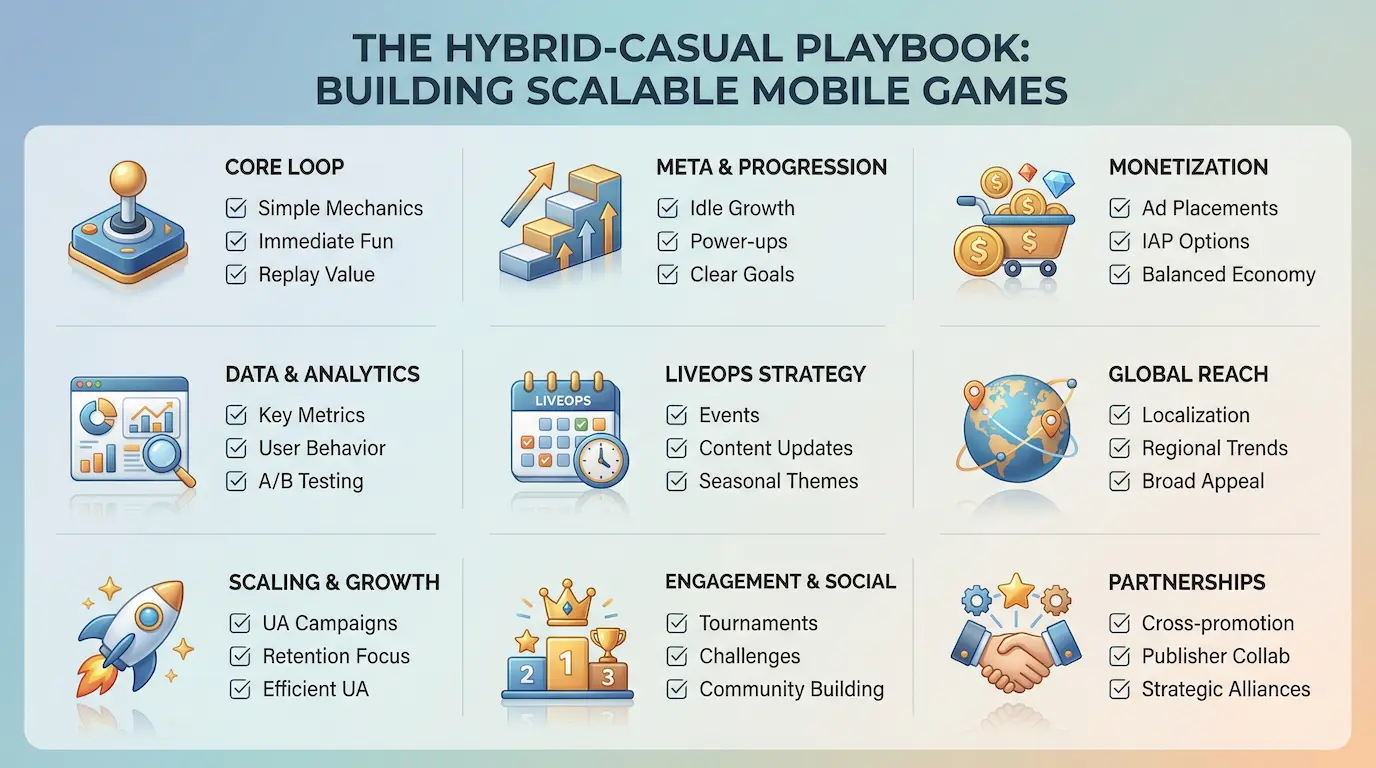
The 2026 Playbook: If You’re Building a Game Today
The mobile gaming landscape has evolved into a data-driven, retention-first ecosystem where success depends on speed, scalability, and strategic design. Hybrid-casual games have emerged as the most resilient and profitable model, offering the perfect balance between accessibility and long-term engagement. For studios, publishers, and entrepreneurs planning their next mobile title, adopting a hybrid-casual approach is no longer optional; it is a strategic necessity.
This playbook outlines the essential principles for building scalable, monetization-ready mobile games that can thrive in competitive global markets such as the USA, UK, UAE, and India.
1. Start with a Simple, Addictive Core Loop
Every successful hybrid-casual game begins with a straightforward and intuitive core mechanic. The goal is instant playability; users should understand and engage with the game within seconds, without the need for lengthy tutorials or complex onboarding.
Short, snackable gameplay sessions of 2–5 minutes drive higher session frequency and improve early retention. Simple mechanics also enable faster prototyping and user testing, reducing development risk while accelerating time-to-market.
2. Build Meta-Progression That Encourages Long-Term Engagement
While the core loop attracts users, meta-progression systems keep them returning. Hybrid-casual games thrive on layered progression elements such as character upgrades, unlockable levels, skill trees, and collectible rewards.
These systems create a sense of accomplishment and habit formation, transforming casual players into long-term users. Strong meta-progression is a key factor behind the higher Day-7 and Day-30 retention rates observed in hybrid-casual titles.
3. Implement a Hybrid Monetization Strategy from Day One
Sustainable revenue generation is central to hybrid-casual success. A balanced monetization model combining rewarded ads, in-app purchases, cosmetic upgrades, and battle passes ensures diversified income streams and higher lifetime value (LTV).
By integrating monetization early in the design process, studios can optimize user experience while maintaining profitability. Hybrid monetization also reduces reliance on volatile advertising CPMs and on rising CPIs in Tier-1 markets.
4. Adopt an Analytics-First Development Approach
Data-driven decision-making is essential for building scalable mobile games. Implementing real-time analytics, player segmentation, and performance dashboards enables studios to track user behavior, optimize gameplay mechanics, and refine monetization strategies.
An analytics-first approach empowers teams to make informed decisions, improve retention, and enhance overall game performance. It also ensures continuous optimization throughout the product lifecycle.
5. Plan LiveOps and Remote Configuration from Day One
LiveOps has become a defining factor in the success of top-performing mobile games. Remote configuration tools, A/B testing frameworks, and live content updates allow developers to refine gameplay, introduce events, and optimize monetization without requiring frequent app updates.
Studios that prioritize LiveOps readiness from the early stages of development achieve higher engagement, improved retention, and sustained revenue growth.
6. Design for Global Scalability and Localization
Hybrid-casual games are inherently scalable across diverse markets. To maximize global reach, studios must design experiences that support localization, regional content adaptation, and culturally relevant progression systems.
High-growth markets such as India, UAE, USA, and the UK present significant opportunities for hybrid-casual titles. Tailoring gameplay mechanics, monetization models, and LiveOps strategies to regional preferences enhances user engagement and improves monetization outcomes.
7. Optimize for Rapid Prototyping and Iteration
Speed is a competitive advantage in the mobile gaming industry. Hybrid-casual development encourages rapid prototyping, enabling studios to validate concepts quickly, gather player feedback, and iterate efficiently.
Agile production pipelines, modular architecture, and scalable frameworks allow developers to test multiple ideas with minimal risk while ensuring faster time-to-market.
8. Foster Community-Driven Growth and Continuous Updates
Community engagement plays a vital role in the long-term success of hybrid-casual games. Social features, leaderboards, seasonal events, and competitive mechanics encourage player interaction and strengthen retention.
Regular content updates, player feedback integration, and community-driven improvements help maintain momentum and build a loyal user base, transforming a game into a sustainable digital product.
9. Where StudioKrew Fits Into This Playbook
Building a successful hybrid-casual game requires more than creative vision—it demands scalable architecture, analytics-driven decision-making, and LiveOps readiness. As a leading mobile game development company, StudioKrew partners with startups, publishers, and enterprises to transform innovative ideas into high-performing gaming experiences.
From rapid prototyping and hybrid monetization frameworks to LiveOps optimization and global deployment, StudioKrew delivers end-to-end solutions tailored for sustainable growth. Our expertise in hybrid casual game development enables studios to build scalable products that maximize retention, engagement, and lifetime value across global markets.
As a full-cycle game development company, StudioKrew supports every stage of development, from concept and design to post-launch optimization, empowering studios to succeed in the rapidly evolving mobile gaming landscape.
10. Quick Checklist for Founders and Product Teams
Before launch, founders and product teams building a hybrid casual game should validate the following:
- Validate your core gameplay loop through rapid prototyping.
- Integrate meta-progression systems to enhance long-term retention.
- Implement hybrid monetization strategies combining ads and in-app purchases.
- Build analytics and LiveOps infrastructure from the earliest stages.
- Optimize user experience through A/B testing and remote configuration.
- Localize gameplay and monetization strategies for global markets.
- Plan a scalable architecture to support continuous updates and growth.
- Partner with an experienced hybrid-casual game development studio to accelerate success.
The Prediction: By 2027, Hybrid won’t be a Genre; it will be the baseline.
Hybrid casual is currently treated like a category, but it is really a new default operating system for mobile games. As acquisition gets tougher, attention gets shorter, and monetization gets more competitive, the formats that survive will be those that seamlessly combine three things: instant playability, long-term progression, and continuous tuning.
That is why the next wave is not “more hybrid casual games.” It is a hybrid architecture that is spreading across almost every casual and semi-casual product looking to scale sustainably.
Below are the shifts that will turn hybrid from an option into the baseline.
1. AI Personalized Gameplay Loops Will Replace One-Size-Fits-All Design
Most mobile games still deliver the same experience to everyone. That model wastes retention.
The next baseline will be personalized loops that adapt to the player’s behavior, not just their level. AI-driven personalization can adjust:
• Difficulty pacing based on frustration signals
• Reward timing based on session patterns
• Offer types based on player intent, spender style, and churn risk
• Event recommendations based on what the player actually engages with
Instead of treating the funnel as a single pipeline, games will run multiple micro-funnels based on player segment. Players will feel the game is “made for them,” even though it is algorithmically tuned.
This is not science fiction. It is an extension of segmentation and remote config, powered by better models and better data pipelines.
2. Procedural Content Will Reduce Content Debt
Hybrid casual thrives on cadence. Cadence creates content demand. Content demand creates production debt.
That debt will increasingly be solved through procedural content systems that generate variation without requiring endless manual design. This can include:
• Procedural level modifiers
• Rotating obstacle patterns
• Daily challenge generation
• Dynamic mission templates
• Reward tables that adapt to progression state
The goal is not to generate entire games automatically. The goal is to create a controlled variety that prevents repetition and supports LiveOps without multiplying content cost.
Studios that rely only on hand-authored content will feel slower and more expensive in comparison.
3. Dynamic Difficulty Adjustment Will Become Standard Retention Tech
One of the biggest reasons casual players churn is simple. The game becomes too hard too fast, or too easy for too long.
Dynamic difficulty adjustment will increasingly be used to protect retention. Not by making the game “fake easy,” but by keeping players in a flow state:
• Reduce frustration spikes for new players
• Increase challenge for highly engaged players
• Adjust difficulty ramps for different cohorts
• Create difficulty variety through modifiers rather than walls
This will also improve the fairness of monetization, as players will not feel pressured to spend just to progress. When difficulty is tuned well, monetization feels optional and rewarding.
4. Agent-Driven LiveOps Tuning Will Reduce Manual Operations
LiveOps is powerful, but it is operationally heavy. Scheduling events, tuning rewards, adjusting offers, and reacting to churn signals takes constant effort.
The next step is agent-driven LiveOps tuning, where AI systems assist with decisions like:
• Detecting churn spikes by cohort and recommending fixes
• Proposing event variations based on performance history
• Suggesting reward adjustments to prevent economic inflation
• Identifying underperforming offers and generating new bundle hypotheses
Humans will still decide the strategy, but the tuning cycle will accelerate. Teams that can run faster iteration loops will outcompete slower operators.
5. Predictive Churn Modeling Will Become a Core Growth Tool
Hybrid casual will increasingly treat churn as preventable rather than inevitable.
Predictive models can flag players who are likely to leave based on patterns such as:
• Drop in session frequency
• Repeated failures at a level
• Reduced rewarded ad engagement
• Economic stagnation
• Lack of progression movement
Once flagged, the game can intervene with:
• Targeted rewards
• Easier difficulty windows
• Personalized missions
• Better timed offers
• Re-engagement events
This increases retention without relying only on more content or more UA spend.
What This Means for Studios Building Now
If hybrid becomes the baseline, studios that win will not be the ones who “build hybrid casual games.” They will be the ones who build hybrid systems well.
That means:
• Analytics-first architecture
• Remote config and experimentation capability
• LiveOps readiness from early builds
• Economy and progression are designed as tunable systems
• Monetization treated as player value, not friction
This is also why hybrid casual has become one of the most strategic categories for publishers. It is the closest thing to a scalable, repeatable mobile business model that still respects modern attention patterns.
For teams evaluating partners, this is the practical filter. Can the studio build a fun prototype and the infrastructure that makes the game tunable and scalable after launch?
If you are exploring this direction, StudioKrew’s work as a mobile game development company and a hybrid casual game development services team corresponds with this system-first future. And as a full-cycle game development company, StudioKrew is positioned to support not only the initial build, but the LiveOps evolution that modern mobile products now require.
Building Hybrid-Casual Games That Scale Beyond Installs
Most mobile games can be launched. Very few can be scaled.
Scaling is not about adding more levels, buying more traffic, or running louder ads. Scaling is about building a product that holds attention, grows value over time, and stays profitable even when the market gets tougher. This is exactly why hybrid casual has become such a dominant direction. It is engineered for the realities of modern mobile gaming: short sessions, rising acquisition costs, and the need for resilient monetization.
The gap between a hybrid casual game that spikes and one that sustains usually comes down to foundations.
What “Scaling” Actually Means in Hybrid Casual
In hybrid casual, scale means you can grow without breaking the experience.
That requires:
• Retention that stays stable across cohorts
• An economy that does not inflate or stall over time
• Monetization that feels fair, optional, and valuable
• LiveOps systems that refresh motivation week after week
• Analytics that identify churn causes early and clearly
If any one of these breaks, the game becomes expensive to grow.
The Foundation Checklist That Makes Hybrid Casual Sustainable
A scalable hybrid casual game is usually built on a few non-negotiables.
– Progression architecture that stays meaningful
Players need a reason to return that goes beyond “more levels.” Upgrade ladders, unlocks, collections, and skill expression need to grow over time without turning the game into a grind.
– Economy designed as a tunable system
Currencies, sinks, rewards, and difficulty must be balanced to create momentum. Economic imbalance is one of the fastest ways to lose trust and retention.
– LiveOps readiness from the start
Even if you do not launch with events, the game should be ready to support events. LiveOps should feel like part of the experience, not a last-minute patch.
– Analytics first, not analytics later
Retention and monetization decisions should be made using real cohort data, not assumptions. Hybrid casual grows through tuning. Tuning requires instrumentation.
– Remote config and experimentation capability
The ability to adjust rewards, difficulty, and offers without frequent updates is what turns a game into a live product. Experimentation is how you improve without guessing.
Where StudioKrew Supports This Journey, Without the Noise
If you are building in a hybrid casual, you do not just need developers. You need a team that understands how snackable games can become long-lifecycle products.
StudioKrew fits into this space through a system-first approach. The focus is on building foundations early, then iterating fast using analytics and LiveOps planning. That keeps the game simple for players while keeping it scalable for publishers.
If you want to explore capability or compare approaches, these pages give a clearer view of how StudioKrew operates across mobile and hybrid casual production:
• Mobile game development company
• Hybrid casual game development services
• Game development company
The practical goal stays the same. Build a hybrid casual game that can be tuned, expanded, and monetized without losing player trust. That is what scaling beyond installs really means.
Conclusion: Hybrid-Casual Is Not the Future – It Is the Present
Hybrid-casual games have emerged as the most resilient and scalable format in modern mobile gaming. By combining instant accessibility with long-term progression, diversified monetization, and analytics-driven optimization, they offer a sustainable growth model in an increasingly competitive market.
As acquisition costs rise and player expectations evolve, studios that embrace hybrid architecture will gain a decisive advantage. The success of tomorrow’s mobile games will depend not only on creativity but also on scalable systems, LiveOps readiness, and data-driven decision-making.
If you are planning to build or scale a hybrid-casual game, partnering with an experienced studio can significantly reduce risk and accelerate success. StudioKrew combines technical expertise, analytics-first architecture, and LiveOps readiness to deliver high-performing mobile games for global markets.
Quick FAQ on Hybrid Game Development Services
Q1. What is hybrid casual game development?
Hybrid casual game development is the process of building mobile games that combine a low-friction, easy-to-learn core loop with deeper progression systems and a blended monetization model. These games are designed to be instantly playable like hyper casual titles, while retaining and monetizing players more sustainably through meta progression, LiveOps, and ads, plus in-app purchases.
Q2. How is hybrid casual different from hyper casual?
Hyper casual games are typically built around a single, simple mechanic and monetized primarily through ads, often with minimal progression depth. Hybrid casual games keep the simple entry experience, but add persistent progression systems, upgrade economies, events, and IAP layers. As a result, hybrid casual usually delivers stronger long-term retention and higher lifetime value compared to ad-only hyper casual models.
Q3. Why are hybrid casual games more profitable?
Hybrid casual games tend to be more profitable because they diversify revenue. Instead of relying only on ad rates, they combine ads with in-app purchases such as boosters, cosmetics, passes, and bundles. In addition, stronger meta progression often improves Day 7 and Day 30 retention, expanding the monetization window and increasing lifetime value, especially in markets with high CPI.
Q4. What retention benchmarks are typical for hybrid casual games?
Retention varies widely by genre and execution, but industry benchmarks often show:
• Day 1 retention: 45 to 60 percent
• Day 7 retention: 15 to 25 percent
• Day 30 retention: 8 to 12 percent
Hyper casual games often see Day 30 retention closer to 2 to 4 percent. Hybrid casual can deliver up to 2x improvement at Day 30 when progression and LiveOps are tuned effectively.
Q5. What monetization model works best for hybrid casual games?
The most effective monetization model for hybrid casual is usually a balanced combination of:
• Rewarded ads for optional value
• Interstitial ads placed at natural breaks
• IAP such as boosters, cosmetics, progression accelerators, and bundles
• Season passes or progression passes for committed players
The key is alignment. Monetization must support player goals rather than interrupt gameplay. When monetization feels fair, retention and revenue both improve.
Q6. How much does it cost to develop a hybrid casual game?
Cost depends on scope, art style, feature depth, and LiveOps readiness. A lightweight prototype can often be built faster and cheaper, while a scalable hybrid casual product with progression systems, analytics, remote config, and LiveOps foundations requires a greater effort.
If you want a practical estimate, it helps to define:
• Core gameplay loop complexity
• Progression depth and number of systems
• Monetization approach
• Multiplayer or competitive features
• LiveOps and analytics requirements
Q7. How long does it take to build a hybrid casual game?
Timelines vary based on the production approach, but many teams follow a staged process:
• Prototype and retention validation
• Soft launch build with analytics and monetization foundations
• LiveOps layering and scale-ready launch
A prototype can be developed quickly, while a scale-ready product typically requires additional time for tuning, economy balancing, and retention optimization.
Q8. What tech stack is best for hybrid casual game development?
Many hybrid casual games are built using Unity because it supports rapid iteration, strong mobile performance optimization, and a mature ecosystem for analytics, LiveOps tooling, and content pipelines. The supporting stack often includes:
• Analytics and telemetry
• Remote config tools
• A/B testing systems
• Backend services for progression, inventory, events, and offers
The best stack depends on scale goals, LiveOps plans, and the frequency of game tuning.
Q9. How do you make a hybrid casual game scalable after launch?
Scalability comes from building the right foundations early:
• Progression and economy designed as tunable systems
• LiveOps-ready event framework
• Remote config for rapid iteration
• A/B testing infrastructure
• Analytics-first architecture
• Monetization designed as value, not pressure
This is why teams often choose experienced partners early, especially when scaling into markets with high CPI.
Q10. Where can I find a team to build a hybrid casual game?
If you are exploring development with a partner, it helps to evaluate whether the team can build not only the core loop but also the progression, analytics, and LiveOps foundation required for long lifecycle scaling.
You can explore StudioKrew’s capabilities here:
• Mobile game development company
• Hybrid casual game development services
• Game development company
Q11. What is the difference between casual and hybrid casual games?
Casual games are broadly defined as mobile games designed for general audiences with simple mechanics. Hybrid casual is a specific architecture within casual gaming that combines a simple core loop with layered meta progression, LiveOps systems, and a blended monetization model combining ads and in-app purchases. Not all casual games are hybrid casual, but all hybrid casual games share a common onboarding approach.
Q12. Is hybrid casual better than hyper casual?
Hybrid casual is not universally better, but it is better suited to current market economics. Hyper casual remains viable for fast-launch, high-volume strategies. Hybrid casual is better when the goal is a longer game lifecycle, higher lifetime value, and the ability to tolerate rising CPI in competitive markets. Studios with the capacity to build progression systems and LiveOps infrastructure generally find hybrid casual more financially defensible at scale.






 INDIA
INDIA CANADA
 USA
USA UAE
UAE