Introduction: Why Autonomous Mobile Systems Are Becoming the New Standard
Mobile applications are evolving from simple tools into intelligent decision systems.
Brands and businesses have long invested in mobile apps to improve speed, customer service, and operational accessibility. AI initially enhanced these apps with recommendations, chat interfaces, predictive dashboards, and automation. However, the current shift goes beyond incremental feature upgrades.
This represents a fundamental change in application behavior.
Agentic AI is pushing mobile products toward autonomy. Instead of waiting for users to ask, click, approve, or nudge workflows forward, applications are starting to interpret context, pursue objectives, and execute decisions within defined boundaries. In practice, this means a mobile system that does not just display information, but actively coordinates outcomes across the ecosystem it belongs to.
Early examples of this shift are visible across sectors. In construction, intelligence is being integrated into BIM workflows and project execution. Healthcare platforms are using it to influence prioritization and continuity of care. In commerce, the focus is moving from recommendations to real-time decision logic. In education, systems are evolving from static, personalized training to adaptive, goal-oriented training.
The goal is not to build “AI apps” for their own sake, but to design applications that manage micro-decisions, reduce friction, and improve outcomes with minimal manual intervention.
This shift is structural.
The future of mobile applications is not defined by smarter features.
It is defined by intelligent autonomy.
In This Article
What Is Agentic AI, and Why It Is Not Just Another AI Layer
The phrase “Agentic AI” is appearing everywhere right now, but most explanations still reduce it to something familiar: a chatbot on top of an app, a smart assistant inside a product, an automation engine that triggers tasks. Those are useful capabilities, but they don’t change the system’s nature.
Agentic AI does.
Traditional AI integrations are reactive. They wait for a question, a button click, a form submission, or a rule-based condition. They can be intelligent, fast, and helpful, but the system still depends on humans to decide what happens next.
Agentic systems are designed around objectives, not prompts.
That sounds subtle, but it changes everything. Instead of acting only when invoked, an Agentic system continuously evaluates context, detects signals, reasons about their meaning, and then moves the workflow forward within the allowed governance. It does not remove humans from decision-making; it reduces the human burden of repetitive coordination and low-level choices by handling them responsibly.
Think about a construction mobile platform that connects project execution with BIM automation. A basic AI layer might summarize updates, generate reports, or answer questions about drawings. An Agentic layer behaves more like a coordinator. It monitors changes, identifies risk patterns, simulates downstream impacts, and recommends corrective sequencing before delays compound. If energy performance targets are part of the project, the same intelligence can evaluate consumption signals, suggest optimizations, and flag deviations early, not as an afterthought, but as part of the system’s ongoing responsibility.
The same shift plays out in other domains. In healthcare, AI assistance might help users navigate information or automate scheduling. Agentic intelligence can interpret engagement and risk signals over time, escalate priorities when patterns suggest deterioration, and support continuity of care across touchpoints. In commerce, it is the difference between recommending products and actively refining decision pathways based on pricing elasticity, inventory movement, and real-time conversion behavior. In education and training, it shifts from static “personalization” to a learning journey that adapts continuously based on progress, friction points, and outcomes.
You can’t bolt this kind of behavior onto an application at the last minute. It demands architectural depth. It requires persistent context across sessions, reliable memory models, secure cloud orchestration, and a clean integration layer that connects mobile and web experiences to a shared intelligence core.
That is why the conversation is shifting from “AI feature integration” to “AI-native application architecture.” The organizations that will win in 2026 are not the ones that add AI labels to products. They are the ones that build applications capable of structured autonomy, with safety, governance, and real operational value built in from day one.
Agentic AI is not about conversational convenience. It is about embedding responsibility into digital systems.
Once autonomy becomes part of an application’s foundation, the way mobile products are designed, scaled, and maintained begins to change completely.
Working on an AI mobile product?
StudioKrew builds agentic AI integrated mobile apps for iOS and Android. From architecture planning to post-launch LLMOps, we support the full build.
AI Chatbot Development AI Integrated App DevelopmentHow Agentic AI Reshapes Mobile, Cloud, and Cross-Platform Architecture
Once you accept that Agentic AI is not a “feature” but a behavior, the next practical question is: how do you actually build it?
This is where most teams get stuck.
They try to “add” autonomy the same way they added analytics or a chatbot, by plugging in an API and placing a UI on top. It looks intelligent in demos, but it breaks down in real usage because autonomy cannot survive on surface-level integration. An Agentic system needs an architecture that supports continuous context, safe execution, and reliable cross-platform coordination.
In simple terms, if your application is expected to think and act, it needs a nervous system, not just a face. Building one of these for your own product? Our AI agent development company team designs the tools an agent can call, the approval steps, and the evaluation set before anything goes live.
Mobile becomes the control layer; cloud becomes the brain
In Agentic systems, mobile applications often serve as the execution and context layer. Mobile provides the always-on interface, real-world signals, user behavior, location context, device-level permissions, and the moment-to-moment decision environment.
But autonomy needs more than that. It needs orchestration.
That orchestration typically lives in the cloud, where agents can access enterprise data, compute resources, event streams, and policy controls. This is why modern teams are actively looking for an Agentic AI integrated cloud application development company, not just an app team that can build screens.
At StudioKrew, this is exactly how we approach AI-native builds: we design mobile and cloud as a single, coordinated system, with the intelligence layer shared across touchpoints and governed centrally. If you are exploring this direction, our AI, mobile, and cloud capabilities align through our AI-focused development practice at AI-Integrated App Development Services and our cloud engineering foundation at Cloud App Development Services.
Cross-platform is no longer about UI consistency; it is about intelligence consistency
Cross-platform development has traditionally been a delivery decision: build once, run on Android and iOS, reduce time-to-market, and maintain a shared UI layer. But in an Agentic AI world, cross-platform becomes something more strategic.
Autonomous systems depend on shared intelligence. If your Android app behaves differently from your iOS app, or your web dashboard sees a different state than your mobile user, autonomy becomes unreliable. Decisions drift. Context fragments. Actions become risky.
This is why an AI-integrated cross-platform app development company is not just a keyword anymore; it is a real architectural requirement.
The clean approach is to design a shared intelligence core, then expose that core through multiple clients:
- A mobile client, often built with native stacks or React Native, depending on performance and distribution goals
- A web dashboard for visibility, approvals, audits, and configuration
- A cloud orchestration layer that hosts reasoning, memory, event processing, and policy enforcement
StudioKrew supports both cross-platform and native execution, depending on performance, roadmap, and distribution goals, through React Native mobile app development, native app development, Android app development, and iOS app development.
The four building blocks of an Agentic architecture
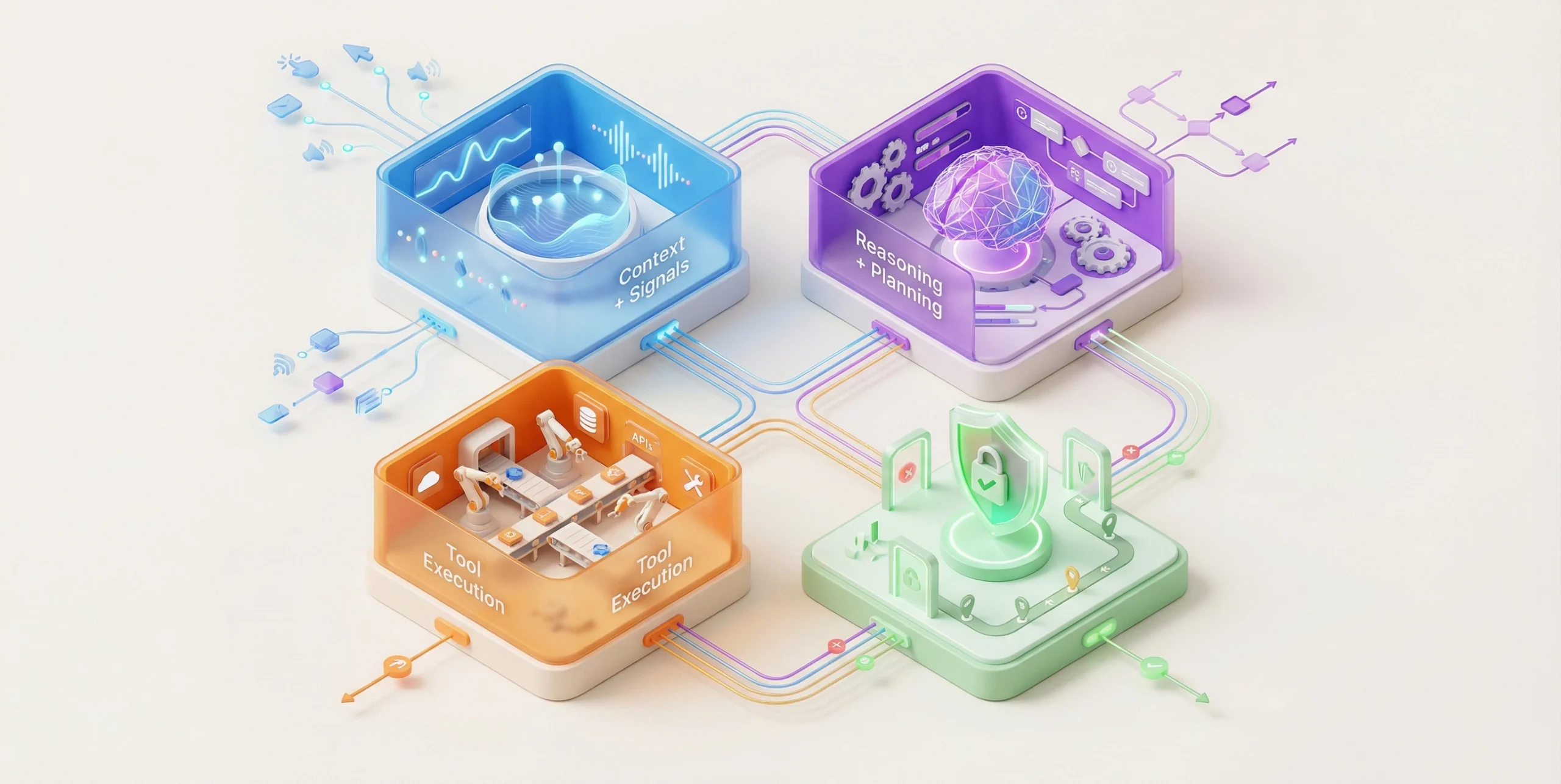
An Agentic mobile system typically consists of four interconnected layers. When these layers are designed well, autonomy becomes predictable and safe. When they are not, you end up with “AI theater”, a smart UI that cannot reliably execute.
1. The context layer
This is where the system learns what is happening. It includes user actions, device signals, workflow state, real-time operational data, and domain events. In construction, this might include progress updates, BIM model changes, site logs, material delivery schedules, and energy performance readings.
2. The reasoning layer
This is where the system decides what should happen next. This could involve a single agent or multiple specialized agents, one for scheduling, one for compliance, one for procurement, and one for energy optimization. The reasoning layer is not only about model calls, but it also includes rules, constraints, and domain-specific logic that prevent unsafe actions.
3. The execution layer
Autonomy is meaningless without execution. This layer connects the reasoning engine to real actions, sending notifications, creating tasks, generating approvals, triggering API calls, updating records, or proposing changes for human review. Execution must always be governed by permissions and auditability.
4. The governance layer
This is the part many teams ignore, but it is what makes systems enterprise-ready and globally deployable. Governance includes role-based controls, explainability logs, audit trails, data privacy boundaries, and safe fallback paths. Without it, you cannot deploy autonomy at scale, especially across the USA, UK, and Europe.
Where BIM automation and energy intelligence fit into this architecture
In construction and built-environment applications, Agentic AI becomes especially powerful when integrated with BIM automation and energy analysis.
A mobile app used by project teams can serve as the interface for an intelligent BIM automation workflow, while the cloud layer coordinates the automation logic, and the “agent” monitors outcomes. For example, an agent can detect repeated modeling inconsistencies, flag them, suggest corrective actions, and even trigger automated BIM routines to validate or update elements.
When energy optimization is included, agents can work as continuous performance monitors. They can compare expected vs actual usage, detect inefficiencies, recommend adjustments, and keep sustainability goals visible throughout the project lifecycle rather than leaving energy analysis as a late-stage report.
StudioKrew supports this intersection through our BIM automation company, AEC automation development company, and construction and architecture app development capabilities.
Why maintenance becomes more strategic in autonomous systems
One more important shift happens with Agentic applications; maintenance is no longer about bug fixing. It is about behavior tuning.
Autonomous systems evolve. Models change. Data patterns shift. Workflows are updated. Governance rules are refined. And if you do not properly maintain that intelligence lifecycle, your system slowly becomes inconsistent or unsafe.
This is why companies moving toward Agentic systems increasingly treat maintenance and support as part of the product strategy, not as a post-launch afterthought. StudioKrew supports this lifecycle with structured application maintenance and support services, especially for teams building AI-integrated mobile and cloud ecosystems.
Agentic AI is not difficult because the models are complex. It is difficult because the architecture must be deliberate.
Once the foundation is right, autonomy stops feeling like an experiment and becomes a competitive advantage.
Industry Use Cases, Where Agentic AI Is Already Transforming Systems
Agentic AI becomes meaningful the moment it stops sounding like “AI inside an app” and starts behaving like “a system that moves work forward.” That is the core shift happening across sectors.
In practice, most teams do not need a magical AI that does everything. They need autonomous decision layers that make micro-decisions responsibly, reduce coordination overhead, and detect risk early. The industries below are already moving in that direction, not as hype, but because operational complexity is rising and manual decision-making is not scaling.
To keep it tangible, each use case follows the same pattern: what changes, what the agent does, and why it matters.
Construction Apps, BIM Automation, Energy Saving Intelligence
Construction workflows are full of moving parts, design revisions, resource constraints, vendor timelines, compliance checks, and site-level unpredictability. Traditional apps in this space mostly capture updates, generate reports, and notify people. Agentic AI shifts the app from “reporting” to “execution support.”
What changes
Instead of showing you what happened, the system starts anticipating what might go wrong and recommending what to do next.
Agent in action: what it actually does
- Watches cost drift signals, schedule dependencies, procurement delays, and site logs
- Flags pattern-based risks early, not after escalation
- Suggests corrective sequencing, reallocation, and mitigation steps
- Coordinates BIM-driven checks when model changes repeat or violate rules
- Connects energy performance signals with recommendations, not just analysis
BIM automation becomes a multiplier
When Agentic AI is connected to BIM workflows, the app can move beyond issue reporting into intelligent coordination. It can detect repeated modeling inconsistencies, trigger rule-based validation, surface likely clash hotspots, and recommend corrective actions before downstream teams burn time in coordination loops.
If you are building in this intersection, StudioKrew’s capabilities align directly through BIM automation, AEC automation development, and construction and architecture app development.
Energy saving analysis becomes continuous, not a final report
Energy performance in modern construction is no longer a late-stage checkbox, especially in the USA, UK, and Europe. Agentic systems can continuously compare expected vs actual patterns, detect inefficiencies early, and recommend optimizations across HVAC schedules, usage peaks, and operational tuning. The value is not just analytics; it is decisions that reduce waste over time.
ERP Systems, From Dashboards to Autonomous Operations
ERP is where coordination lives, procurement, approvals, reconciliations, exceptions, and follow-ups. That also makes ERP a perfect home for Agentic AI, because so much work is not “hard”; it is repetitive decision-making.
What changes
ERP stops being a place where humans hunt data; it becomes a place where the system prepares decisions, proposes actions, and keeps workflows unblocked.
Agent in action
- Detects demand shifts and recommends procurement timing
- Monitors supplier reliability, pricing trends, and delivery delays; suggests alternatives
- Flags reconciliation anomalies and proposes correction paths
- Prepares approval packets with justification and impact context
- Pushes actions into mobile workflows so work does not stall
If the goal is an AI-native ERP experience across mobile and web, the build needs cross-platform intelligence consistency, not just UI consistency. This is where the “AI integrated cross-platform app development company” requirement becomes real, not marketing.
Related StudioKrew capability, ERP software development company, and application development company.
CRM and Sales Platforms, From Reminders to Revenue Execution
Most CRMs fail for one reason: momentum is fragile. Leads go cold, follow-ups get missed, pipelines rot quietly. Basic AI adds summaries. Agentic AI protects execution.
What changes
The system shifts from “tracking sales activity” to “driving next best actions.”
Agent in action
- Interprets engagement signals across touchpoints
- Prioritizes leads based on intent patterns, not gut feel
- Suggests next actions and timing, then orchestrates follow-up sequences
- Flags pipeline risk early and nudges the right corrective steps
- Keeps context consistent across mobile and web, so handoffs do not break
This is where StudioKrew’s AI-native build approach matters, because execution requires a secure intelligence layer, not just a chat UI, supported by AI-integrated app development and AI-integrated software development company.
HRMS, Onboarding, Retention, Assessments That Adapt
HR platforms traditionally store information. Agentic HR systems improve outcomes by behaving like a coordinator, not a portal.
What changes
Instead of static onboarding and periodic reviews, the system supports continuous guidance and adaptive assessment.
Agent in action
- Guides onboarding based on role context and completion behavior
- Detects friction points, recommends training modules, and adjusts learning sequence
- Monitors engagement trends and retention risk signals
- Suggests manager actions and timely interventions
- Runs assessments that adapt to progress, not fixed questionnaires
This use case also naturally sets up your later “Trending ideas” section, because it proves that autonomy has real value beyond the enterprise and works for any team with people workflows.
Manufacturing and Operations, Autonomy Where Minutes Matter
Operations are full of time-sensitive decisions. The cost of delay is measurable: downtime, missed schedules, wasted inventory cycles.
What changes
Instead of reacting to breakdowns, the system coordinates prevention and response.
Agent in action
- Monitors telemetry and workflow events continuously
- Predicts maintenance needs, then plans the response
- Schedules work orders, checks parts availability, and aligns downtime windows
- Flags quality exceptions early and recommends corrective steps
- Keeps execution aligned across mobile teams and cloud control layers
This is one of the strongest examples of why businesses look for an Agentic AI integrated cloud application development company; orchestration requires robust cloud architecture, supported by a cloud application development company.
Healthcare, From Scheduling Tools to Continuity Systems
In healthcare, the value is not in answering questions. It is in preventing drop-offs, improving coordination, and escalating attention at the right time.
What changes
The app stops being a utility; it becomes a continuity layer.
Agent in action
- Identifies engagement drop patterns and risk indicators
- Adjusts prioritization logic dynamically
- Flags gaps in care workflows and recommends next steps
- Coordinates reminders, follow-ups, and intervention triggers responsibly
StudioKrew is a healthcare capability and healthcare app development company, paired with AI-integrated app development.
Shopping and Commerce, From Personalization to Real-Time Decision Pathways
Commerce apps already use AI for recommendations. Agentic AI pushes this further: it continuously optimizes decisions.
What changes
The system starts tuning outcomes in real time, not just presenting options.
Agent in action
- Learns pricing elasticity, detects conversion shifts, and adjusts pathways
- Monitors inventory movement and recommends merchandising actions
- Identifies abandonment patterns and proposes recovery strategies
- Keeps the loop running across mobile and web, with a shared intelligence core
User Access Platforms, Security That Adapts Without Adding Friction
Access systems often trade off security and user experience. Agentic AI helps reduce friction while improving trust.
What changes
Authentication becomes adaptive instead of rigid.
Agent in action
- Learns behavioral patterns and detects anomalies
- Recommends step-up authentication only when needed
- Coordinates approvals with audit trails and policy boundaries
- Maintains security consistency across devices, sessions, and platforms
Automotive and Mobility, Intelligence That Moves With the User
Mobility systems generate continuous signals that drive behavior, service patterns, fleet usage, and maintenance cycles. Agentic AI helps convert those signals into coordinated actions.
What changes
The app shifts from “information display” to “operational assistant.”
Agent in action
- Predicts service needs and schedules proactively
- Optimizes fleet usage and route-level decisions
- Coordinates support workflows and notifications with context
- Uses cloud orchestration for reliability, mobile for execution
Related StudioKrew capability, automobile app development, and a custom mobile app development company.
Why these use cases matter for 2026
Across sectors, the story is the same. The next wave of mobile applications will not win because they “have AI.” They will win because they reduce coordination cost, prevent risk earlier, and execute decisions faster, safely, and consistently across mobile, web, and cloud.
That is the real difference between AI-enabled apps and Agentic AI integrated applications.
Next, we move into the most exciting part for product teams: how trending AI mobile ideas are emerging, and why some of them will become the next breakout categories.
Trending Ideas for AI in Mobile Applications
Here’s the easiest way to spot what will trend in AI mobile this year and next: follow the tasks people hate doing repeatedly.
Not “what app category is popular,” but what responsibility users are ready to outsource.
That is the real tailwind behind Agentic AI. In 2026, the winning mobile products will not feel like tools you open to “do something.” They will feel like systems that quietly keep life, work, and operations moving, with autonomy that is useful, controlled, and reliable.
Below are the ideas accelerating fastest. I’m not listing them like a feature checklist. I’m describing what they feel like when built right, and why they turn into scalable products when you treat autonomy as architecture, not a gimmick. This is exactly the kind of build StudioKrew supports through AI integrated app development.
AI Companion Apps, including regulated adult companion experiences
The companion category is exploding for one reason: it delivers continuity. Users do not want “chat.” They want a system that remembers tone, context, boundaries, preferences, and the emotional thread across days.
In a well-built companion app, the “magic” is not the conversation. It is the persistence. The agent remembers what matters, adapts its personality safely, and behaves consistently across sessions.
This is also where some products explore adult companion experiences, sometimes framed as NSFW virtual girlfriend themes. From a serious product lens, this category succeeds only when it is built with safeguards at the core, age gating, consent boundaries, content moderation, privacy-first memory handling, and region-aware compliance. If those layers are not engineered into the architecture, the product becomes fragile, risky, and hard to scale globally.
That is why teams in this space quickly end up needing an Agentic AI integrated cloud application development company, because the intelligence layer, memory layer, and policy layer must be centrally governed and auditable, supported by a cloud application development company.
Virtual Assistant, AI Secretary, the app that runs your day, not your reminders
The assistant market is evolving beyond “set a reminder” into “run my coordination.”
The newer expectation looks like this. You open the app, and it already knows what is pending. It preps meeting briefs, suggests replies, schedules follow-ups, protects focus time, and pulls the right context before you ask for it. It feels like a calm operator, not a noisy notifier.
The big product unlock here is cross-platform continuity. These assistants have to work across mobile and web, as well as calendars, mail, docs, CRM, and internal tools. If the context breaks across Android, iOS, and the web, the user stops trusting the agent.
For delivery, StudioKrew builds across native and cross-platform stacks through Android app development company, iOS app development company, iPhone app development company, and React Native mobile app development company.
Virtual Project Manager, the agent that protects delivery momentum
Most project tools track tasks. They do not protect momentum. That’s the gap.
A virtual PM agent is valuable when it quietly does the work that drains teams, tracking blockers, spotting risk patterns, nudging the right owner with context, proposing sequencing changes, and keeping timelines honest without creating noise.
Picture the experience in practice. Instead of a “status meeting,” the app already knows what is slipping. It suggests a decision, “swap these tasks; pull this dependency earlier; reassign this item; schedule a short check-in with two specific people,” and it provides the why. It becomes less of a planner and more of a coordinator.
This category pairs naturally with full lifecycle builds through an application development company, plus ongoing stability and tuning through application maintenance and support.
Employee Onboarding Agents, HR guidance that feels like a mentor, not a portal
Onboarding is repetitive, role-specific, and full of small friction points. That makes it perfect for Agentic workflows.
A good onboarding agent does not dump documents and links. It guides the journey. It checks what has been completed, detects where the user is stuck, adjusts the path based on role and behavior, and maintains momentum without making the person feel managed.
This also becomes a powerful internal product for mid-size companies, not only large enterprises, because onboarding and enablement are universal. When designed right, it reduces support load and accelerates time-to-productivity.
Employee Retention and Assessments, moving from surveys to early signals
Retention is rarely sudden. It is a pattern.
Agentic systems can monitor leading indicators, engagement behavior, learning progress, workload signals, feedback frequency, performance shifts, and then propose interventions that make sense. Not “send a survey,” but “do this now; this person is drifting; here’s the likely cause; here’s the smallest next action that helps.”
Assessment engines also change under Agentic AI. Instead of fixed tests, they become adaptive. The system adjusts difficulty, sequence, and practice tasks based on progress, not on a one-time score.
This overlaps strongly with training and learning systems, aligned to educational app development.
Virtual Trainers, skill coaches that adapt daily, not monthly
Virtual training apps are shifting from content libraries to coaching systems.
The breakout products here behave like this. The agent understands the user’s goal, watches performance over time, adapts the plan, nudges at the right time, and keeps motivation alive by reducing confusion and choice overload.
This works across fitness, language learning, enterprise enablement, compliance training, and even in-app product education. It is also one of the best categories for retention-driven monetization because the system is perceived as “helping me progress,” not “showing me content.”
Entertainment AI experiences, stories, and characters that evolve with the user
Entertainment is becoming interactive again. Agentic AI makes that practical.
Instead of recommending content, the system can shape experiences, interactive narratives that adapt to mood; characters that remember prior interactions; game-like loops where the experience evolves, not just resets. With entertainment game development services, you can create engaging, story-driven games that dynamically adapt to user interests, rather than following only what the game designer originally planned.
This is where AI becomes the experience layer, not an add-on. For products in this category, StudioKrew’s entertainment app development services build a capability that connects naturally.
Smart access platforms, security that adapts without punishing the user
People want security; they hate friction.
Adaptive access systems are a strong Agentic use case because they depend on continuous signals. The agent learns normal behavior patterns, detects anomalies, triggers step-up verification only when needed, and maintains clean audit trails for compliance.
This category grows especially fast in regions where privacy and governance expectations are rising, such as the UK and Europe, because trust becomes a product feature.
Vertical Agentic apps, the biggest opportunity hiding in plain sight
The biggest wins in 2026 will not come from generic “AI apps.” They will come from vertical autonomy, apps built for specific operational workflows.
What changes
Instead of building broad AI features, products focus on one workflow and make it autonomous, repeatable, governed, and measurable.
Agent in action
- Detects workflow drift early and proposes the next best action
- Coordinates tasks across mobile and cloud execution layers
- Keeps decisions consistent across platforms and teams
- Builds trust with guardrails, audits, and reversibility
- Delivers ROI because the autonomy is tied to real operations
Construction is a clear example. When mobile execution is connected to BIM automation and energy performance intelligence, the system can coordinate far more than reporting. It can detect modeling inconsistencies; trigger validations; recommend sequencing; flag energy inefficiencies early; and keep sustainability decisions active throughout the lifecycle, supported by BIM automation, AEC automation development, and construction and architecture app development.
Automobile and mobility apps follow the same pattern: continuous signals, continuous decisions, proactive coordination, supported by automobile app development.
Healthcare and education, too, where continuity and personalization matter more than one-off interactions, are supported by a healthcare app development company and an educational app development company.
The real takeaway for founders and product leaders
In 2026, “AI features” will be baseline. Autonomy will be the differentiator.
The products that win will be those that reduce coordination costs, eliminate decision fatigue, and deliver consistent outcomes across mobile, web, and cloud. That is why the market is shifting toward teams that can build the full stack of autonomy, an Agentic AI integrated mobile application development company that can combine architecture, governance, cross-platform delivery, and post-launch tuning into one reliable capability.
Next, we’ll tackle the most important question that determines whether an Agentic product succeeds or collapses in production: how to build autonomy safely, keep it compliant, and make it dependable across the USA, UK, Europe, and India.
Building Agentic AI You Can Trust, Security, Privacy, Compliance, and Responsible Autonomy
Agentic AI sounds exciting until you ship it.
Because the moment an application can act on behalf of a user or an organization, the product stops being “just software.” It becomes a decision system. And decision systems are judged differently.
Users judge them based on trust. Enterprises judge them by auditability. Regulators judge them by safety and accountability. In 2026, the most successful Agentic products will not be those with the smartest prompts; they will be those with the strongest guardrails.
This is the part most teams underestimate. Autonomy is not hard because AI is complex. Autonomy is hard because responsibility is complex.
Below is the practical blueprint we use at StudioKrew when building Agentic AI-integrated mobile applications meant to scale across the USA, UK, Europe, and India without creating governance debt later.
Start with “What is the agent allowed to do?”, not “What can the model do?”
A reliable Agentic system begins with boundaries.
Before you think about models, define the agent’s operating contract, what goals it can pursue, what actions it can take, what it must ask permission for, and what it must never do. This is where good products separate themselves from “AI demos.”
A simple rule that keeps systems safe is to treat autonomy like a ladder:
- level 1, the agent can observe and summarize
- level 2, it can recommend and explain
- level 3, it can draft actions and prepare approvals
- level 4, it can execute limited actions under policy
- level 5, it can orchestrate end-to-end workflows with audits and overrides
Most business apps should not jump to level 5 on day one. They should earn it.
This is exactly why teams look for an Agentic AI integrated application development company, not just an AI integration vendor. The real work is in designing action boundaries, not chat experiences.
If you’re building an AI-native product roadmap, this foundation typically starts here: AI-Integrated App Development Services
Responsible autonomy is identity-first, permissions, roles, and least privilege
When an agent acts, it must be acting as someone and within someone’s permissions.
That means your architecture needs a clear identity and role boundaries across mobile, web, and cloud. The agent must not become a “super user” just because it is convenient.
In real systems, this becomes critical in ERP, healthcare, and construction platforms:
- in ERP, procurement actions must respect approval hierarchies
- in healthcare, access must respect privacy roles and sensitive workflows
- in construction, BIM automation triggers must respect project governance and accountability
This is where cloud orchestration becomes foundational; most Agentic actions require secure service-to-service access and policy enforcement. That is why modern builds increasingly demand an Agentic AI integrated cloud application development company approach.
Related StudioKrew capability cloud application development company.
Privacy by design is not optional anymore, especially across the EU and India
Agentic systems love context. Compliance teams hate uncontrolled context.
So the winning pattern is “minimum necessary memory.” The agent should remember what improves outcomes, and forget what creates risk.
For Europe, the EU AI Act has a clear rollout timeline that product teams need to plan around, it entered into force on 1 August 2024 and becomes fully applicable on 2 August 2026, with staged obligations including earlier application for prohibited practices and AI literacy from 2 February 2025, and obligations for general-purpose AI models from 2 August 2025.
For India, the Digital Personal Data Protection framework moved into an operational phase with the DPDP Rules, 2025, being notified in November 2025, formally operationalising the DPDP Act, 2023.
So if your Agentic mobile app uses personal data, user memory, behavior tracking, or cross-platform profiles, you need:
- clear consent flows and purpose limitation
- retention rules, what is stored, for how long, and why
- secure deletion pathways, especially for user-controlled memory
- special handling for children’s data where applicable
This is not “legal overhead.” This is product trust. And trust is a ranking factor indirectly too, because safer apps retain users longer, get cited more, and earn better backlinks.
Security in Agentic apps is not just encryption; it is “safe execution.”
An Agentic system is dangerous only when it can execute actions unsafely.
So security is not only about protecting data, it is about protecting actions.
A few non-negotiables for 2026 Agentic products:
- isolate the agent runtime from sensitive systems, use gated tool access
- treat prompts, tools, and connectors as attack surfaces
- enforce rate limits and action budgets to prevent runaway automation
- store secrets safely, never in the client app, never in logs
- implement tamper-resistant audit logs for decisions and actions
- secure mobile surfaces properly, especially if building native Android or iOS experiences
For secure delivery across platforms, this maps directly to the Android app development company, the iOS app development company, and the broader mobile application development.
Transparency is not “explain AI”, it is “show intent and accountability”
Users do not need a textbook explanation of AI. They need clarity:
- why did the system suggest this
- what data did it consider
- what will happen if I approve
- can I reverse it
- who can see it
The EU AI Act also introduces transparency expectations in specific contexts, including disclosure when interacting with AI systems such as chatbots and obligations to identify AI-generated content.
From a product standpoint, transparency is your lever for adoption. The more autonomy you introduce, the more users need confidence that the system is predictable.
“Autonomous” does not mean “unsupervised”; it means designing human oversight that feels natural
The best Agentic products do not remove humans. They remove friction.
So instead of forcing approvals everywhere, you design smart checkpoints:
- auto-execute low-risk actions
- escalate medium-risk decisions for approval
- block high-risk actions unless explicitly permitted
- provide one-tap rollback and clear remediation flows
This is especially important in construction workflows that touch BIM automation and energy recommendations. A system can propose energy-saving adjustments or flag BIM anomalies early, but the moment it triggers changes in project-critical flows, you want governance built in.
If your construction roadmap includes BIM automation and AI-driven engineering workflows, this is where we typically align product architecture with delivery execution.
Monitoring and support are where Agentic systems either mature or collapse
Agentic AI is not “ship once and forget.” It evolves.
Models drift. Data patterns shift. Policies change. Edge cases appear in production.
That is why post-launch monitoring, incident handling, and behavior tuning become part of the product strategy. It is also why many teams underestimate the importance of application maintenance for AI-native products.
This is exactly what structured support is built for.
If you want a practical governance lens for ongoing AI risk management, many product teams also align internal practices to established frameworks like the NIST AI Risk Management Framework, which is intended for voluntary use and has also published a Generative AI risk profile. And for organizational governance maturity, ISO/IEC 42001 defines requirements and guidance for establishing and continually improving an AI management system.
The simple truth for 2026
Agentic AI will be everywhere. Trustworthy Agentic AI will be rare.
If your goal is to rank globally for keywords like Agentic AI integrated mobile application development company, AI integrated cross-platform app development company, and Agentic AI integrated cloud application development company, your content and your product positioning must reflect the same reality:
Autonomy is not a feature. It is a responsibility layer.
In the next section, we’ll translate this into execution, what the 2026 blueprint looks like when you actually architect and ship an Agentic mobile product end-to-end, from MVP to governed scale.
The 2026 Blueprint: What Autonomous Systems Will Look Like
By 2026, the most important change will not be that more apps “use AI.” That will be normal. The real shift will be in behavior; mobile applications will start taking responsibility for outcomes, rather than just providing information.
Autonomous systems will feel less like software you operate and more like a coordinated layer that moves work forward across mobile, web, and cloud. And because most real workflows span finance, legal, operations, construction, healthcare, sales, and training, this autonomy will not reside in a single screen or model. It will be multi-agent, multi-platform, and deeply integrated into product architecture.
Here are the six predictions that will define what autonomy actually looks like in 2026.
Apps negotiating contracts autonomously
Today, contract workflows still rely on slow loops, drafting, review, redlines, approvals, follow-ups, and context lost between stakeholders. In 2026, autonomous systems will begin handling a much larger share of the negotiation cycle.
Not in the sense of an AI “signing contracts” without permission, but in the more practical sense, the system prepares negotiation-ready drafts, proposes clause options aligned to policy, detects risk language, compares against prior agreements, and coordinates iteration cycles with stakeholders. It will become normal for mobile systems to pre-negotiate terms, surface trade-offs, and present decision-ready options to humans.
This is a major unlock for sales operations, vendor onboarding, procurement, legal workflows, and even construction vendor contracts. The product value is speed, clarity, and reduced friction, while governance stays intact.
AI agents collaborating across platforms
Autonomy will not be a single agent doing everything. It will be a team of specialized agents, one that interprets data, one that manages workflows, one that monitors risk, one that optimizes performance, all coordinated through a cloud orchestration layer.
The mobile application becomes the execution and decision surface. The web interface becomes the oversight and reporting surface. The cloud becomes the orchestration layer where memory, reasoning, and policy enforcement live.
This is why the AI-integrated cross-platform app development company positioning matters. For teams building this architecture, StudioKrew’s AI and cloud foundation aligns directly through AI integrated app development, cloud application development company, and cross-platform delivery through Cross-Platform mobile application development.
Self-optimizing ERP dashboards
ERP involves many repetitive, operational, and time-sensitive decisions. In 2026, ERP dashboards will stop being passive reporting layers. They will become self-optimizing decision surfaces.
Instead of users digging into reports, systems will continuously monitor patterns, demand shifts, supplier reliability, cost variance, and workflow bottlenecks. They will proactively suggest or prepare actions, forecast impact, and escalate only what needs approval. Over time, these dashboards will “learn” what the organization typically approves, how workflows are structured, what exceptions look like, and how to reduce the time between signal and resolution.
This is where enterprise AI application development delivers real value. The objective isn’t just “AI in ERP,” but true operational autonomy that minimizes friction across procurement, finance, inventory, workforce planning, and compliance. For organizations taking this path, a strong foundation in ERP development services is essential.
AI-driven enterprise decision ecosystems
The biggest shift is ecosystem-level autonomy. In 2026, organizations will stop thinking in terms of “one smart app” and start building decision ecosystems that coordinate multiple systems.
For example, a construction ecosystem might integrate BIM automation, procurement, workforce scheduling, and energy optimization into a single decision loop. A healthcare ecosystem might connect triage, scheduling, compliance, and continuity-of-care signals into a coordinated execution layer. A commerce ecosystem might connect pricing intelligence, inventory movement, supply chain signals, and customer experience into one real-time orchestration.
This is where Agentic AI’s integrated cloud application development becomes essential, because coordination at the ecosystem level requires scalable orchestration, policy enforcement, audit trails, and governance. It also provides a clear reason for businesses to partner with teams that can build both the intelligence and application layers end-to-end.
Game levels based on user engagement
Gaming is one of the clearest places where autonomy becomes instantly measurable, because retention, session time, completion rate, and churn are all visible signals.
By 2026, level design will no longer be fully static. Instead of shipping the same difficulty curve for every player, games will increasingly use Agentic systems to adapt progression based on engagement patterns.
A well-designed Agentic layer can detect when a player is breezing through levels, struggling repeatedly, or losing interest, then dynamically adjust the experience within defined boundaries. That could mean tuning difficulty, unlocking alternate routes, reshaping challenges, adjusting reward pacing, or triggering micro-events that keep momentum alive.
The key is not “AI making random levels.” The key is intelligent progression control, personalization that feels fair, and a game economy that stays healthy. This is where AI-integrated mobile application development becomes a competitive advantage, because the system must adapt without breaking balance, trust, or player satisfaction.
BIM automation and energy intelligence, construction platforms that self-correct
Construction workflows are full of moving parts, design coordination, procurement, sequencing, compliance, and sustainability targets. In 2026, construction apps will stop behaving like reporting tools and start behaving like self-correcting systems.
With Agentic AI layered into BIM automation, platforms can continuously monitor model changes, detect repeated inconsistencies, trigger validation routines, flag likely clash hotspots, and recommend corrective actions before coordination overhead grows. This reduces rework loops and protects delivery timelines.
Energy intelligence will evolve the same way. Instead of energy-saving analysis appearing as a final report, the system will continuously compare expected vs. actual usage patterns, detect inefficiencies early, and recommend practical optimizations that teams can act on. This is especially relevant for the USA, UK, and Europe, where sustainability performance is becoming non-negotiable.
If you are building in this intersection, StudioKrew’s AEC automation and BIM capability aligns directly here.
In short, 2026 autonomy is not about “smart responses.” It is about coordinated execution.
And the companies that win will not be the ones who add AI to apps. They will be the ones who redesign applications so decisions can move faster, safely, and consistently across the entire mobile and cloud ecosystem.
Why Businesses Choose an Agentic AI Integrated Mobile Application Development Company
By now, the direction should feel clear.
Agentic AI is not a feature you add at the end of development. It is a behavior you design into the system. That one shift changes how products are scoped, how architecture is planned, how cross-platform consistency is maintained, and how post-launch support is handled.
So when businesses search for an Agentic AI integrated mobile application development company, they are rarely looking for “a team that can plug in an LLM.” They are trying to solve a more serious problem: how do we build autonomy that is useful, safe, compliant, and reliable across mobile, web, and cloud?
This is exactly where partner choice becomes strategic.
They are not buying AI; they are buying outcome reliability
Most AI failures in mobile applications happen for a simple reason. The product works in a demo, but it does not hold up in production.
Real users create unpredictable patterns. Data comes from messy sources. Workflows have exceptions. Policies change. Regions have different compliance expectations. A model response that looks intelligent in one context can be wrong or unsafe in another.
That is why serious teams select partners who understand outcome reliability, not just AI integration.
At StudioKrew, our AI-first builds are scoped around dependable behavior. We focus on how the system reasons, when it escalates to humans, what it is permitted to execute, and how it maintains auditability across platforms. Our AI integrated app development capability is designed for this exact requirement.
They need cross-platform intelligence consistency, not only cross-platform UI
A large share of organizations operate across Android, iOS, and web simultaneously. If your agent behaves differently across platforms, it immediately loses trust.
In Agentic systems, consistency is everything. Decisions, context, memory rules, and policy enforcement must be unified, regardless of whether a user interacts through an Android phone, an iPhone, a tablet, or a web dashboard.
This is where the need for an AI-integrated cross-platform app development company becomes real: you are not only building user interfaces, but also a shared intelligence core exposed across multiple clients.
StudioKrew supports cross-platform and native approaches based on your product goals and performance requirements, through React Native mobile app development company and our native practices, Android app development company, iOS app development company, iPhone app development company, along with Kotlin and Swift engineering depth, Kotlin app development company, and Swift app development company.
They need cloud orchestration because autonomy runs on coordination
An agent cannot be autonomous if it cannot safely coordinate across systems.
As soon as your application needs to connect to ERP, CRM, BIM workflows, authentication, analytics streams, commerce engines, or internal databases, the intelligence layer has to be orchestrated in the cloud. That orchestration layer is what enables memory, safe tool access, policy enforcement, scaling, and monitoring.
This is why many teams specifically search for an Agentic AI integrated cloud application development company, because cloud architecture is where autonomy becomes dependable.
StudioKrew’s cloud application development company delivery practice aligns directly here.
They want industry fluency because autonomy is domain-specific
Agentic AI is only useful when it understands the workflow it is supposed to improve.
A retention agent is different from a procurement agent. A BIM automation agent is different from a healthcare continuity agent. A game LiveOps agent is different from an energy optimization agent. The logic, risk boundaries, and governance rules change.
This is why domain fluency matters.
StudioKrew has active capability coverage across key verticals that are adopting autonomy quickly, BIM automation company, AEC automation development company, and construction and architecture app development for built environment platforms; healthcare app development company for patient and provider ecosystems; automobile app development for mobility products; educational app development for learning and training platforms; and entertainment app development for consumer experiences where personalization and dynamic engagement matter.
When you combine domain fluency with AI-native architecture, autonomy becomes practical rather than theoretical.
They want lifecycle ownership because Agentic systems require tuning, not only development
Autonomous systems evolve.
User behavior shifts. Data patterns drift. Policies tighten. Models get updated. Edge cases appear. A team that only builds and hands over code will struggle to maintain stable autonomy in the real world.
That is why businesses increasingly evaluate the maintenance posture of their development partner before they even start.
If you are building an Agentic product, you need structured support for behavior tuning, performance optimization, stability, security updates, and ongoing improvements, which is where StudioKrew’s application maintenance and support becomes part of the product strategy.
The real selection criteria in 2026
In 2026, choosing an AI partner is less about who can build the app fastest and more about who can build a system you can trust.
The best Agentic AI integrated mobile application development companies will be the ones that can deliver:
- a shared intelligence core across platforms
- cloud orchestration with safe tool access
- governance, auditability, and compliance readiness
- domain-aware agent behavior
- post-launch tuning and long-term reliability
That is the difference between launching an AI feature and launching an autonomous system.
If your goal is to build AI-native mobile products that can scale across the USA, UK, Europe, and India, StudioKrew’s end-to-end capabilities in AI, mobile, cloud, and lifecycle support provide the foundation for doing so responsibly through our application development and software development services.
Closing Thoughts, Building for Intelligent Autonomy, Not AI Hype
Agentic AI is not a trend that will sit on the surface of mobile apps. It is moving into the core of product design, workflow execution, and decision-making across industries.
In 2026, users will not measure AI by how well it talks. They will measure it by how reliably it reduces friction, prevents mistakes, and advances outcomes. The winning products will embed autonomy responsibly, with clear boundaries, strong governance, and cross-platform consistency.
If you are planning an AI-native mobile product or modernizing an existing application with Agentic workflows, the starting point is simple: identify one workflow where decisions stall, where teams repeat coordination, or where outcomes depend on too many manual steps. That is usually the best place to start introducing structured autonomy.
StudioKrew helps teams design and build AI integrated app development services and deliver reliable mobile application development for products that need autonomy at scale across the USA, UK, Europe, and India. For systems that require orchestration, governance, and performance under real-world load, we also support cloud application development, backed by structured application maintenance and support to keep autonomous behavior stable over time.
If you would like a practical starting plan, we can share a simple autonomy-readiness blueprint, recommended use cases for your industry, and an MVP scope that embeds governance and safety from day one through our application development services.
Ready to move from blueprint to build? See our AI agent development services, or request a proposal, and we will scope one workflow first.
Frequently Asked Questions About Agentic AI in Mobile Applications
What is agentic AI in mobile applications?
Agentic AI in mobile applications refers to AI systems that can independently plan, execute, and adapt multi-step tasks without requiring manual input at each step. Unlike standard AI features that respond to a single prompt, agentic systems maintain context across sessions, call tools and APIs, manage workflow state, and make decisions to achieve a defined goal. In mobile apps, this shows up in workflows like autonomous customer support, proactive scheduling, intelligent document processing, and real-time decision coordination across operations.
How is agentic AI different from regular AI features in apps?
Standard AI features respond to one input at a time. Agentic AI takes a goal, breaks it into steps, calls the right tools, handles errors, and completes the workflow autonomously. For product teams, the practical difference is that agentic features require deliberate architecture decisions around persistent state, tool boundaries, cost controls, and governance. A chatbot answering FAQs is not agentic. A system that monitors project signals, identifies risk, and coordinates a corrective sequence without being asked is agentic.
What architecture do you need to support agentic AI in a mobile app?
An agentic mobile architecture needs four layers working together: a context layer that captures real-world signals and user behavior; a reasoning layer where agents evaluate options and plan next steps; an execution layer that connects the reasoning engine to real actions such as API calls, notifications, and record updates; and a governance layer with role-based controls, audit trails, and safe fallback paths. Mobile handles the interface and context capture. Cloud handles orchestration, memory management, and policy enforcement.
Which industries benefit most from agentic AI in mobile apps in 2026?
Construction and AEC platforms are using agentic AI for BIM automation, schedule risk detection, and energy performance monitoring. ERP systems use agents for procurement coordination, approval management, and exception handling. Healthcare apps use agents to maintain continuity of care, prioritize care, and coordinate follow-up. Commerce platforms use agents for real-time pricing decisions, cart recovery, and inventory management. HRMS platforms use agents for adaptive onboarding, assessment, and monitoring of retention signals.
How do you control costs and safety in an agentic mobile system?
Cost control requires LLM call budgets, caching for repeated query patterns, and routing simpler tasks to lighter models. Safety requires defining explicit tool boundaries so agents can only access what they are permitted to, adding human-in-the-loop approval for high-stakes actions, and maintaining comprehensive audit logs for every agent decision. These controls should be built into the architecture from the start, not added after launch when the production system is already running.






 INDIA
INDIA CANADA
 USA
USA UAE
UAE